Goodnews River
Fly fishing in Alaska · Advanced · Best seasons: Summer, Fall
Target Species
Rainbow Trout, Arctic Grayling, Silver Salmon
About This Water
Remote western Alaska river with trophy rainbow trout. Fly-out access only.
Fishing Recommendations
Welcome to the Goodnews River, one of the crown jewels of Southwest Alaska. Located within the Togiak National Wildlife Refuge, this river system—comprising the North, Middle, and South Forks—offers a quintessential Alaskan wilderness experience. It is a world-class "grand slam" river, but for those targeting Rainbows, Grayling, and Silvers, it is arguably the best in the Bristol Bay region.
🎣 Location Overview
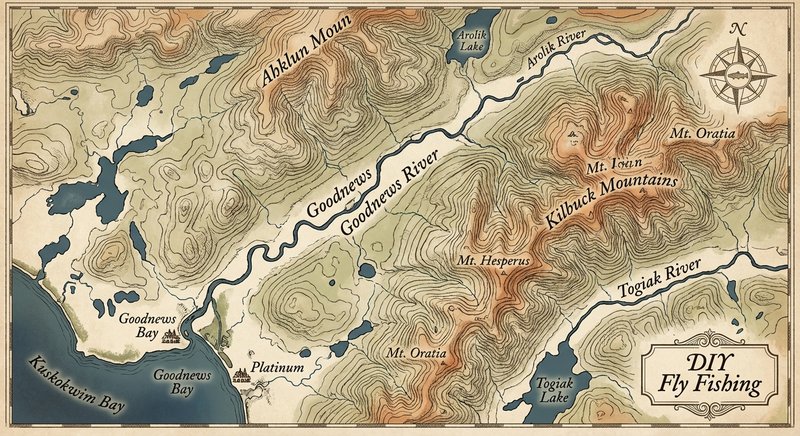
The Goodnews River is a remote, crystal-clear freestone system that flows from the Ahklun Mountains into Goodnews Bay. Unlike the larger, turbid rivers of the north, the Goodnews is perfectly sized for fly anglers, featuring classic braided channels, sweeping gravel bars, and deep, emerald-green pools.
What makes it special is its remoteness and diversity. It is accessible only by bush plane, meaning fishing pressure is remarkably low. The river is famous for its "Leopard" Rainbow Trout—stunningly spotted fish that are indigenous to this drainage—and its prolific runs of Silver (Coho) Salmon that charge into the system with incredible aggression.
🐟 Target Species & Behavior
Rainbow Trout (The "Leopard" Rainbow)
- Behavior: These are highly predatory and migratory. In early summer, they hold in the main stems feeding on smolt and insects. By mid-August, they move behind spawning salmon to gorge on eggs and decaying flesh.
- Hold: Look for them in "seams" behind spawning beds (redds), under cut banks, and near woody debris.
Arctic Grayling
- Behavior: The "sailfish of the north" are prolific here. They are opportunistic feeders and will rise to dry flies even when no hatch is visible.
- Hold: They prefer the upper reaches of the river and the swifter, oxygenated water at the heads of pools.
Silver Salmon (Coho)
- Behavior: Known for their aerial acrobatics and willingness to strike a fly. Unlike other salmon, Silvers actively chase moving targets.
- Hold: They favor "froggy" water—slow-moving sloughs, backwaters, and deep, quiet holes near the riverbanks. They want to conserve energy before the next push upstream.
📅 Best Times to Fish
- July (Peak Summer): Best for high-volume Arctic Grayling and "mousing" for Rainbow Trout. This is when the river is most active with insect life and salmon smolt.
- August (The Transition): Early August is prime for Rainbows feeding on Sockeye and Chum eggs. Late August marks the arrival of the first Silver Salmon.
- September (Fall Prime): This is Silver Salmon season. It is also the best time for trophy Rainbows, as they are at their maximum weight, gorging on salmon flesh.
- Conditions: Alaska weather is unpredictable. Overcast days are actually better for Silver Salmon fishing, as they are less "light shy" and more likely to strike on the surface.
🪰 Recommended Flies & Techniques
For Rainbow Trout
- Technique: Nymphing with beads (egg mimicry) is the most effective. However, mousing (skating a foam mouse on the surface) is the most thrilling.
- Flies:
- Beads: 6mm and 8mm in "mottled orange," "peach," or "salmon fly."
- Flesh Flies: Ginger, white, and apricot "bunny leeches."
- Mice: Mr. Hankey, Morrish Mouse.
For Arctic Grayling
- Technique: Traditional dry fly presentation or light nymphing.
- Flies:
- Dries: Elk Hair Caddis (size 12-16), Parachute Adams, Royal Wulff.
- Nymphs: Gold-ribbed Hare's Ear, Prince Nymph.
For Silver Salmon
- Technique: Stripping streamers or "wogging" (topwater). Use a rhythmic, jerky strip to trigger an instinctual strike.
- Flies:
- Streamers: Pink or Chartreuse Dolly Varden, Hareball Leeches, Lead-Eyed Egg Suckers.
- Surface: The Pink Salmon Wog. This is a foam topwater fly that you skate across the surface. Seeing a 12lb Silver smash a Wog is the pinnacle of the trip.
💡 Pro Tips & Local Knowledge
- The "Soft" Water: When targeting Silvers, many anglers cast into the fast current. Don't. Look for the "dead" water where the river barely moves near the banks. Silvers stack up there like cordwood.
- Matching the Egg: As the season progresses, the salmon eggs in the river change color from bright orange to a pale, washed-out peach. Match your bead color to the state of the spawn.
- The Side Channels: Don't ignore the small, narrow braids that look too shallow. Big "Leopard" Rainbows often hide in these small ribbons of water to avoid the chaos of the main stem.
- Short Accuracy over Long Distance: You rarely need to cast 60 feet. Focus on 20-30 foot accurate casts that place your fly right in the "seam" between fast and slow water.
⚠️ Important Information
Access
The Goodnews is a "fly-in" destination. Most anglers either book a stay at the Goodnews River Lodge (the only permanent facility on the river) or arrange a float trip via bush plane from Dillingham or Bethel.
Regulations & Permits
- License: You must have a valid Alaska State Fishing License and a King Salmon stamp (if targeting Kings in early summer).
- Regulations: The Goodnews is largely Catch and Release for Rainbow Trout. Regulations can change annually; always check the Alaska Department of Fish & Game (ADF&G) emergency orders before your trip.
- Gear:
- Rainbows/Grayling: 5wt or 6wt rod with floating line.
- Silvers: 8wt or 9wt rod. High-quality reels with a strong drag are essential; Silvers will test your gear.
Special Considerations
- Bears: This is prime Grizzly territory. Always fish with a partner, carry bear spray (or a firearm if experienced), and never leave fish or food on the banks.
- Wading: The Goodnews has a relatively stable gravel bottom, but felt soles are banned in Alaska. Use sticky rubber boots with studs.
Bug Hatches & Matching Flies
| Hatch | Type | Peak months | Time of day | Hook sizes | Matching flies |
|---|---|---|---|---|---|
| Midges Chironomidae | midge | May, June, September | All Day | #18-24 | Zebra Midge #18-20, Griffith's Gnat #18-22, Buzzer #16-18 |
| Blue-Winged Olive Baetis tricaudatus | mayfly | May, September | Mid-day/Afternoon | #16-20 | RS2 #18-20, BWO Parachute #16-18, Pheasant Tail #16-20 |
| American Grannom Brachycentrus | caddis | June, July | Afternoon/Evening | #14-16 | Peeking Caddis #14-16, Elk Hair Caddis #14-16, LaFontaine's Deep Sparkle Pupa #14-16 |
| Golden Stonefly Hesperoperla pacifica | stonefly | June, July | Afternoon | #6-10 | Pat's Rubber Leg #6-10, Golden Stimulator #8-10, 20-Incher Stone #8-12 |
| Mosquito Aedes / Ochlerotatus | terrestrial | June, July | All Day | #12-16 | Alaska Mosquito #12-14, Black Gnat #14-16, Royal Wulff #12-14 |
| Little Yellow Stonefly Isoperla | stonefly | July, August | Evening | #14-16 | Yellow Sally #14-16, Iron Lotus #16, Yellow Stimulator #14-16 |
| Spotted Sedge Hydropsyche | caddis | July, August, September | Evening | #12-16 | Hydropsyche Larva #12-14, Goddard Caddis #12-16, Soft Hackle Hare's Ear #14-16 |
| Black Fly Simulium | midge | July, August | All Day | #18-22 | Black Smut #20-22, Serendipity #18-20, Mercury Midge #20 |