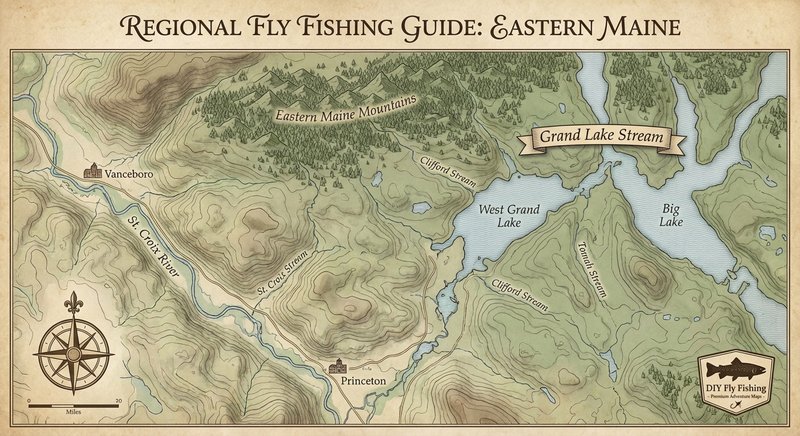
Grand Lake Stream
Fly fishing in Maine · Intermediate · Best seasons: Spring, Summer, Fall
Target Species
Landlocked Salmon, Smallmouth Bass
About This Water
Eastern Maine's famous landlocked salmon stream. Historic fly fishing village and tradition.
Fishing Recommendations
Grand Lake Stream (GLS) is hallowed ground in the world of fly fishing. Located in Washington County in "Down East" Maine, this three-mile stretch of water connecting West Grand Lake to Big Lake is the spiritual home of landlocked salmon fishing. As a guide, I consider this one of the most technical yet rewarding tailwaters in the Northeast.
🎣 Location Overview
Grand Lake Stream is a historic, fly-fishing-only (FFO) tailwater that flows through a picturesque village of the same name. What makes it special is its consistency; because it is dam-controlled, the water remains cool and oxygenated even when other Maine rivers warm up in mid-summer.
The stream is characterized by classic "pocket water," deep pools, and gravelly runs. It has a timeless feel, reinforced by the presence of traditional handcrafted wooden Grand Lake Canoes and local lodges that have been operating for over a century. It is rugged, rocky, and requires careful wading, but the reward is a shot at some of the hardest-fighting freshwater fish in the country.
🐟 Target Species & Behavior
Landlocked Salmon (Salmo salar sebago)
Unlike their Atlantic cousins, these salmon spend their entire lives in freshwater.
- Behavior: They are famous for their acrobatic leaps and "grayling-like" tendency to rise to tiny dries.
- Holding Water: They love the "heads" of pools where oxygen is high, and they often sit right in the bubble line. In the fall, they move into the shallower gravelly runs to spawn.
- Feeding: Their primary forage is the rainbow smelt. When they aren't chasing baitfish, they feed heavily on caddis, stoneflies, and Hendricksons.
Smallmouth Bass
While the salmon get the glory, the "smallies" here are world-class, especially in the lower reaches of the stream and the surrounding lakes.
- Behavior: Highly aggressive. They hold near large boulders, submerged logs, and in the slower "frothy" eddies.
- Feeding: They focus on crawfish, leeches, and surface bugs during the evening "witching hour."
📅 Best Times to Fish
- Spring (Ice Out - Mid-June): This is Smelt Season. As the ice leaves West Grand Lake, salmon follow the smelt into the river. This is the best time for streamer fishing.
- Summer (Late June - August): The best time for Smallmouth Bass and evening dry fly fishing for salmon. The water remains cool enough for salmon, but they become more selective.
- Fall (September - October 25th): The Prime Season. Salmon move into the stream in massive numbers for their spawning run. The fish are in their "vibrant" spawning colors (kypes and red spots).
- Note: The season on the stream typically extends to October 25th, but check current Maine IF&W regulations as they can change.
Best Time of Day: During the summer, focus on the first two hours of light and the last two hours. In the spring and fall, the midday sun often warms the water just enough to trigger an insect hatch or a smelt move.
🪰 Recommended Flies & Techniques
For Landlocked Salmon
- Streamers (The Classic Maine Way):
- Patterns: Grey Ghost, Black Ghost, Mickey Finn, and the Governor Aiken.
- Technique: Cast across and down, stripping with a "darting" motion to mimic a panicked smelt.
- Nymphs:
- Patterns: Pheasant Tail (#14-18), Prince Nymph (#12-14), and Copper Johns.
- Technique: High-stick nymphing through the pocket water or using a light indicator in the deeper pools like the Hatchery Pool.
- Dry Flies:
- Patterns: Elk Hair Caddis (Tan/Olive), Blue Winged Olives, and the Light Cahill.
- Technique: Dead drift over the bubble lines. Be ready for a lightning-fast take.
For Smallmouth Bass
- Surface: Murray’s Hellgrammite, Deer Hair Poppers, or large Foam Hoppers.
- Sub-surface: Woolly Buggers (Olive/Black) and Clouser Minnows.
💡 Pro Tips & Local Knowledge
- The "Dying Smelt" Drift: If the salmon aren't chasing active streamers, try fishing a soft-hackle streamer or a Grey Ghost with a "dead drift" technique. Let it tumble like a wounded or dead smelt coming over the dam. This often triggers a strike when nothing else works.
- Focus on the Upper Reach: The stretch from the Dam Pool down to the Hatchery Pool is the most famous. It gets the most pressure, but it also holds the most fish.
- The "Meadow" Stretch: For a quieter experience, head further downstream to the Meadow. The water slows down, and it is prime territory for Smallmouth Bass and rising salmon in the evening.
- Wading Safety: The rocks in GLS are notoriously slippery (often called "bowling balls"). Felt soles (where legal) or studded boots and a wading staff are highly recommended.
⚠️ Important Information
- Regulations: Grand Lake Stream is Fly Fishing Only (FFO). This means no spinning gear and no bait. Most of the river is Catch and Release for salmon—always check the current Maine Open Water Fishing Regulations (Lawbook) for size and bag limits.
- Licensing: You need a valid Maine Freshwater Fishing License. You can purchase these online via the MDIFW website.
- Access: There is a well-maintained trail that runs along the stream, making it very easy to "walk and wade." Numerous parking turn-offs are available along the main road in the village.
- Special Consideration: Respect the local guides in their Grand Lake Canoes. If you see a canoe anchored in a pool, give them plenty of space and do not wade through their drift.
Guide’s Final Word: Grand Lake Stream isn't just a place to catch fish; it's a place to soak in fishing history. Slow down, observe the water, and don't be afraid to chat with the locals at the Pine Tree Store—they usually know exactly what’s hatching.
Bug Hatches & Matching Flies
| Hatch | Type | Peak months | Time of day | Hook sizes | Matching flies |
|---|---|---|---|---|---|
| Hendrickson Ephemerella subvaria | mayfly | May, June | Afternoon | #12-14 | Red Quill #12-14, Hendrickson Nymph #12-14, Pheasant Tail #14 |
| Grannom Caddis Brachycentrus | caddis | May | Morning/Afternoon | #14-16 | Elk Hair Caddis (Olive) #14-16, LaFontaine's Deep Sparkle Pupa #14-16, Peacock Caddis #16 |
| Blue-Winged Olive Baetis | mayfly | May, September, October | Afternoon | #18-22 | RS2 #20-22, BWO Parachute #18-22, WD-40 #20-22 |
| March Brown Maccaffertium vicarium | mayfly | June | Afternoon/Evening | #10-12 | March Brown Dry #10-12, Hare's Ear Nymph #10-12, March Brown Wet #12 |
| Light Cahill Stenacron candadense | mayfly | June, July | Evening | #12-14 | Light Cahill #12-14, Gold Ribbed Hare's Ear #14, Cahill Emerger #14 |
| Isonychia Isonychia bicolor | mayfly | July, August, September | Afternoon/Evening | #10-12 | Slate Drake #10-12, Zug Bug #10-12, Prince Nymph #10-14 |
| Cinnamon Caddis Hydropsyche | caddis | June, July, August | Evening | #14-18 | Cinnamon Ant #16, Elk Hair Caddis (Tan) #14-18, Soft Hackle Hare's Ear #14-16 |
| Early Brown Stonefly Strophopteryx fasciata | stonefly | April, May | Afternoon | #12-16 | Little Brown Stone #14-16, Pats Rubber Legs (Brown) #12-14, Copper John #14-16 |
| Terrestrials (Ants/Beetles) Formicidae / Coleoptera | terrestrial | July, August | All Day | #12-18 | Black Foam Ant #14-18, Chernobyl Ant #10-12, Crowe Beetle #14-16 |