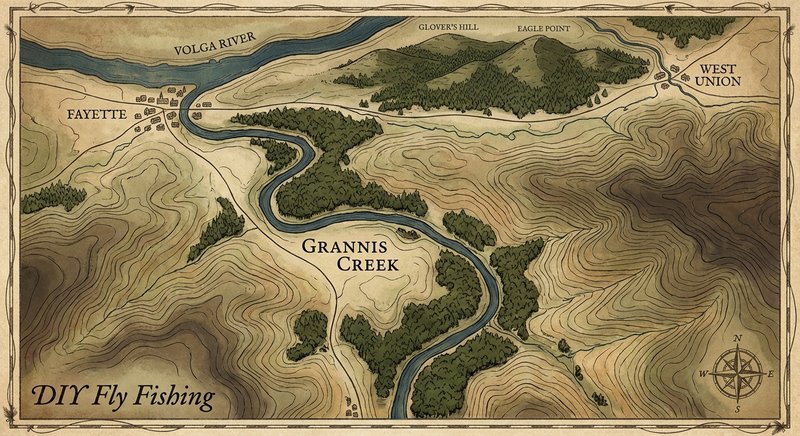
Grannis Creek
Fly fishing in Iowa · advanced · Best seasons: spring, summer, fall
Target Species
Brown Trout, Brook Trout
About This Water
Fayette County tributary with wild trout. Small stream with limited access.
Fishing Recommendations
Welcome to the heart of the Iowa Driftless. As your guide, I can tell you that Grannis Creek is one of those hidden gems that reminds you why we fly fish. Located in Fayette County, this is a quintessential "crick"—it’s small, intimate, and demands respect and stealth. It doesn't have the wide-open casting lanes of the West, but it rewards the technical angler with some of the prettiest wild fish in the Midwest.
🎣 Location Overview
Grannis Creek is a cold-water tributary to the Volga River. What makes it special is its rugged, secluded character. Unlike some of the more manicured "park-style" streams in Iowa, Grannis feels wild. It meanders through deep limestone valleys, timbered hillsides, and limestone outcroppings.
The water is remarkably clear and stays cold year-round thanks to heavy spring influence. It is a narrow stream, often only 10 to 15 feet wide, characterized by deep pool-and-riffle sequences, undercut banks, and significant overhead canopy. Anglers love it because it offers a "small stream" challenge where stalking and accuracy are more important than long-distance casting.
🐟 Target Species & Behavior
- Brown Trout: The primary resident. These are largely wild or "put-and-grow" fish that have become highly acclimated. They are wary. They hold tight to undercut banks, submerged logs, and the dark shadows of limestone ledges. Expect them to be "spooky"—if they see your silhouette, the pool is done for the hour.
- Brook Trout: You will find Brookies higher up in the headwaters and in the colder runs. They are opportunistic but require the coldest, cleanest water. They tend to hold in the "pillows" in front of rocks or in the bubbly water at the head of a pool.
Feeding Behavior: These fish are focused on high-protein terrestrial drops in the summer and steady midge/mayfly hatches in the spring and fall. Because the stream is small, they are extremely vibration-sensitive.
📅 Best Times to Fish
- Spring (April - June): This is the prime window. The aquatic insect life is peaking (Hendricksons and Blue Winged Olives). The water levels are usually stable unless there is a major rain event.
- Summer (July - August): This is "Terrestrial Season." While other streams might warm up, the spring-fed nature of Grannis keeps it fishable. Look for shaded stretches.
- Fall (September - October): The most beautiful time to be on the creek. Brown trout become aggressive as they prepare to spawn. The colors of the fish match the changing leaves.
- Best Time of Day:
- Early morning (first light to 10 AM) during summer to beat the heat.
- Late afternoon/Dusk for the best dry fly action.
- Overcast days are your best friend here; the big Browns lose some of their wariness.
🪰 Recommended Flies & Techniques
Top Fly Patterns
- Dry Flies:
- Elk Hair Caddis (Size 14-18): A staple for the riffles.
- BWO Sparkle Dun (Size 18-22): Essential for spring and fall cloudy days.
- Hippie Stomper or Foam Beetles (Size 12-16): The go-to during summer months.
- Nymphs:
- Bead-head Pheasant Tail (Size 16-20): Mimics almost everything in the creek.
- Zebra Midge (Size 18-22): Black or Red; lethal in the deep, slow pools.
- Pink Squirrel (Size 14-16): A Driftless legend—it just works here.
- Streamers:
- Black or Olive Woolly Bugger (Size 10-12): Use these in the deeper holes or after a rain when the water has a "tea" stain.
Techniques & Presentation
- The "Bow and Arrow" Cast: You’ll need this. The brush is thick, and often you won't have room for a backcast.
- Stealth Approach: Fish upstream. If you walk downstream, you’ll send silt and "scare signals" to every fish below you.
- Light Tackle: A 2-weight or 3-weight rod (7’ to 8’ long) is ideal. Use a 5x or 6x fluorocarbon tippet for nymphs, and nylon for dries.
💡 Pro Tips & Local Knowledge
- The "One-Cast" Rule: In these small pools, your first cast is your best (and often only) chance. Spend two minutes observing the pool before you ever pull line off your reel. Look for the "rise" or the "flash" of a nymphing trout.
- Focus on the Under-cuts: Grannis has incredible undercut banks. Don't just fish the middle of the stream. Your fly needs to land within inches of the bank to entice the larger Browns out of their "living rooms."
- The Volga River State Recreation Area: While parts of Grannis are on private land (see below), much of the best water is accessible within or near the state recreation area. Explore the stretches that require a bit of a hike; the further you get from the road, the better the fishing.
⚠️ Important Information
- Access: Much of the fishable water is on Public Land within the Volga River State Recreation Area or protected by DNR Easements. Look for the "Iowa Fish and Wildlife" signs. Always respect private property boundaries where easements end.
- Regulations:
- Iowa requires a valid fishing license and a Trout Fee.
- Check current DNR regulations, as some Driftless streams have specific "Catch and Release" only sections or artificial-lure-only restrictions.
- Safety: The banks can be slippery and muddy. Keep an eye out for stinging nettles (wear long pants even in summer) and wild parsnip, which can cause skin irritation.
- Ethics: Grannis is a fragile ecosystem. Practice Catch and Release whenever possible, and keep the fish in the water while unhooking them to ensure these wild populations continue to thrive.
Guide’s Final Word: Grannis Creek isn't about the size of the fish—it's about the soul of the stream. Slow down, stay low, and enjoy the quiet of the Driftless. Tight lines!
Bug Hatches & Matching Flies
| Hatch | Type | Peak months | Time of day | Hook sizes | Matching flies |
|---|---|---|---|---|---|
| Blue-Winged Olive Baetis spp. | mayfly | March, April, September, October | Afternoon | #18-22 | RS2 #20-22, Parachute Adams #18-22, BWO Sparkle Dun #18-20 |
| Midges Chironomidae | midge | January, February, March, December | Late Morning/Afternoon | #20-26 | Zebra Midge #18-22, Griffith's Gnat #20-24, Mercury Midge #20-22 |
| Grannom Caddis Brachycentrus | caddis | April, May | Afternoon/Evening | #14-16 | Elk Hair Caddis #14-16, Deep Sparkle Pupa #14-16, Peacock Caddis #14-16 |
| Sulfur Mayfly Ephemerella invaria | mayfly | May, June | Evening | #14-18 | Sulfur Parachute #16-18, Pheasant Tail Nymph #14-18, Sulfur Emerger #16-18 |
| Light Cahill Stenacron canadense | mayfly | June, July | Evening/Dusk | #12-14 | Light Cahill Dry #12-14, Gold Ribbed Hare's Ear #12-14 |
| Trico Tricorythodes | mayfly | July, August, September | Early Morning | #20-24 | Trico Spinner #20-24, Sunken Trico Spinner #22-24 |
| Cinnamon Caddis Hydropsyche | caddis | June, July, August | Evening | #16-20 | X-Caddis #16-20, LaFontaine Sparkle Pupa #16-18 |
| Terrestrials Orthoptera/Formicidae | terrestrial | July, August, September | All Day | #10-18 | Dave's Hopper #10-14, Black Foam Ant #16-18, Crowe Beetle #14-16 |