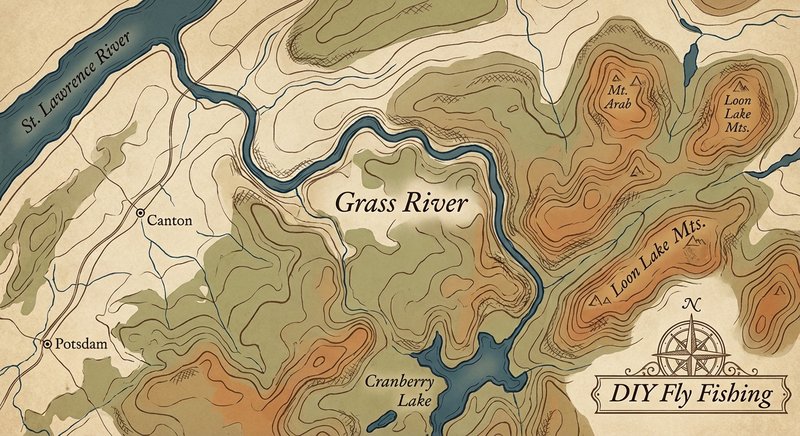
Grass River
Fly fishing in New York · Beginner · Best seasons: Summer, Fall
Target Species
Brook Trout, Brown Trout
About This Water
St. Lawrence County stream with wild brook trout. Less pressured northern Adirondack fishing.
Fishing Recommendations
The Grass River, winding through the rugged landscape of St. Lawrence County in Northern New York, is one of the Adirondacks' best-kept secrets. While the nearby Ausable gets the glory, the Grass offers a more intimate, secluded experience for the angler who values solitude and "wild" water.
Here is your comprehensive guide to fly fishing the Grass River.
🎣 Location Overview
The Grass River is a classic Northern freestone river characterized by tea-colored (tannic) water, granite boulder gardens, and thick coniferous forests. It originates in the foothills of the Adirondack Mountains and flows northwest toward the St. Lawrence River.
What makes it special is the diversity of its branches. The South Branch and Middle Branch are the crown jewels for trout enthusiasts. Much of the best fishing is located within the Tooley Pond Tract, a stretch of public land featuring dramatic waterfalls (like Basford and Sinclair Falls) and pocket water. It is a "low-pressure" fishery where you are more likely to see a moose than another angler.
🐟 Target Species & Behavior
The Grass River is a dual-threat trout fishery, though the character of the fish changes depending on where you stand.
- Brook Trout: These are the native inhabitants of the upper reaches and smaller tributaries. They are opportunistic feeders but can be spooky in the crystal-clear shallow stretches. Look for them in the "pocket water" behind large boulders and in the oxygenated bubbles at the base of small falls.
- Brown Trout: Found primarily in the deeper pools and undercut banks of the main stems. The Browns here tend to be "resident" fish that grow wary. During the summer, they hug the bottom in deep runs to stay cool; in the fall, they become aggressive as they prepare for the spawn.
- Behavior: Due to the tannic (darker) water, fish often rely on vibration and silhouette. They tend to hold in slightly shallower water than you might expect during low-light periods.
📅 Best Times to Fish
While the river is open in the spring, the "North Country" winters keep the water dangerously cold and high until late May.
- Summer (June - August): This is the prime window for dry fly fishing. Even in the heat of July, the heavily shaded sections and cold-water tributaries keep the river fishable.
- Prime Window: Dawn and dusk. The "Hex" hatch (Giant Mayflies) can occur in late June/early July on the slower stretches, leading to explosive evening rises.
- Fall (September - October 15): This is arguably the best time for trophy Browns. As water temperatures drop, the fish become more active throughout the day.
- Prime Window: 10:00 AM to 4:00 PM. The fall colors in the Tooley Pond Tract provide a world-class backdrop.
🪰 Recommended Flies & Techniques
Top Fly Patterns
- Dry Flies:
- Summer: Royal Wulff (#12-16), Elk Hair Caddis (#14-18), and Adams (#14-16).
- Terrestrials: Black Ants and Foam Beetles are essential in August.
- Nymphs:
- Bead-head Pheasant Tails (#14-18) and Gold-ribbed Hare’s Ears.
- Pro Pick: Pat’s Rubber Legs (Stonefly) in black or coffee.
- Streamers:
- Woolly Buggers in Black or Olive (mimics leeches and crayfish).
- Muddler Minnows (effective for both Brookies and Browns).
Techniques
- High-Sticking / Euro Nymphing: Because the Grass is very "bouldery," traditional long-line nymphing often leads to snags. Short-line nymphing through the pockets is highly effective.
- Skating Caddis: In the summer evenings, "skating" a caddis pattern across the surface of the riffles can trigger aggressive strikes from native Brookies.
- Stealth Approach: The water is often low in late summer. Stay low, wear drab clothing, and cast from downstream to avoid shadowing the pools.
💡 Pro Tips & Local Knowledge
- The Tooley Pond Road: This is your lifeline. It parallels the South Branch for miles. Use the designated "Waterfall" parking areas as your entry points. Fish the water between the falls—most tourists just look at the falls and leave the water in between untouched.
- Tannin Tactics: Because the water is tea-colored, flies with flash or high contrast (like a Prince Nymph with a silver bead or a dry fly with a white calf-tail wing) are easier for the fish to spot.
- The "Feeder" Secret: If the main river feels too warm in August, hike up any small tributary you find. These small "trickles" often hold surprisingly large Brook Trout seeking thermal refuge.
⚠️ Important Information
Access
- Public Access: Much of the upper Grass River is within the New York State Forest Preserve (Adirondack Park). Look for the yellow and blue "Public Fishing Rights" or "Forest Preserve" signs.
- Wading: The riverbed is notorious for "greased bowling balls"—extremely slippery rocks. Studded wading boots and a wading staff are mandatory if you value your tailbone.
Regulations & Permits
- License: A valid New York State Fishing License is required.
- Special Rules: Be aware that certain stretches may have "Catch and Release Only" or "Artificial Lures Only" regulations. Always check the NYS DEC Freshwater Fishing Regulations for the specific section you are fishing.
- Season: Trout season generally runs April 1st to October 15th, but check for specific "extended season" reaches which may allow catch-and-release year-round.
Special Considerations
- Black Flies: If you visit in June, the black flies can be brutal. Bring heavy-duty repellent or a head net.
- Cell Service: Expect zero cell service once you leave the main towns (Canton/Degrasse). Download your maps for offline use and let someone know your itinerary.
Bug Hatches & Matching Flies
| Hatch | Type | Peak months | Time of day | Hook sizes | Matching flies |
|---|---|---|---|---|---|
| Hendrickson Ephemerella subvaria | mayfly | May | Afternoon | #12-14 | Red Quill #12-14, Hendrickson Emerger #12-14, Pheasant Tail #12-16 |
| Grannom Caddis Brachycentrus | caddis | May | Morning/Afternoon | #14-16 | Green Weenie #14-16, Elk Hair Caddis (Olive) #14-16, LaFontaine Sparkle Pupa #14-16 |
| Sulfur Ephemerella invaria/dorothea | mayfly | June | Evening | #14-18 | Sulfur Parachute #14-18, Sulfur Cripple #16-18, Gold Ribbed Hare's Ear #14-18 |
| March Brown Maccaffertium vicarium | mayfly | May, June | Afternoon | #10-12 | March Brown Western #10-12, Hare's Ear Nymph #10-12, March Brown Spun Dun #10-12 |
| Golden Stonefly Acroneuria carolinensis | stonefly | June, July | Evening/Night | #6-10 | Golden Stone Nymph #6-10, Stimulator (Yellow) #8-12, Pat's Rubber Legs #8-12 |
| Light Cahill Stenacron interpunctatum | mayfly | June, July | Evening | #12-14 | Light Cahill #12-14, Cream Usual #12-16, Light Cahill Emerger #14 |
| Isonychia (Slate Drake) Isonychia bicolor | mayfly | July, August, September | Afternoon/Evening | #10-12 | Isonychia Parachute #10-12, Prince Nymph #10-14, Iso Wet Fly #12 |
| Black Ant Formicidae | terrestrial | July, August | All Day | #16-20 | Black Foam Ant #16-20, Fur Ant #18-20, Transparant #16-18 |