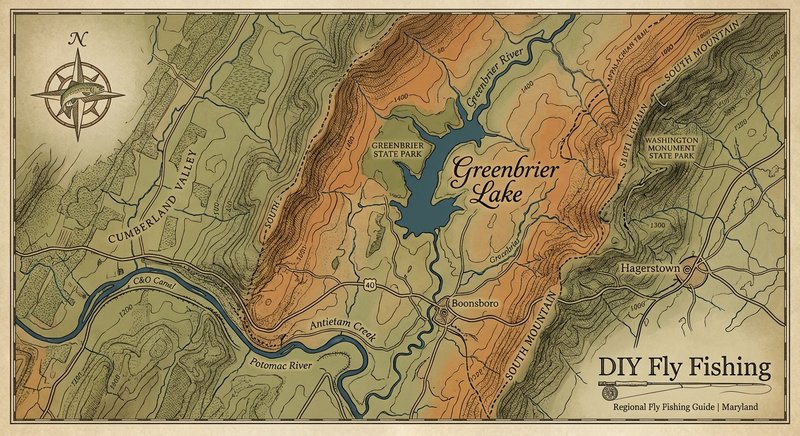
Greenbrier Lake
Fly fishing in Maryland · Beginner · Best seasons: Spring, Summer, Fall
Target Species
Largemouth Bass, Crappie, Bluegill
About This Water
Washington County lake with bass and panfish. Family-friendly fishing.
Fishing Recommendations
Welcome to the "Mountain Lake" experience of Western Maryland. As your guide, I’m excited to break down Greenbrier Lake. Located within Greenbrier State Park near Boonsboro, this 42-acre man-made lake is a gem for fly anglers who appreciate clear water and scenic Appalachian views.
While it is a popular recreational spot, for the fly fisher, it offers a technical but rewarding pursuit of warm-water species.
🎣 Location Overview
Greenbrier Lake is tucked into the South Mountain range. What sets this water apart from other Maryland impoundments is its exceptional clarity. Because the lake is fed by mountain springs and runoff, you can often see several feet down, which is rare for Maryland bass ponds.
The lake features a mix of sandy beaches (the swimming area), rocky points near the dam, and lush weed beds and lily pads along the western and northern shores. This diversity allows for multiple styles of fly fishing, from delicate dry fly presentations for panfish to aggressive "frog-popping" for bass.
🐟 Target Species & Behavior
Largemouth Bass
The bass here are healthy but can be "spooky" due to the clear water and high recreational pressure.
- Behavior: They hold tight to the weed lines and submerged timber. During the heat of the day, they retreat to the deeper channels near the dam.
- Feeding: They primarily forage on bluegill, crayfish, and the occasional dragonfly or frog.
Bluegill & Sunfish
Greenbrier is a "numbers" lake for panfish. They are aggressive and provide non-stop action for beginners or those looking to test new patterns.
- Behavior: During the spring spawn, you'll see "craters" (beds) in the shallow sandy areas. In summer, they hover under overhanging branches and around the docks.
Crappie
- Behavior: Crappies are more structure-dependent here. Look for them in the "woodier" sections of the lake or suspended near the dam breast. They move shallow in the spring (April) and retreat to 10–15 foot depths in the summer.
📅 Best Times to Fish
Optimal Seasons
- Spring (Late April – Early June): This is the "Golden Era." The water warms up, the bass move to the shallows to spawn, and the bluegill are extremely aggressive.
- Fall (September – October): As the swimmers leave and the water cools, bass go on a feeding binge to prepare for winter. The shoreline becomes productive again.
Best Times of Day
- Summer Peak: You must fish the "shoulder hours." Arrive at park opening (usually 8:00 AM, though seasonal hours vary) or stay until sunset. Mid-day in summer is difficult due to the swimming crowds and the sun pushing fish deep.
- Overcast Days: Because the water is so clear, a cloudy day is your best friend. It breaks up the light and makes the fish much more confident in shallow water.
🪰 Recommended Flies & Techniques
For Largemouth Bass
- Topwater: BoogleBugs (size 4) or Umpqua’s Swimming Frog. Use a "Pop-and-Pause" retrieve near the lily pads.
- Subsurface: Clouser Minnows (White/Chartreuse) to mimic baitfish, or a Woolly Bugger (Black or Olive) with a brass bead to mimic crayfish.
- Technique: Use a 6-weight or 7-weight rod with a weight-forward floating line. If fishing near the dam, a sink-tip line can help reach fish in the 10-12 foot range.
For Bluegill & Crappie
- Topwater: Foam Beetles, Hoopers, or small Poppers (Size 10-12).
- Subsurface: San Juan Worms (Red) or Micro-Buggers. For Crappie, a white marabou streamer (size 8) fished with a slow, twitchy retrieve is deadly.
- Technique: A 3-weight or 4-weight rod is ideal. Use a 9-foot leader tapered to 4X or 5X; the long leader is essential because of the water clarity.
💡 Pro Tips & Local Knowledge
- The "West Shore" Secret: The western shore (opposite the beach) has the most overhanging mountain laurel and fallen timber. This is where the biggest bass hide. If you have a kayak or belly boat, focus your energy here.
- Stealth is Mandatory: Because the water is clear, if you can see the bass, they have likely already seen you. Long casts and a low profile (if fishing from the bank) will double your hook-up rate.
- The Dam Breast: Most people fish the shallows, but the rocky rip-rap near the dam is a hotspot for Crappie. Use a tandem rig (a small popper with a weighted nymph dropper 2 feet below it).
- Avoid the "Beach" during midday: During the summer, the swimming area is chaotic. However, at dawn, bass often patrol the edges of the sandy swimming area looking for displaced baitfish.
⚠️ Important Information
- Access: There is a daily entrance fee per person to enter Greenbrier State Park. It can reach capacity on summer weekends, so arrive early!
- Boating: Gas engines are prohibited. Electric trolling motors, kayaks, canoes, and rowboats are allowed. There is a convenient boat launch on-site.
- Regulations:
- A Maryland Non-Tidal Fishing License is required for everyone 16 and older.
- Check the current MD DNR "Summary of Regulations" for creel limits, though Catch & Release is highly encouraged to maintain the quality of this small lake.
- Wading: Wading is permitted, but be careful of the sudden drop-offs near the dam and certain silty areas that can be "mucky."
Guide’s Final Word: Greenbrier is a "finesse" lake. Scale down your tippet, slow down your retrieve, and enjoy some of the prettiest water in the state!
Bug Hatches & Matching Flies
| Hatch | Type | Peak months | Time of day | Hook sizes | Matching flies |
|---|---|---|---|---|---|
| Midges Chironomidae | midge | March, April, October, November | All day | #18-24 | Zebra Midge #18-22, Griffith's Gnat #20-24, Palomino Midge #20-22 |
| Blue-Winged Olive Baetis spp. | mayfly | April, May, September, October | Afternoon | #18-22 | RS2 #20-22, BWO Parachute #18-20, Pheasant Tail #18-20 |
| Damselfly Enallagma spp. | terrestrial | June, July, August | Late Morning/Afternoon | #10-14 | Marabou Damsel #10-12, Adult Damsel #12-14 |
| Speckled Dun Callibaetis | mayfly | May, June, August, September | Morning | #14-16 | Callibaetis Spinner #14-16, Hare's Ear Nymph #14-16, Parachute Adams #14-18 |
| Black Carpenter Ant Camponotus pennsylvanicus | terrestrial | July, August | All day | #12-16 | Black Foam Ant #12-16, Chernobyl Ant #10-14 |
| Dragonfly Anisoptera | terrestrial | June, July, August | Afternoon | #4-10 | Dragonfly Nymph #6-10, Woolly Bugger (Olive) #4-10 |
| Scud Gammarus spp. | terrestrial | April, May, September, October | All day | #14-18 | Ray Charles #14-18, Olive Scud #14-16 |
| Water Boatmen Corixidae | terrestrial | September, October | Afternoon | #14-18 | Water Boatman #14-16, Prince Nymph #14-18 |
| Light Cahill Stenacron interpunctatum | mayfly | June, July | Evening | #12-14 | Light Cahill #12-14, Gold Ribbed Hare's Ear #12-14 |