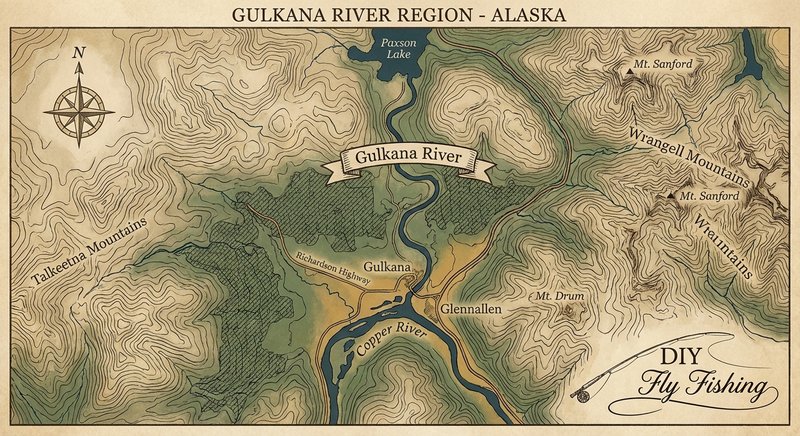
Gulkana River
Fly fishing in Alaska · Intermediate · Best seasons: Summer
Target Species
King Salmon, Arctic Grayling, Rainbow Trout
About This Water
Interior Alaska river with king salmon and grayling. Accessible via Richardson Highway.
Fishing Recommendations
The Gulkana River is one of Alaska’s most storied fly fishing destinations. Designated as a "Wild and Scenic River," it flows from the Alaska Range into the Copper River. Unlike many of the glacial, silt-heavy rivers in the region, the Gulkana runs relatively clear, making it a paradise for sight-fishing and traditional fly techniques.
As your guide, I’m going to break down how to tackle this interior Alaska gem.
🎣 Location Overview
The Gulkana is a diverse river system that changes character significantly from its headwaters at Paxson Lake down to its confluence with the Copper River.
- The Upper River: Above the Canyon, the river is characterized by meandering bends, crystal-clear water, and a relatively mellow current. This is "Grayling Heaven."
- The Canyon: A challenging section of Class III-IV rapids that requires expert rowing skills or a portage.
- The Lower River: Below the Sourdough boat launch, the river widens, slows down, and becomes the primary theater for the massive King Salmon runs.
Anglers love the Gulkana because it offers a "road-accessible wilderness" experience. You can access parts of it from the Richardson Highway, but a multi-day float trip reveals the river’s true, untouched soul.
🐟 Target Species & Behavior
King Salmon (Chinook)
These are the heavyweights. Gulkana Kings are legendary for their size and power.
- Behavior: They move into the river in June and July. They hold in deep "buckets," behind large boulders, or in the soft seams where fast water meets slow water.
- Feeding: They aren't actively feeding once they enter the river, but they are highly territorial and aggressive. You are fishing for a "strike of irritation" or reflex.
Arctic Grayling
The Gulkana is arguably the best Grayling fishery in the state.
- Behavior: They are ubiquitous in the upper sections. Grayling are "lookers"—they hang in the current and watch the surface.
- Feeding: They are opportunistic. They will rise for dry flies even when no hatch is visible. They love mosquitoes, caddis, and midges.
Rainbow Trout
Wild, hard-fighting, and often overlooked in favor of the salmon.
- Behavior: They follow the salmon. In early summer, they are in the riffles; by late summer, they are stationed behind spawning salmon to feast on eggs.
- Feeding: Early season is about nymphs and small streamers; mid-to-late summer is 100% an egg and flesh fly game.
📅 Best Times to Fish
The Gulkana is a summer-centric fishery due to its interior location.
- June (Early to Mid): The King Salmon start their move. Grayling fishing is excellent as the ice has recently cleared and they are hungry.
- July (Peak Season): This is the prime window. July 1st–July 20th is usually the peak for King Salmon. Grayling are active all day.
- August: The King season usually closes (check regulations), and the focus shifts to Sockeye Salmon and Rainbow Trout feeding on eggs.
- Best Time of Day: With nearly 24 hours of daylight, "time of day" matters less than "light angle." Early morning and late evening (10 PM – 2 AM) offer the best visibility for the fish and less crowded water.
🪰 Recommended Flies & Techniques
For King Salmon
- Technique: "The Swing." Use a 9-10 weight rod with a heavy sink tip (T-14 or T-17). Cast 45 degrees downstream, mend deeply, and let the fly swing through the deep holes.
- Flies: Massive Intruders (Pink/Orange or Blue/Black), Egg-Sucking Leeches, and the "Gulkana Comet."
For Arctic Grayling
- Technique: Dry fly fishing is the draw here. A 3-4 weight rod is perfect. Dead drift your flies over rising fish or through promising seams.
- Flies: Elk Hair Caddis (Size 12-14), Parachute Adams, and Royal Wulff. For nymphs, use a Gold Ribbed Hare’s Ear or a Copper John.
For Rainbow Trout
- Technique: Nymphing with an indicator. If salmon are spawning, "matching the egg" is mandatory.
- Flies: Plastic beads (8mm or 10mm) in "Oregon Cheese" or "Mottled Roe" colors. Bunny Flesh flies in white or ginger for late summer.
💡 Pro Tips & Local Knowledge
- The "Sourdough" Strategy: Many people fish near the bridge, but the best King fishing is often accessed by floating from the Sourdough Campground down to the Richardson Highway bridge. This stretch has the best "holding water."
- Respect the Redds: In late July and August, you will see salmon on their spawning beds (redds). Do not walk on these. Not only does it kill the next generation of fish, but the trout are usually sitting 5-10 feet behind the redds anyway.
- The "Gulkana Twitch": When fishing for Grayling, if they aren't rising, give your dry fly a tiny twitch. The movement often triggers a strike from a curious fish that was sitting deep.
- Carry "The Wood": If you are floating the Canyon, scout it first. The Gulkana can collect "sweepers" (fallen trees) that change every year.
⚠️ Important Information
- Access: The primary access points are Paxson Lake (headwaters), the Sourdough Campground (middle), and the Gulkana River Bridge on the Richardson Highway (lower).
- Regulations: The Gulkana has very specific rules. It is often unbaited, single-hook artificial only. King Salmon fishing usually requires a specific locking tag and has a strict season (often ending July 19th). Always check the current Alaska Department of Fish & Game (ADF&G) emergency orders before your trip.
- Bear Safety: This is high-density Grizzly country. Carry bear spray on your person (not in your pack), make noise, and never leave fish guts near your campsite.
- Gear Prep: Bring the "Alaska Trio": A 4-wt for Grayling, a 7-wt for Trout/Sockeye, and a 10-wt for Kings. Deet or head nets are non-negotiable—the mosquitoes here can be legendary.
The Gulkana is a world-class river that rewards the prepared angler. Respect the water, watch the weather, and tight lines!
Bug Hatches & Matching Flies
| Hatch | Type | Peak months | Time of day | Hook sizes | Matching flies |
|---|---|---|---|---|---|
| Chironomids Chironomidae | midge | May, June, September | All Day | #18-24 | Zebra Midge #18-22, Griffith's Gnat #20-22, Smoke Jumper #20 |
| Golden Stonefly Hesperoperla pacifica | stonefly | June, July | Afternoon/Evening | #6-10 | Pats Rubber Legs #6-10, Chubby Chernobyl #8-10, Golden Rogue Stone #8 |
| Blue Winged Olive Baetis tricaudatus | mayfly | May, August, September | Late Morning/Afternoon | #16-20 | RS2 #18-20, Parachute Adams #16-18, Pheasant Tail Nymph #16-18 |
| Spotted Sedge Hydropsyche | caddis | July, August | Evening | #12-16 | Elk Hair Caddis #14-16, LaFontaine's Deep Sparkle Pupa #14-16, Holy Grail Caddis #14-16 |
| Little Yellow Stonefly Isoperla | stonefly | July | Afternoon/Evening | #14-16 | Yellow Sally Foam #14-16, Iron Lotus #16, Little Yellow Stone Nymph #14 |
| Pale Morning Dun Ephemerella excrucians | mayfly | July, August | Morning/Early Afternoon | #14-18 | PMD Sparkle Dun #16-18, Split Case PMD #16, Hare's Ear Nymph #14-16 |
| Grannom Caddis Brachycentrus | caddis | June | Afternoon | #12-16 | Peacock Caddis #14, Guide's Choice Hare's Ear #12-14, Z-Wing Caddis #14 |
| American Black Fly Simulium | terrestrial | June, July | All Day | #18-22 | Black Gnat #18-22, Bead Head Black Midge #20, Black Klinkhammer #18 |