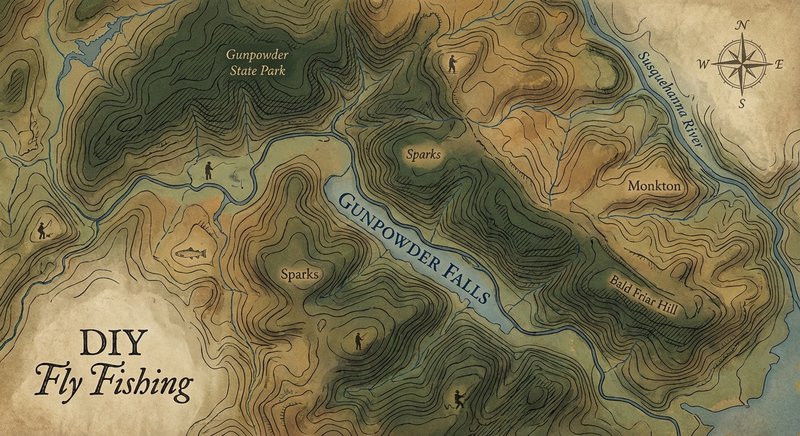
Gunpowder Falls
Fly fishing in Maryland · Intermediate · Best seasons: Spring, Summer, Fall, Winter
Target Species
Brown Trout, Rainbow Trout
About This Water
Maryland's premier trout stream below Prettyboy Dam. Year-round catch-and-release fishing with wild brown trout.
Fishing Recommendations
As an expert guide who has spent countless hours navigating the technical currents of the Mid-Atlantic, I can tell you that Gunpowder Falls (specifically the "Big Gunpowder") is the crown jewel of Maryland fly fishing. Located just 30 minutes north of Baltimore, it is a tailwater fishery—fed by the cold bottom-release waters of Prettyboy Reservoir—which keeps the river cold enough for trout to thrive year-round.
Here is your comprehensive guide to mastering "The Gunpowder."
🎣 Location Overview
The Gunpowder Falls is a quintessential eastern limestone-style tailwater. What makes it special is its consistency and technicality. Because it is a bottom-release dam, the water temperature rarely exceeds 60°F, even in the heat of July.
The river is characterized by its intimacy; it is relatively small, ranging from 20 to 50 feet wide, with a mix of boulder-strewn pocket water, long glassy pools, and shallow riffles. Anglers love it because it offers a "wild" experience in a suburban setting. The trout here are famously wary and "educated," requiring long leaders, light tippets, and perfect presentations.
🐟 Target Species & Behavior
- Brown Trout: The stars of the show. The Gunpowder is famous for its wild, stream-born Brown Trout. These fish are buttery gold with vibrant red spots. They are notoriously spooky and tend to hold in tight to undercut banks, behind large boulders, or in the "tail-outs" of pools during hatches.
- Rainbow Trout: While the upper sections are dominated by wild Browns, Maryland DNR does stock Rainbows in certain stretches (like Glencoe). These fish are more aggressive and often found in faster, more oxygenated riffles.
Behavior Note: These fish see a lot of flies. They are "micro-feeders," often focusing on tiny midges or blue-winged olives even when larger bugs are present.
📅 Best Times to Fish
- Spring (April – June): Peak season. This is when the major hatches occur (Hendricksons, Sulphurs). The water levels are usually stable, and the fish are most active.
- Summer (July – August): While other rivers are too warm, the Gunpowder remains a cold-water refuge. This is Terrestrial Season. High sun can make fish skittish, so low-light hours (dawn/dusk) are best.
- Fall (September – November): The Brown Trout spawn occurs in late autumn. Fishing can be excellent with Blue-Winged Olives, though anglers should avoid stepping on "redds" (spawning beds).
- Winter (December – March): A true year-round fishery. Focus on the warmest part of the day (11 AM – 3 PM). Look for Midge hatches on sunny afternoons.
🪰 Recommended Flies & Techniques
Top Fly Patterns
- Dry Flies:
- Sulphurs (Size 16-20) – The legendary Gunpowder hatch (May-June).
- CDC Blue-Winged Olives (Size 18-24) – Essential for cloudy days.
- Elk Hair Caddis (Size 14-18) – Great for prospecting riffles.
- Ants & Beetles (Size 16-20) – Crucial for summer success.
- Nymphs:
- Pheasant Tail (Size 18-22) – The gold standard here.
- Zebra Midge (Size 20-24) – Black or Red; a winter staple.
- Frenchies/Perdigons (Size 16-18) – Effective in the faster pocket water.
- Streamers:
- Woolly Buggers (Size 10-12) – Olive or Black. Best used during higher flows or stained water.
Effective Techniques
- Technical Dry Fly: Use a 9ft to 12ft leader tapered to 6X or 7X tippet. A "reach cast" is essential to prevent drag in the complex currents.
- Euro Nymphing: Increasingly popular here. Because the river is small, a long rod allows you to probe pockets without spooking fish with a heavy fly line.
- Dry-Dropper: A small hopper or klinkhammer with a tiny bead-head nymph 18 inches below is deadly in the summer.
💡 Pro Tips & Local Knowledge
- The "Falls Road" Stretch: The section from the Dam down to Falls Road is the most popular. For more solitude, hike further downstream toward Masemore Road or Bunker Hill.
- Walk Slow, Fish Slower: The water is exceptionally clear. If you can see the fish, they have likely already seen you. Wear drab clothing (greens/browns) to blend into the foliage.
- Small is Better: When in doubt, go smaller. A size 22 midge will often get a take when a size 18 nymph is ignored.
- The "Gunpowder Twitch": During a Caddis hatch, a very slight movement of the fly can trigger a strike, but for Sulphurs, a dead drift is non-negotiable.
⚠️ Important Information
- Regulations: Much of the upper river (from the Dam to Blue Mount Rd) is Catch and Release Only, Artificial Lures/Flies Only. Always check the current Maryland DNR Freshwater Fishing Guide as boundaries can change.
- Permits: You need a Maryland Non-Tidal Fishing License and a Trout Stamp.
- Access: Key access points include Falls Road, Masemore Road, Bunker Hill Road, and Blue Mount Road. Parking lots are well-marked but can fill up early on weekends.
- Wading: The rocks in the Gunpowder are notoriously slippery (covered in "didymo" or rock snot). Felt soles or studded boots are highly recommended.
- Check the Flow: Before heading out, check the USGS gauge for "Gunpowder Falls near Parkton." Ideal flows for wading and fishing are between 30 cfs and 100 cfs. Anything over 150 cfs becomes difficult to wade and very technical to fish.
Bug Hatches & Matching Flies
| Hatch | Type | Peak months | Time of day | Hook sizes | Matching flies |
|---|---|---|---|---|---|
| Blue-Winged Olive (BWO) Baetis | mayfly | March, April, October, November | Late Morning/Afternoon | #18-24 | RS2 #20-22, Parachute BWO #18-22, WD-40 #20-24 |
| Trico Tricorythodes | mayfly | July, August, September | Early Morning | #22-26 | Trico Spinner #22-26, Trico Dun #22-24, Zebra Midge #22-24 |
| Sulphur Ephemerella invaria / dorothea | mayfly | May, June | Late Afternoon/Evening | #14-18 | Pheasant Tail #14-18, Sulphur Parachute #16-18, Sulphur Snowshoe Emerger #16-18 |
| Tan Caddis Hydropsyche | caddis | May, June | Morning/Evening | #14-18 | Elk Hair Caddis #14-18, Pupa #16-18, Iris Caddis #16-18 |
| Midges Chironomidae | midge | January, February, March, December | Mid-day | #20-28 | Griffith's Gnat #20-24, Zebra Midge #18-24, Mercury Midge #20-22 |
| Little Winter Stonefly Allocapnia | stonefly | February, March | Late Morning/Afternoon | #16-20 | Early Girl Stonefly #18, Black Stonefly Nymph #16-18, Copper John #18 |
| Terrestrials (Ants and Beetles) Formicidae / Coleoptera | terrestrial | July, August, September | All Day | #14-22 | Black Foam Ant #16-20, Cinnamon Ant #18-22, Crowe Beetle #14-18 |
| Light Cahill Stenacron | mayfly | June, July | Evening | #12-14 | Light Cahill #12-14, Gold Ribbed Hare's Ear #12-14, Cream Usual #14 |