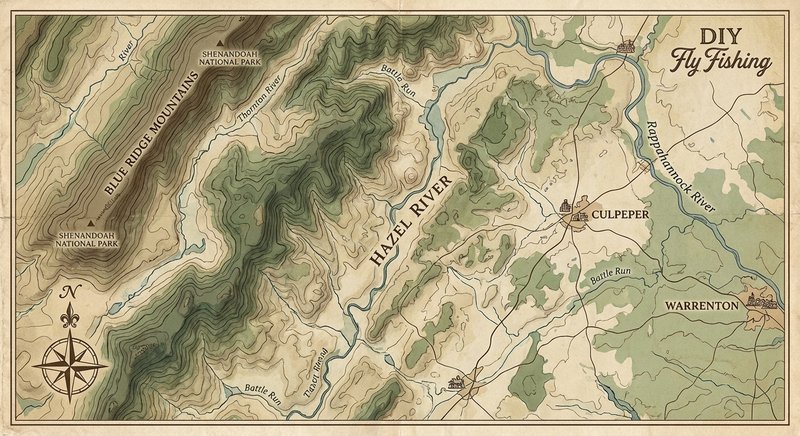
Hazel River
Fly fishing in Virginia · Intermediate · Best seasons: Spring, Summer, Fall
Target Species
Brook Trout, Brown Trout
About This Water
Rappahannock County stream with native brook trout. Scenic Blue Ridge fishing.
Fishing Recommendations
As an expert guide who has spent countless hours navigating the freestone gems of the Blue Ridge, I can tell you that the Hazel River is one of Virginia’s true "blue-ribbon" experiences for the wild trout enthusiast. It is a rugged, beautiful, and demanding fishery that rewards those willing to hike and hunt.
Here is your comprehensive guide to fly fishing the Hazel River.
🎣 Location Overview
The Hazel River is a quintessential Blue Ridge mountain stream located on the eastern slope of Shenandoah National Park (SNP), near Sperryville and Nethers, Virginia. It is a freestone stream, meaning its flow is dictated entirely by rainfall and snowmelt.
What makes the Hazel special is its remoteness and "pocket water" character. Unlike the more famous Rapidan River nearby, the Hazel feels wilder and more secluded. It features steep gradients, massive granite boulders, deep plunge pools, and crystal-clear water. It is a classic "blue-lining" destination—where you follow the thin blue line on a map into the wilderness.
🐟 Target Species & Behavior
The Hazel River is primarily a Wild Brook Trout fishery in its upper reaches, with Wild Brown Trout appearing as you move toward the park boundary and into the lower, private sections.
- Native Brook Trout: These are the jewels of the Appalachians. They are opportunistic but incredibly wary. They hold in the "bubble line" at the head of pools or in the slack water behind large boulders. They feed aggressively on aquatic insects and terrestrials but will spook instantly if they see your shadow or feel the vibration of a heavy footstep.
- Wild Brown Trout: Found in the lower, deeper holes. They are much more calculated than the Brookies. They prefer overhead cover (undercut banks or submerged logs) and are most active during low-light transitions (dawn/dusk).
📅 Best Times to Fish
Spring (April – Early June) - PRIME TIME
This is the golden window. Water temperatures rise into the 50s, and the major hatches occur. The fish are hungry after a long winter and are less cautious than they will be in the low water of summer.
Summer (Late June – August)
Fishing remains good in the higher elevations inside the Park where the water stays cool. However, as the water levels drop, the trout become extremely "spooky." You must use long leaders and a stealthy approach.
Fall (September – November)
A spectacular time to be on the Hazel. The Brook Trout take on vibrant spawning colors (deep oranges and reds). Note: Be mindful of spawning beds (redds) in late October and November—avoid stepping in shallow gravel areas.
- Best Time of Day: In Spring, mid-day is best as the sun warms the water. In Summer, focus on the "Grey Light" hours of early morning and late evening.
🪰 Recommended Flies & Techniques
Top Fly Patterns
- Dry Flies:
- Attractors: Royal Wulff, Stimulators (Size 14-16), and the Mr. Rapidan (a local legend pattern).
- Match the Hatch: Elk Hair Caddis (Tan/Olive), Parachute Adams, and Quill Gordons.
- Terrestrials: Foam Ants, Green Weenies, and Cricket patterns (essential in Summer).
- Nymphs:
- Bead-head Pheasant Tails, Hare’s Ears, and Prince Nymphs (Size 16-20).
- Streamers:
- Small Woolly Buggers (Olive or Black) can entice larger Browns in the lower deep pools during high water.
Effective Techniques
- High-Sticking: Due to the turbulent pocket water, keep as much fly line off the water as possible to prevent drag.
- Dry-Dropper: A very effective Hazel River rig. Hang a small Pheasant Tail nymph 12–18 inches below a buoyant Stimulator or Mr. Rapidan.
- Stealth Approach: This is more like hunting than fishing. Crouch low, wear earthy colors (no white hats!), and cast from downstream to upstream so you stay behind the fish’s field of vision.
💡 Pro Tips & Local Knowledge
- The "Hazel Country" Hike: The best fishing requires a hike. Access the river via the Hazel Mountain Trail or the Sam’s Ridge Trail. The further you get from the trailhead, the better the fishing becomes.
- Read the Bubbles: In the plunge pools, the trout stay right where the white water settles into a steady current. If your fly isn't tracking through the bubble line, you’re missing the fish.
- Don't Overstay Your Welcome: If you haven't had a rise in a pool after 5–10 good casts, move on. The Hazel is about covering ground.
- The "Local" Secret: After a heavy rain, as the water is "claring" (dropping and losing its tea color), the larger Brown trout in the lower sections lose their inhibitions. This is your best chance at a 14+ inch fish.
⚠️ Important Information
Access
- Access is primarily through Shenandoah National Park. You can enter from the bottom (Nethers/Route 600) or from the top via Skyline Drive (at the Hazel Mountain parking area).
- Parking: Be respectful of private property boundaries near the Nethers entrance. Ensure you are parked in designated areas to avoid towing.
Regulations & Permits
- Virginia State Fishing License is required.
- National Park Regulations: Inside SNP, you are restricted to single-point hook, artificial lures only. No bait is allowed.
- Creel Limits: Most anglers on the Hazel practice 100% Catch and Release to preserve the fragile native Brookie populations. Check current SNP regulations for size and harvest limits if you plan to keep fish.
Special Considerations
- Wildlife: This is Black Bear and Timber Rattlesnake country. Keep your eyes open and make noise while hiking.
- Cell Service: Expect zero cell service once you descend into the Hazel River canyon. Bring a map or a satellite GPS (like a Garmin inReach) if you are going deep.
- Wading: The rocks in the Hazel are notoriously slippery. Felt soles (where legal) or studded rubber soles are highly recommended.
Bug Hatches & Matching Flies
| Hatch | Type | Peak months | Time of day | Hook sizes | Matching flies |
|---|---|---|---|---|---|
| Quill Gordon Epeorus pleuralis | mayfly | April | Mid-day | #12-14 | Quill Gordon Dry #12-14, Quill Gordon Nymph #12-14 |
| Blue-Winged Olive Baetis spp. | mayfly | March, April, October, November | Mid-day/Afternoon | #18-22 | RS2 #20-22, Parachute BWO #18-20, Pheasant Tail Nymph #18-22 |
| Hendrickson Ephemerella subvariabilis | mayfly | April, May | Afternoon | #12-14 | Hendrickson Dark #14, Red Quill #12-14, Hare's Ear Nymph #12-14 |
| March Brown Maccaffertium vicarium | mayfly | May | Afternoon | #10-14 | March Brown Dry #10-12, Gold Ribbed Hare's Ear #10-12 |
| Sulphur Ephemerella invaria/dorothea | mayfly | May, June | Evening | #14-18 | Sulphur Parachute #14-18, Sulphur Emerger #16-18, Frenchie #16-18 |
| Tan Caddis Hydropsyche spp. | caddis | May, June, September | Morning/Evening | #14-18 | Elk Hair Caddis #14-16, LaFontaine's Deep Sparkle Pupa #14-16, Holy Grail #14-16 |
| Yellow Sally Isoperla spp. | stonefly | June, July | Late Afternoon/Evening | #14-16 | Yellow Sally Dry #14-16, Little Yellow Stone Nymph #14-16 |
| Light Cahill Stenacron interpunctatum | mayfly | June, July | Evening | #12-14 | Light Cahill Dry #12-14, Cream Variant #14 |
| Terrestrials Formicidae/Coleoptera | terrestrial | July, August, September | All Day | #12-20 | Black Foam Ant #16-18, Crowe Beetle #14-16, Cricket #12 |