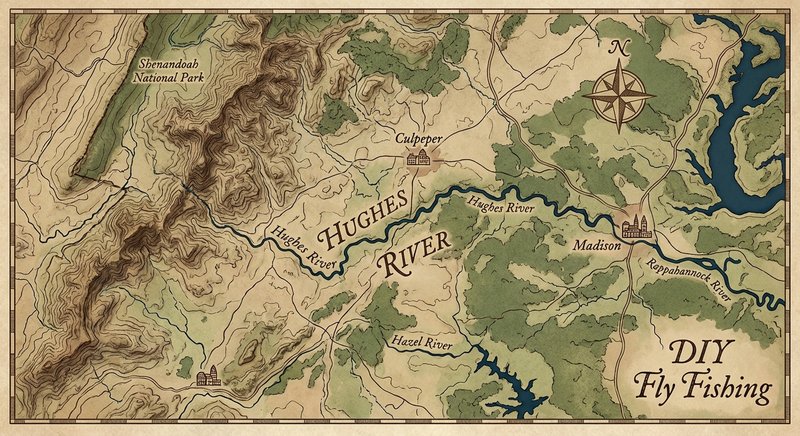
Hughes River
Fly fishing in Virginia · Intermediate · Best seasons: Spring, Summer, Fall
Target Species
Brook Trout
About This Water
Blue Ridge stream with native brook trout. Shenandoah National Park headwaters.
Fishing Recommendations
The Hughes River is a quintessential Blue Ridge mountain stream. Located primarily within the boundaries of Shenandoah National Park (SNP), it is widely considered one of the premier native Brook Trout fisheries in the Eastern United States.
As your guide, here is everything you need to know to find success on these pristine, boulder-strewn waters.
🎣 Location Overview
The Hughes River is a high-gradient mountain stream that tumbles down the eastern slope of the Blue Ridge Mountains. What makes it special is its classic "pool-and-drop" structure. The river is characterized by crystalline water, massive granite boulders, and deep, cold plunge pools.
Anglers love the Hughes because it offers a true wilderness experience. Once you hike a mile or two past the trailheads, the crowds disappear, and you are left with some of the most beautiful native Brook Trout habitat in Virginia. The water stays colder here longer than in many other SNP streams due to heavy canopy cover and the river's high-elevation headwaters.
🐟 Target Species & Behavior
The star of the show is the Salvelinus fontinalis—the Native Brook Trout.
- Behavior: These are wild, opportunistic feeders. Because mountain streams are nutrient-poor, these fish can’t afford to be too picky. However, they are incredibly "spooky." The shadow of a rod or a heavy footstep will send them darting under a rock for an hour.
- Where they hold: Look for fish in the "tail-outs" of pools during active feeding windows, and in the "bubbles" (the oxygenated water at the head of a pool) during mid-day. The largest fish usually claim the best real estate: the dark water underneath overhanging banks or behind submerged boulders.
- Diet: Their diet consists mainly of aquatic insects (Mayflies, Stoneflies, Caddis) and terrestrial insects (Ants, Beetles, Grasshoppers) that fall from the dense forest canopy.
📅 Best Times to Fish
- Spring (Late March – Early June): The Golden Era. This is the prime window. Water levels are usually perfect, and the major hatches (Quill Gordons, March Browns, and Hendricksons) occur.
- Summer (Late June – August): Fishing remains good, but you must focus on the higher elevations inside the Park where the water stays cool. This is "Terrestrial Season."
- Fall (September – October): A spectacular time to be on the water. The Brookies are in their vibrant spawning colors (vivid oranges and reds). Note: Be mindful of spawning beds (redds) in late October and try to avoid walking on them.
- Best Time of Day: In Spring, mid-day (10 AM – 4 PM) is best as the sun warms the water. In the heat of Summer, focus on early mornings and late evenings.
🪰 Recommended Flies & Techniques
Top Fly Patterns
- Dry Flies:
- Royal Wulff / Royal Coachman (Size 14-16): The white wings are easy for the angler to see in broken water.
- Mr. Rapidan (Size 14-16): Created by local legend Harry Murray; this is the definitive SNP fly.
- Elk Hair Caddis (Size 16-18): Great for skating across riffles.
- Parachute Adams (Size 16-20): For when the fish are being more selective.
- Terrestrials:
- Black Ants and Foam Beetles (Size 16-18): Essential from July through September.
- Nymphs:
- Pheasant Tail or Gold-Ribbed Hare's Ear (Size 16-18): Fish these under a dry fly (Dry-Dropper rig).
Techniques & Presentation
- The Stealth Approach: This is more important than your fly choice. Wear drab colors (camo, olive, or tan), stay low, and move upstream.
- Short Casts: You will rarely need more than 15-20 feet of fly line. This is "tight quarters" fishing.
- High Sticking: Keep as much line off the water as possible to avoid "drag." The complex currents in the Hughes will pull your fly in three different directions at once.
💡 Pro Tips & Local Knowledge
- The "One Cast" Rule: Often, your first cast into a pool is your only chance. If you botch the drift, move to the next pocket.
- Identify "The Slot": In many of the larger pools on the Hughes, there is a deep, dark slot right against the granite face. Even if you don't see a rise, a well-placed dry fly over that slot will often coax a 10-inch "trophy" Brookie out.
- Gear Choice: Use a 2-weight or 3-weight rod, 6 to 7.5 feet in length. A 9-foot rod is often too long for the overhanging rhododendron branches. Use a 6X or 7X leader; these fish have keen eyesight in the clear water.
- Hike to Fish: Most people fish within a half-mile of the Nicholson Hollow trailhead. If you hike 2+ miles in, the fish become less pressured and more aggressive.
⚠️ Important Information
- Access: The most popular access point is the Nicholson Hollow Trail near Nethers, VA (at the base of Old Rag Mountain). You can also access the upper reaches from the Skyline Drive at Milepost 44.2 (Hughes River Gap).
- Regulations:
- Inside Shenandoah National Park, it is Catch and Release only for most streams, or very specific size/creel limits. Single-hook, artificial lures only. No bait is permitted.
- A valid Virginia Freshwater Fishing License is required.
- Safety: The boulders on the Hughes are notorious for being slick. Felt-soled boots or studs are highly recommended. Also, be "Bear Aware"—this is prime Black Bear territory.
- Check the Gauge: Before driving out, check the USGS gauges for nearby rivers (like the Robinson or Rapidan). If the water is too low (drought) or too high (after a hurricane), the fishing will be tough.
Guide's Final Word: The Hughes River isn't about catching the biggest fish of your life; it’s about catching the most beautiful fish in one of the most beautiful places in Virginia. Respect the resource, and leave no trace.
Bug Hatches & Matching Flies
| Hatch | Type | Peak months | Time of day | Hook sizes | Matching flies |
|---|---|---|---|---|---|
| Quill Gordon Epeorus pleuralis | mayfly | March, April | Midday | #12-14 | Quill Gordon Dry #12-14, Hare's Ear Nymph #12-14 |
| Blue Winged Olive Baetis species | mayfly | March, April, October, November | Midday/Afternoon | #18-22 | RS2 #20-22, Parachute Adams #18-22 |
| March Brown Maccaffertium vicarium | mayfly | May | Afternoon | #10-14 | March Brown American #10-12, Gold Ribbed Hare's Ear #10-14 |
| Sulfur Ephemerella invaria/dorothea | mayfly | May, June | Evening | #14-18 | Sulfur Parachute #14-18, Pheasant Tail Nymph #14-18 |
| Yellow Sally Isoperla species | stonefly | May, June, July | Afternoon/Evening | #14-16 | Yellow Stimulator #14-16, Little Yellow Stone Nymph #14-16 |
| Tan Caddis Hydropsyche species | caddis | April, May, June | Morning/Evening | #14-16 | Elk Hair Caddis (Tan) #14-16, LaFontaine's Deep Sparkle Pupa #14-16 |
| Black Carpenter Ant Camponotus pennsylvanicus | terrestrial | June, July, August, September | All Day | #12-16 | Black Foam Ant #12-16, Chernobyl Ant #12-14 |
| Little Brown Stonefly Strophopteryx fasciata | stonefly | February, March | Midday | #14-16 | Early Brown Stone #14-16, Pats Rubber Legs (Small) #14-16 |