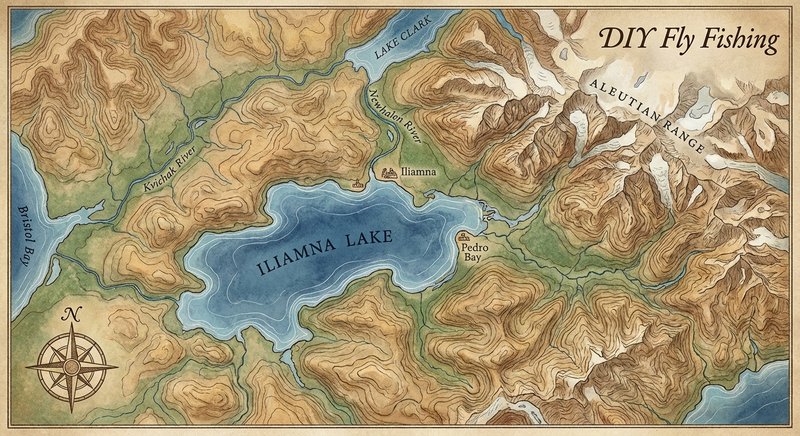
Iliamna Lake
Fly fishing in Alaska · Intermediate · Best seasons: Summer, Fall
Target Species
Rainbow Trout, Arctic Char, Lake Trout
About This Water
Alaska's largest lake with trophy rainbow trout and landlocked salmon. Multiple tributary options.
Fishing Recommendations
Welcome to the "Everglades of the North." As a guide, I can tell you that Lake Iliamna is the holy grail of Alaskan freshwater fishing. It is the largest lake in Alaska (about 1,000 square miles), but its true magic lies in its role as the engine for the Kvichak River system—home to the largest Sockeye Salmon run in the world and the legendary "leopard" Rainbow Trout.
Here is your comprehensive guide to fishing this majestic inland sea.
🎣 Location Overview
Lake Iliamna is a massive, deep-water inland sea located at the base of the Alaska Peninsula. What makes it special isn't just the lake itself, but the tributaries and the outlet (the Kvichak River).
The water is crystal clear and cold. The shoreline varies from sandy beaches to jagged rock drop-offs and complex island chains (the Porcupine Islands). Anglers love this area because it represents the pinnacle of "big water" fly fishing. You aren't just fishing for numbers; you are fishing for specimens. The Rainbow Trout here are genetically distinct—migratory "lake-run" fish that grow to massive proportions by gorging on salmon biomass.
🐟 Target Species & Behavior
Rainbow Trout (The Legends)
These are not your average stream trout. Known as "Kvichak Rainbows," they spend much of their time in the big lake and move into the rivers and creek mouths to feed. They are incredibly powerful, often silver-bright, and heavily spotted.
- Behavior: They follow the food. In early summer, they hunt outmigrating salmon smolt. In late summer/fall, they stack up behind spawning salmon to eat eggs and flesh.
Arctic Char
Often found near the mouths of tributary streams and around rocky points.
- Behavior: Char are opportunistic. They hover in the deeper transition zones where a stream enters the lake, waiting for anything washed out by the current. Their colors in the fall are breathtaking (vibrant oranges and reds).
Lake Trout
The monsters of the depths. While they can stay deep, they move into the shallows of Iliamna during the spring and late fall.
- Behavior: They are apex predators. They hold near rocky ledges and underwater humps, feeding on smaller fish like whitefish and sculpin.
📅 Best Times to Fish
Early Summer (June – Early July)
- The Window: This is "Smolt Season."
- Conditions: As the ice clears and the sun stays up 20+ hours, millions of salmon smolt migrate from the lake to the ocean.
- Target: Rainbows and Lake Trout go into a feeding frenzy. Look for "boils" on the surface where trout are busting schools of baitfish.
Late Summer/Fall (August – September)
- The Window: This is the "Egg and Flesh" season.
- Conditions: The Sockeye Salmon have arrived to spawn.
- Target: This is the prime time for trophy Rainbows and Arctic Char. The fish move out of the lake and into the tributaries (like the Newhalen River or the upper Kvichak). September is arguably the best month for a true 30-inch Rainbow.
🪰 Recommended Flies & Techniques
Top Fly Patterns
- Smolt Patterns (June/July): Thunder Creek Smolt, AK Shiny Moe, or any sparse, silver/white streamer (Size 2-6).
- Beads (August/September): 8mm and 10mm plastic beads in "Mottled Roe," "Orange Clear," or "Peach." Note: This is the most effective way to catch Rainbows during the spawn.
- Flesh Flies: "Battlefield Medics" or white/pink bunny strips. These represent decaying salmon meat in late September.
- Sculpins/Leeches: Black or Olive Articulated Leeches and Bunny Sculpins (Size 2).
Effective Techniques
- The "Smolt Swing": Use a sink-tip line. Cast across the current at a river mouth, strip fast and erratically to mimic a panicked smolt.
- Indicator Nymphing: When the salmon are on the redds (spawning beds), dead-drift a bead under a strike indicator. The key is to keep your bead within inches of the bottom.
- Streamer Stripping: For Lake Trout along rocky drop-offs, use a heavy sink-tip and large articulated streamers.
💡 Pro Tips & Local Knowledge
- Watch the Gulls: If you see seagulls diving on the open water of the lake, they are likely targeting salmon smolt being pushed to the surface by predatory Rainbows or Lake Trout. Get there immediately.
- The "Newhalen River" Connection: The Newhalen enters Iliamna near the village of Iliamna. It is a major corridor for fish. The lower stretches offer incredible access to big water fish moving into the system.
- Find the "Redds": When fishing the tributaries, look for the bright gravel patches where salmon are spawning. Do not walk on the nests, but fish the "trough" directly behind the salmon—that’s where the trophy trout are waiting for stray eggs.
- Gear Up: Use a 7-weight rod as your all-around tool. The wind on Iliamna can be brutal, and the fish are exceptionally strong. You need the backbone to turn a 10lb trout in a heavy current.
⚠️ Important Information
Access
- No Roads: You cannot drive to Iliamna. Access is via bush plane (usually from Anchorage to the Iliamna or Igiugig airfields).
- Lodging: Most anglers stay at fly-out lodges (like Intricate Bay Lodge or Rainbow King Lodge) which provide boats and pilots to reach the best spots.
Regulations & Permits
- License: You need a standard Alaska Fishing License (available online).
- Single Hook/No Bait: Most of this region is "Unbaited, Single-Hook, Artificial Lure Only."
- Catch & Release: While you can keep some species, trophy Rainbow Trout are almost universally catch-and-release in this drainage to preserve the world-class genetics.
Special Considerations
- Bears: This is high-density Brown Bear country. Always carry bear spray, stay alert, and never fish alone.
- Weather: The lake creates its own weather system. It can go from glass-calm to 6-foot waves in thirty minutes. If you are DIY-ing in a small boat, be extremely cautious.
Bug Hatches & Matching Flies
| Hatch | Type | Peak months | Time of day | Hook sizes | Matching flies |
|---|---|---|---|---|---|
| Midges Chironomidae | midge | May, June, September | All Day | #18-24 | Zebra Midge #18-22, Griffith's Gnat #20-22, Brooks Sprout Midge #20-22 |
| Blue Winged Olive Baetis | mayfly | May, June, August, September | Afternoon | #16-20 | Parachute Adams #16-20, RS2 #18-20, Pheasant Tail #16-18 |
| Grannom Caddis Brachycentrus | caddis | June, July | Late Afternoon/Evening | #12-16 | Elk Hair Caddis (Olive) #14-16, Peeping Caddis #12-14, LaFontaine Sparkle Pupa #14-16 |
| Traveling Sedge Hesperophylax | caddis | July, August | Evening | #8-12 | Goddard Caddis #8-10, Mikulak Sedge #8-12 |
| Pale Morning Dun Ephemerella | mayfly | July, August | Late Morning/Afternoon | #14-16 | PMD Sparkle Dun #14-16, Copper John (Yellow) #14-16 |
| Alaskan Mosquito Aedes / Culex | terrestrial | June, July | All Day | #12-16 | Alaskan Mosquito #12-16, Black Gnat #14-16 |
| Golden Stonefly Hesperoperla pacifica | stonefly | June, July | All Day | #6-10 | Pat's Rubber Leg #6-10, Rogue River Stone #8-10 |
| Black Fly Simuliidae | terrestrial | June, July, August | All Day | #18-22 | Black Fly Larva #18-22, Stewart's Black Spider #16-20 |