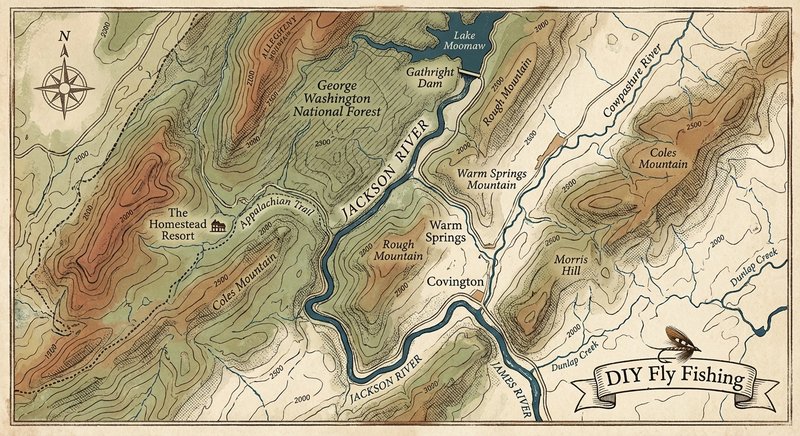
Jackson River
Fly fishing in Virginia · Intermediate · Best seasons: Spring, Summer, Fall, Winter
Target Species
Brown Trout, Rainbow Trout
About This Water
Excellent tailwater below Gathright Dam. Trophy brown and rainbow trout in scenic valley.
Fishing Recommendations
The Jackson River, specifically the tailwater section below the Gathright Dam (Lake Moomaw), is arguably the crown jewel of Virginia trout fishing. Flowing through the scenic Alleghany Highlands, it offers a large-river experience that is rare in the Southeast, characterized by cold, nutrient-rich water and wild, hard-fighting fish.
🎣 Location Overview
The Jackson River tailwater is a 18-mile stretch of river that stays cold year-round thanks to the bottom-release Gathright Dam. What makes it special is its wild character. Unlike many East Coast tailwaters that rely heavily on stocking, the Jackson is managed as a wild trout fishery.
The river is physically diverse: you’ll find deep, limestone-tinted pools, fast-moving riffles, and long, glassy glides. It feels "big"—averaging 60 to 100 feet wide—giving anglers plenty of room to cast. The water quality is exceptional, supporting a massive biomass of aquatic insects, which translates to fast growth rates for the trout.
🐟 Target Species & Behavior
- Wild Brown Trout: These are the kings of the Jackson. They are notoriously wary and sophisticated. They tend to hold near heavy structure—downed timber, undercut banks, and the deep shadows of limestone ledges. Large browns here are known to be aggressive streamer eaters, especially during low-light conditions.
- Wild Rainbow Trout: Usually found in the faster water, riffles, and the heads of pools. They are acrobatic and lean. On the Jackson, rainbows often "key in" on specific insect hatches more than the browns do.
Feeding Behavior: Because this is a tailwater, the fish have a steady "conveyor belt" of food. They are efficient feeders and will not move far for a fly unless it’s a high-protein meal (like a sculpin or a large stonefly).
📅 Best Times to Fish
The Jackson is a true four-season fishery, but each season requires a different strategy.
- Spring (March – May): Prime Time. This is when the major hatches occur. Blue-Winged Olives (BWO), Quill Gordons, and the famous Caddis hatches bring the big fish to the surface.
- Summer (June – August): Excellent fishing, but watch the release schedules. While the water stays cold, the air is hot. Terrestrial fishing (beetles/ants) becomes vital. This is the best time for "wet wading."
- Fall (September – November): The Trophy Season. Brown trout become aggressive as they prepare to spawn. Streamer fishing is at its peak. The scenery with the changing leaves is world-class.
- Winter (December – February): Challenging but rewarding. Midges and small nymphs are the name of the game. You’ll have the river to yourself, and on sunny afternoons, you might even see a midge rise.
Best Window: Generally, the first two hours of light and the last two hours before dark are most productive, especially for larger browns.
🪰 Recommended Flies & Techniques
Top Fly Patterns
- Nymphs: Frenchies (size 14-18), Pat’s Rubber Legs (tan/brown), Zebra Midges (black/silver, size 18-22), and Pheasant Tails.
- Dry Flies: Elk Hair Caddis (size 14-16), Parachute Adams, Tan/Olive Caddis, and Griffith’s Gnat.
- Streamers: Black or Olive Woolly Buggers, Sex Dungeon (small versions), and the Jackson River Special (a local streamer variation).
Techniques
- Indicator Nymphing: The most consistent producer. Use a "drop-shot" rig to get nymphs down into the deep slots quickly.
- The "Jackson Swing": Swinging soft hackles or small streamers through the riffles is a local favorite and highly effective during a caddis emergence.
- Streamer Stripping: Use a sink-tip line and cast toward the banks, stripping aggressively. This is how you find the 20-inch+ browns.
💡 Pro Tips & Local Knowledge
- Mind the Pulse: The Gathright Dam releases can change the river height rapidly. Always check the USGS Gauge at Falling Springs before heading out. A flow between 250 and 450 CFS is ideal for wading. Above 600 CFS, it becomes a float-fishing river.
- The "Caddis Blizzard": In late April/May, the caddis hatches can be so thick they get in your ears and nose. During this time, fish a pupa pattern just under the surface rather than a high-floating dry fly.
- Stealth is Key: The water is often very clear. Long leaders (9–12 feet) and 5x or 6x fluorocarbon tippets are often necessary to fool the larger, educated wild fish.
⚠️ Important Information
Access & The "Floating" Law
This is the most critical part of fishing the Jackson. Due to historical "King's Grants," some sections of the riverbed are privately owned.
- Public Access Points: There are six well-marked US Forest Service/VDWR access points (e.g., Smith Bridge, Indian Draft, Petticoat Junction).
- The Law: You can float through private sections, but in certain "King's Grant" areas, you cannot anchor or wade on the river bottom. Stick to the designated public areas to avoid trespassing issues.
Regulations
- Wild Trout Area: Most of the tailwater is under special regulation. This is a Catch and Release only or strictly limited harvest area (check current VDWR signs).
- Gear: Single-hook artificial lures only in most stretches.
- License: A valid Virginia Freshwater Fishing License AND a Trout License are required.
Safety
The river bottom is notoriously "greasy" (slick rocks). Aluminum-barred boots or felt with studs are highly recommended to avoid a soaking!
Bug Hatches & Matching Flies
| Hatch | Type | Peak months | Time of day | Hook sizes | Matching flies |
|---|---|---|---|---|---|
| Sulphur Ephemerella invaria/dorothea | mayfly | May, June | Late Afternoon/Evening | #14-18 | Comparison Dun #16-18, Pheasant Tail #14-18, Sulphur Parachute #14-18 |
| Blue Winged Olive Baetis | mayfly | March, April, October, November | Late Morning/Afternoon | #18-22 | RS2 #20-22, BWO Sparkle Dun #18-22, WD-40 #20-22 |
| Tan Caddis Hydropsyche | caddis | April, May, June | All Day/Evening | #14-18 | Elk Hair Caddis #14-16, Holy Grail #14-18, LaFontaine's Deep Sparkle Pupa #16 |
| Yellow Sally Isoperla | stonefly | June, July | Afternoon/Evening | #14-16 | Yellow Stimulator #14-16, Iron Lotus #16, Little Yellow Stone #14-16 |
| Trico Tricorythodes | mayfly | July, August, September | Morning | #20-24 | Trico Spinner #20-24, Sunken Trico Spinner #22, Griffith's Gnat #20-24 |
| Light Cahill Stenacron interpunctatum | mayfly | June, July | Evening | #12-14 | Light Cahill #12-14, Cream Usual #14, Gold Ribbed Hare's Ear #12-14 |
| Zebra Midge Chironomidae | midge | January, February, March, December | All Day | #18-24 | Zebra Midge #18-22, Morgan's Midge #20-24, Mercury Midge #20-22 |
| Terrestrials (Beetles/Ants) Coleoptera/Formicidae | terrestrial | July, August, September | Mid-day/Afternoon | #12-18 | Black Foam Beetle #14-16, Cinnamon Ant #16-18, Crowe Beetle #14 |