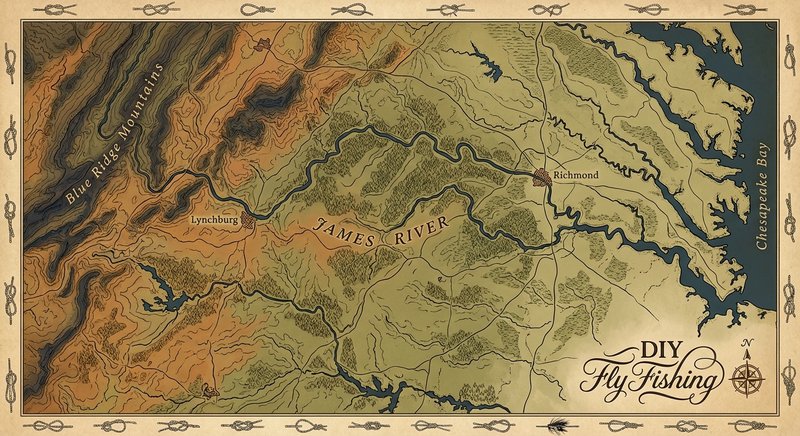
James River
Fly fishing in Virginia · Intermediate · Best seasons: Spring, Summer, Fall
Target Species
Smallmouth Bass, Striped Bass, Channel Catfish
About This Water
Virginia's iconic river with diverse fishing from mountains to the Bay. Smallmouth and striped bass.
Fishing Recommendations
The James River is one of the most storied and diverse river systems in the Eastern United States. Flowing from the Blue Ridge Mountains to the Chesapeake Bay, it offers a "dual personality" that fly anglers adore: it is both a premier Smallmouth Bass destination and a rugged, tidal powerhouse for migratory species.
As your guide, here is your comprehensive breakdown for fly fishing the "mighty James."
🎣 Location Overview
The James River is the heartbeat of Virginia fishing. What makes it special is its diversity of water types. The Upper James (above Lynchburg) and Middle James (Lynchburg to Richmond) are characterized by limestone ledges, boulder gardens, and classic riffle-pool-run sequences.
Once the river hits the Fall Line in Richmond, it transforms. It drops over dramatic granite rapids into a tidal ecosystem. This transition creates a world-class fishery right in the middle of a capital city. Anglers love the James because you can catch a trophy Smallmouth in the morning and potentially hook a hard-charging Striped Bass or a massive Catfish in the afternoon, all while surrounded by ancient rock formations and bald eagles.
🐟 Target Species & Behavior
Smallmouth Bass (The Bronze Back)
- Behavior: Known as the "pound-for-pound" kings of the river. They are aggressive, territorial, and love structure.
- Where they hold: Look for "slack water" behind large boulders, the edges of deep ledges, and the seams where fast water meets slow water. During high summer, they move into the faster, oxygenated riffles.
- Diet: Primarily crayfish, hellgrammites, and baitfish (shiners and sunfish).
Striped Bass (Rockfish)
- Behavior: These are migratory powerhouses. They move up the river from the Chesapeake Bay to spawn in the spring and return in the fall to feed.
- Where they hold: Deep holes below rapids, bridge pilings, and tidal eddies. They are "shadow hunters," often sitting in the dark beneath bridges or structure waiting for current-borne prey.
- Diet: Gizzard shad, herring, and eels.
Channel Catfish
- Behavior: While often ignored by fly anglers, they are highly predatory on the James. They are surprisingly active hunters, especially in low-light conditions.
- Where they hold: Deep, muddy bottoms near structure or at the base of deep runs.
- Diet: They will take large, dark streamers worked slowly along the bottom that mimic crawfish or dying shad.
📅 Best Times to Fish
- Spring (March – May):
- Prime Window: The Striped Bass run peaks in April.
- Conditions: Water is higher and cooler. Smallmouth begin to wake up and move toward spawning flats.
- Summer (June – August):
- Prime Window: The "Golden Age" for Smallmouth.
- Time of Day: Early morning (dawn to 10 AM) and late evening (6 PM to dusk). Topwater action is electric during these windows.
- Fall (September – November):
- Prime Window: Late September through October.
- Conditions: As water cools, Smallmouth feed heavily for winter. "False" spawning runs of Stripers can also occur in the lower tidal sections.
🪰 Recommended Flies & Techniques
For Smallmouth Bass
- Topwater: BoogleBugs (Poppers), Murdich Minnows (fished high), and Stealth Bombers.
- Technique: Cast toward the bank or ledge, let the rings dissipate, and give it two sharp "chugs."
- Sub-Surface: Clouser Minnows (Chartreuse/White), Gamechangers, and CK Hellgrammites.
- Technique: The "Swing and Strip." Cast 45 degrees downstream, let it sink, and use erratic strips to mimic a fleeing baitfish.
For Striped Bass
- Patterns: Large Hollow Fleyes, Half-and-Halfs, and Deceivers (6–9 inches long).
- Technique: Use a 9wt rod with a sinking tip line. You must get the fly down 5–10 feet quickly in the heavy current of the Fall Line.
For Channel Catfish
- Patterns: Woolly Buggers (Black or Olive) and heavy Lead-Eyed Crawfish patterns.
- Technique: Slow, bottom-bouncing "nymphing" style presentations with a heavy fluorocarbon leader.
💡 Pro Tips & Local Knowledge
- Read the Ledges: The James is full of "ledges" that run perpendicular to the flow. Bass sit right on the downstream side of these ledges. If your fly isn't ticking the rocks, you aren't deep enough.
- The Richmond "Fall Line": For a unique experience, fish the Belle Isle or Pony Pasture areas in Richmond. It offers incredible wade fishing access for both Smallies and Spring Stripers.
- Low Water Stealth: In August, the James can get very low and clear. Switch to longer leaders (9-12 feet) and fluorocarbon to avoid spooking wary trophy Smallmouth.
- The "Hellgrammite Hatch": In early summer, hellgrammites (dobsonfly larvae) are a primary food source. Using a heavy, dark weighted fly that mimics these "crawly-bottom-dwellers" is a local secret for the biggest fish.
⚠️ Important Information
- Access:
- Upper/Middle: Numerous DGIF boat ramps (Buchanan, Eagle Rock, Scottsville). Best fished via drift boat or raft.
- Richmond: Excellent wade access at James River Park System (Pony Pasture, Reedy Creek, 42nd Street).
- Regulations:
- A Virginia Freshwater Fishing License is required. If fishing below the 14th Street Bridge in Richmond, you are in tidal waters and may need a Saltwater/Tidal license.
- Check current VDWR regulations for "Creel Limits" on Striped Bass, as these change frequently to protect the population.
- Safety: The James is powerful. It has "river wide" hydraulics and slippery granite. Always wear a life jacket (PFD) if in a boat or wading in heavy current. The James can rise rapidly after rains in the mountains, even if it hasn't rained in Richmond. Always check the USGS gauge levels before heading out.
Bug Hatches & Matching Flies
| Hatch | Type | Peak months | Time of day | Hook sizes | Matching flies |
|---|---|---|---|---|---|
| White Miller Ephoron leukon | mayfly | July, August | Evening/Night | #12-14 | White Wulff #12-14, Ephoron Spinner #14, White Miller Nymph #12 |
| Trico Tricorythodes | mayfly | July, August, September | Morning | #20-24 | Trico Spinner #20-24, Trico Drowned Spinner #22, RS2 #20-22 |
| Blue Winged Olive Baetis | mayfly | March, April, October, November | Afternoon | #18-22 | BWO Parachute #18-22, Pheasant Tail Nymph #18-20, Barr's BWO Emerger #20 |
| Spotted Sedge Hydropsyche | caddis | April, May, June | Evening | #14-16 | Elk Hair Caddis (Tan) #14-16, LaFontaine's Deep Sparkle Pupa #14-16, Holy Grail Caddis #14-16 |
| Golden Stonefly Acroneuria | stonefly | May, June | Morning/Evening | #6-10 | Pat's Rubber Legs (Golden) #6-10, Kaufmann's Stimulator #8-10, Golden Stone Nymph #8-10 |
| Light Cahill Stenonema | mayfly | May, June | Late Afternoon/Evening | #12-14 | Light Cahill #12-14, Gold Ribbed Hare's Ear #12-14, Cahill Emerger #14 |
| Grasshopper Orthoptera | terrestrial | July, August, September | Late Morning/Afternoon | #8-12 | Dave's Hopper #8-12, Morrish Hopper #10, Yug's Chubby Chernobyl #8-12 |
| Damselfly Calopteryx | terrestrial | June, July, August | All Day | #10-12 | Adult Damselfly #10-12, Marabou Damsel Nymph #12, Blue Foam Damsel #10 |