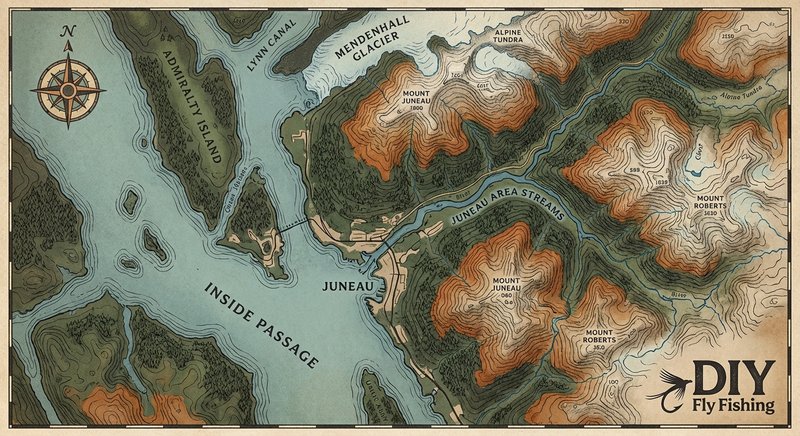
Juneau Area Streams
Fly fishing in Alaska · Beginner · Best seasons: Summer, Fall
Target Species
Silver Salmon, Pink Salmon, Dolly Varden
About This Water
Multiple streams near the capital including Mendenhall River. Salmon and Dolly Varden.
Fishing Recommendations
Welcome to the "Panhandle" of Alaska. As a guide in the Juneau area, I can tell you that fishing here is a quintessential Southeast Alaska experience: rugged coastlines, temperate rainforests, and streams that are often short but incredibly productive.
Juneau is unique because it is landlocked by the Juneau Icefield; you can’t drive here, which keeps the pressure manageable compared to the Kenai Peninsula. The streams here are primarily "spate" rivers—short, rain-fed coastal systems that rise and fall quickly with the weather.
🎣 Location Overview
The Juneau area offers a mix of roadside and remote-access fly fishing. What makes it special is the interconnectedness of the ecosystem. You aren't just fishing a river; you are fishing the tide. Many of the best spots are in the "intertidal zone"—the area where the stream meets the salt water.
The water is generally clear but can turn "glacial milk" (silty) or "tannin-stained" (tea-colored) depending on the specific drainage. Anglers love it here because you can hook a 15-pound Silver salmon while a Bald Eagle watches from a Sitka Spruce, all within a 20-minute drive from downtown.
🐟 Target Species & Behavior
Pink Salmon (Humpies)
- Behavior: They are the most numerous and aggressive. They enter streams in massive schools.
- Holding: They hold in the lower reaches and slow moving "frog water." They are suckers for movement and bright colors.
- Feeding: They stop eating once they hit fresh water, but they retain a high strike reflex.
Silver Salmon (Coho)
- Behavior: The crown jewel of Southeast Alaska. They are acrobatic, powerful, and notoriously moody.
- Holding: They love "woody debris" (fallen logs) and deep, slow pools. They are very sensitive to light; on bright days, they hide deep.
- Feeding: Like Pinks, they strike out of aggression. They respond well to "twitching" movements.
Dolly Varden (Char)
- Behavior: These are the opportunists. They follow the salmon from the salt into the streams.
- Holding: Look for them directly behind spawning salmon. If you see salmon splashing on a redd (gravel nest), the Dollies are 5 to 10 feet downstream waiting for loose eggs.
- Feeding: They are focused almost exclusively on salmon eggs and flesh (decomposing salmon) during the late summer and fall.
📅 Best Times to Fish
- Pink Salmon: Mid-July through late August. The "peak" is usually the first two weeks of August.
- Silver Salmon: Mid-August through September. September is the prime month for Coho in Juneau.
- Dolly Varden: July (eating out-migrating fry), but the prime window is August and September when they are gorging on salmon eggs.
- Time of Day: Early morning (first light) is critical for Silvers.
- The Tide Factor: In Juneau, the tide is your clock. The incoming tide pushes fresh, aggressive fish into the streams. The outgoing tide can be excellent at the "mouth" of the creeks.
🪰 Recommended Flies & Techniques
For Salmon (Silvers & Pinks)
- Flies:
- Dolly Varden Special (ironically great for salmon)
- Pink or Purple Humpy Hookers
- Clouser Minnows (Chartreuse/White or Pink/White)
- The "Wog" (Pink Salmon Chariot): A topwater foam fly for Silvers.
- Technique: The "Strip and Twitch." For Silvers, use a weighted fly and strip it with erratic pauses. For Pinks, a steady swing across the current usually does the trick.
For Dolly Varden
- Flies:
- Beads: 6mm or 8mm plastic beads in "Mottled Roe" or "Orange Peel" colors. (This is the most effective method).
- Battle Creek Special or Egg Soft Hackles.
- Technique: Dead Drift Nymphing. Use a strike indicator and enough split shot to get the bead down to the bottom. It must look like a natural egg tumbling along the gravel.
💡 Pro Tips & Local Knowledge
- Montana Creek: This is the local favorite. Hike past the end of the road to get away from the crowds. Focus on the deep bends for Silvers and the riffles for Dollies.
- Cowee Creek: Located at the "End of the Road" (North). It is a beautiful, larger system. It has a fantastic run of Silvers in September.
- The "Twitch": If Silvers are being stubborn, use a fly with lead eyes (like a Dolly Varden Special) and "jig" it vertically in front of their noses. It often triggers a frustration strike.
- Bear Safety: This is crucial. Juneau has a high density of Black Bears and some Browns. Always carry bear spray, make noise, and never leave your fish or backpack unattended on the bank.
- Polarized Glasses: Essential. Much of this fishing is "sight casting." You need to see the dark shapes of the fish against the gravel.
⚠️ Important Information
- Access: Most local streams like Fish Creek (Douglas Island), Montana Creek, and Peterson Creek are accessible by car and a short hike.
- Regulations: Alaska Department of Fish & Game (ADF&G) regulations are strict and can change mid-season (Emergency Orders). Always check the "Southeast Alaska Sport Fishing Regulations" before heading out.
- Permits: You need a valid Alaska Sport Fishing License. If you are keeping Silvers, ensure you have any necessary tags if required for that specific year/location.
- Gear:
- Silvers: 8-weight rod.
- Pinks/Dollies: 6-weight rod.
- Waders: Breathable waders with felt soles (check current regs on felt) or high-quality rubber studs are necessary as rocks can be extremely slippery with algae.
Guide’s Final Word: Respect the fish and the land. If the "Humpies" are starting to look dark and humped-back, they are spawning—leave them be and focus on the fresh "chrome" fish or the Dolly Varden behind them!
Bug Hatches & Matching Flies
| Hatch | Type | Peak months | Time of day | Hook sizes | Matching flies |
|---|---|---|---|---|---|
| Blue-winged Olive Baetis | mayfly | May, June, September | Mid-day/Afternoon | #16-20 | BWO Sparkle Dun #16-18, Pheasant Tail #18-20, RS2 #18-20 |
| Midges Chironomidae | midge | March, April, May, June | All Day | #18-24 | Zebra Midge #18-22, Griffith's Gnat #18-20, Black Beauty #20-22 |
| Little Black Stonefly Capniidae | stonefly | March, April, May | Mid-day | #14-18 | Little Black Stone #16-18, Prince Nymph #14-16, Copper John (Black) #16 |
| Golden Stonefly Hesperoperla pacifica | stonefly | June, July | Evening | #6-10 | Golden Stone #8-10, Pat's Rubber Leg #6-10, 20 Incher Stone #8-10 |
| March Brown Rhithrogena morrisoni | mayfly | May, June | Afternoon | #12-14 | March Brown Dry #12-14, Gold Ribbed Hare's Ear #12-14, March Brown Emerger #14 |
| Cinnamon Caddis Hydropsyche | caddis | July, August | Evening | #12-16 | Elk Hair Caddis (Tan) #14-16, Hydropsyche Larva #12-14, Soft Hackle Peeping Caddis #14 |
| Saddle-case Caddis Glossosoma | caddis | June, July | Morning/Afternoon | #14-18 | Deep Sparkle Pupa #16-18, Caddis Larva (Green) #16, E C Caddis #16 |
| Carpenter Ant Camponotus | terrestrial | July, August | All Day | #10-14 | Chernobyl Ant #10-12, Black Foam Ant #12-14, Fur Ant #14 |