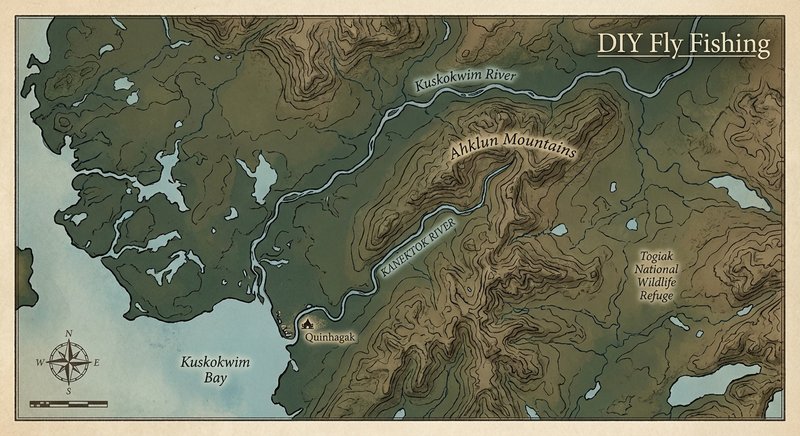
Kanektok River
Fly fishing in Alaska · Advanced · Best seasons: Summer, Fall
Target Species
Rainbow Trout, Silver Salmon, Dolly Varden
About This Water
Remote western Alaska river with excellent rainbow trout and salmon. True wilderness experience.
Fishing Recommendations
Welcome to the "Chosen River." As a guide who has spent seasons navigating the braided channels of Southwest Alaska, I can tell you that the Kanektok River is one of the most prolific fisheries on the planet. Flowing out of the Ahklun Mountains and through the Togiak National Wildlife Refuge into the Bering Sea, it offers a quintessential Alaskan experience: remote wilderness, incredible biomass, and aggressive fish.
Here is your comprehensive guide to fly fishing the Kanektok.
🎣 Location Overview
The Kanektok is approximately 90 miles of pristine water. What makes it special is its diversity of habitat. The upper river is characterized by clear, fast water and mountain scenery; the middle section features complex braids, logjams, and gravel bars; the lower river opens into long, sweeping runs influenced by the tides of the Bering Sea.
Anglers love the Kanektok because it is a "Grand Slam" river. It hosts all five species of Pacific Salmon, but it is world-renowned for its leopard-spotted Rainbow Trout and massive runs of Dolly Varden. Unlike many other Alaskan rivers that require deep sinking lines, the Kanektok is famously "user-friendly," offering incredible topwater action.
🐟 Target Species & Behavior
Leopard Rainbow Trout
These aren't your typical hatchery-influenced trout. They are heavily spotted, thick-bodied, and extraordinarily aggressive.
- Behavior: Early season, they hold in main channel seams. As salmon begin to spawn, they move behind the beds.
- The "Mouse" Factor: The Kanektok is perhaps the best river in the world to catch trout on mouse patterns. They will move 10 feet across a current to smash a skater.
Silver Salmon (Coho)
Silvers are the acrobats of the salmon world. They enter the river in massive schools, fresh from the salt, often with sea lice still attached.
- Behavior: They look for "froggy" water—sloughs, backwaters, and slow-moving inside bends. They are highly territorial and will chase down a stripped fly with a predatory instinct.
Dolly Varden
Often overlooked but incredibly beautiful (especially in their orange spawning colors), the Dollies here are numerous and large (20–28 inches).
- Behavior: They are the river’s clean-up crew. They follow the salmon runs relentlessly, gorging on eggs and flesh. You will find them in the "drop-offs" directly behind active salmon redds.
📅 Best Times to Fish
- July (Peak Rainbow & Dolly Varden): This is the prime time for "mousing." The water is generally at its most stable, and the trout are looking up before the massive egg glut begins. You’ll also catch the end of the King and Chum salmon runs.
- August (The Transition): Early August offers incredible Dolly Varden fishing. By mid-August, the Silver Salmon begin to arrive in force. This is the best month for variety.
- September (Silver Salmon & Fat Trout): The first two weeks of September are prime for Silvers. The Rainbows are at their heaviest now, feeding on salmon flesh and eggs. The weather can be "Alaskan" (windy/rainy), but the fishing is spectacular.
🪰 Recommended Flies & Techniques
For Rainbow Trout
- The Mouse: Mr. Hankey, Morrish Mouse, or White-Bellied Articulated Mouse.
- Technique: Cast tight to the overhanging willows and "skate" it across the current with a steady twitch.
- Sculpins & Streamers: Black or Olive Dali Lama, Complex Twist Buggers.
- Technique: Swing these through deep slots or strip them through woody debris.
For Silver Salmon
- Surface Patterns: Pink Pinkies, Dolly Llama (Pink/White), and the Pink Popper.
- Technique: Stripping a popper on a floating line for Silvers is the most fun you can have. Use an erratic, fast strip.
- Subsurface: Hareline’s Coho Cruiser or any weighted fly in "Fluorescent Pink" or "Chartreuse."
For Dolly Varden
- Beads: 8mm and 10mm plastic beads in "mottled orange," "peach," or "dead egg" colors.
- Technique: Indicator nymphing. You must be on the bottom. Match the color of the eggs being dropped by the specific salmon species spawning at that moment.
💡 Pro Tips & Local Knowledge
- The "Willow Slap": When mousing for trout, don't be afraid to let your fly "clack" against the overhanging willows before hitting the water. It mimics a shrew falling in, and often triggers an immediate strike.
- Follow the Smell: In late August and September, look for "Salmon Corridors." If you see a concentration of spawning Chums or Pinks, the Rainbows and Dollies are guaranteed to be 10–20 yards downstream in the deeper depressions.
- Tidal Influence: In the lower river (near the village of Quinhagak), the Silver Salmon fishing is dictated by the tides. "Fresh" fish push in on the high tide. If the fishing slows down, wait for the next push of salt-water.
- The "Dali Lama" Secret: If the mousing is slow, switch to a black-and-white Dali Lama streamer. It is a universal "meat" fly on the Kanektok that everything from 5lb Trout to 15lb Silvers will eat.
⚠️ Important Information
Access
- The Kanektok is remote. You fly into Bethel (BET) from Anchorage, then take a bush plane (usually a Cessna Caravan) to the village of Quinhagak.
- Most anglers stay at a fixed base camp (like Alaska West or Reel Action) or do a multi-day "float trip" from the headwaters at Kagati Lake.
Regulations & Permits
- License: You need a standard Alaska Sport Fishing License. If you are targeting King Salmon (June/July), you need a King Stamp.
- Gear: This is a barbless, single-hook river. Pinch your barbs before you get on the water.
- Catch and Release: Rainbow Trout are strictly catch-and-release to preserve the trophy genetics of the river.
Special Considerations
- Bear Safety: This is prime Grizzly country. They are there for the salmon. Always carry bear spray, make noise, and never keep food in your waders.
- Gear Strength: Bring an 8-weight rod for Silvers and a 6-weight for Trout/Dollies. Ensure your reels have excellent drag systems; a fresh Silver Salmon will test your equipment to its limit.
Guide’s Final Word: The Kanektok is a place of extremes. Bring the best rain gear you can afford, plenty of DEET for the bugs, and a camera—because you’re going to catch more fish here in a week than most people catch in a year.
Bug Hatches & Matching Flies
| Hatch | Type | Peak months | Time of day | Hook sizes | Matching flies |
|---|---|---|---|---|---|
| Blue-Winged Olive Baetis tricaudatus | mayfly | June, September | Afternoon | #16-20 | BWO Parachute #16-18, Pheasant Tail Nymph #16-20, RS2 #18-20 |
| Grannom Caddis Brachycentrus occidentalis | caddis | June | Afternoon/Evening | #12-16 | Peacock Caddis #14-16, Green Caddis Larva #12-14, Sparkle Pupa #14-16 |
| Chironomid Chironomidae | midge | June, July, August, September | All Day | #18-24 | Zebra Midge #18-22, Griffith's Gnat #20-22, Top Secret Midge #20-24 |
| Golden Stonefly Hesperoperla pacifica | stonefly | July | Morning/Evening | #6-10 | Pats Rubber Legs #6-10, Rogue Foam Stone #8-10, Golden Stone Nymph #8-10 |
| March Brown Rhithrogena morrisoni | mayfly | June, July | Afternoon | #12-14 | Western March Brown #12-14, Gold Ribbed Hare's Ear #12-14 |
| Spotted Sedge Hydropsyche | caddis | July, August | Evening | #14-16 | Elk Hair Caddis (Tan) #14-16, Hydropsyche Larva #14-16, Godzilla Caddis #14 |
| Mosquito Aedes spp. | terrestrial | June, July | All Day | #12-16 | Alaskan Mosquito #12-16, Gnat #14-16 |
| Yellow Sally Isoperla spp. | stonefly | July, August | Afternoon/Evening | #14-16 | Yellow Sally #14-16, Little Yellow Stone Nymph #14-16 |