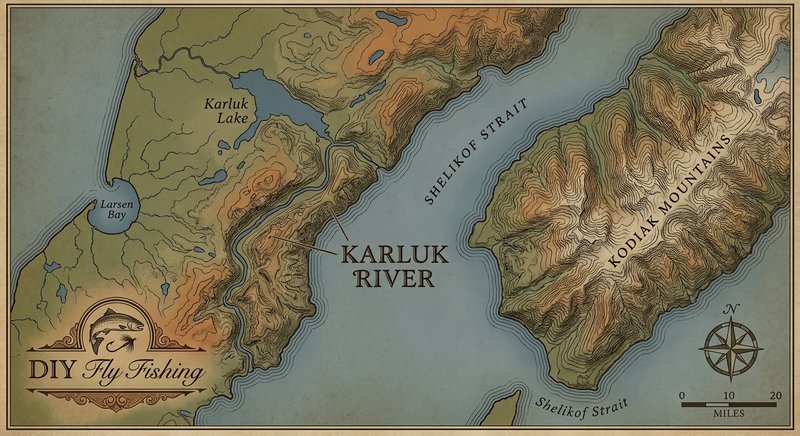
Karluk River
Fly fishing in Alaska · Advanced · Best seasons: Summer, Fall
Target Species
Silver Salmon, Pink Salmon, Steelhead
About This Water
Remote Kodiak Island river famous for its salmon runs and pristine wilderness fishing.
Fishing Recommendations
The Karluk River, located on the southwest side of Kodiak Island, is legendary among fly fishermen. Often referred to as one of the most productive salmon and steelhead systems in the world, the Karluk is a unique "lake-fed" river. It flows roughly 22 miles from Karluk Lake to the Shelikof Strait. Because it begins in a large lake, the river remains relatively clear and stable compared to the glacial, silty rivers of mainland Alaska.
🎣 Location Overview
The Karluk is a wild, remote, and visually stunning river set in the heart of the Kodiak National Wildlife Refuge. It is characterized by its tea-colored, clear water and relatively gentle gradient. Unlike many Alaskan rivers that are roaring torrents, the Karluk offers classic "riffle-pool-run" water that is extremely wade-friendly.
What makes it special is the biomass. The sheer volume of fish that push into this system is staggering. It is one of the few places where you can target chrome-bright Steelhead and aggressive Silver Salmon in the same runs during the peak of fall. The river is surrounded by rolling green tundras and is home to the highest density of Kodiak Brown Bears on the island.
🐟 Target Species & Behavior
Silver Salmon (Coho)
Silvers enter the Karluk with a "bad attitude." They are aggressive, prone to chasing flies, and famous for their acrobatic jumps.
- Behavior: They hold in "frog water," sloughs, and the soft edges of main currents. They love structure like downed logs or deep cut banks.
- Feeding: While they stop eating to spawn, their predatory instinct remains high. They respond to movement, flash, and vibration.
Pink Salmon (Humpies)
Pinks arrive in astronomical numbers during even-numbered years (though odd years still see plenty).
- Behavior: They fill every available inch of the river. They are great for beginners because they are incredibly willing to strike almost anything pink or chartreuse.
- Feeding: Aggressive strikers until they begin to "hump up" and deteriorate near spawning.
Steelhead
The Karluk hosts one of the largest runs of wild Steelhead in Alaska. These are "fall-run" fish, meaning they enter the river in September and October to overwinter before spawning in the spring.
- Behavior: Unlike the Silvers, Steelhead hold in the "classic" water—the walking-speed current at the head of a pool or the glassy tailouts.
- Feeding: They are focused on high-protein intake before the freeze. They feast on the millions of salmon eggs drifting downstream from spawning Pinks and Sockeye.
📅 Best Times to Fish
- Summer (Late July – August): Prime time for Pink Salmon and the tail end of the Sockeye run. This is "high volume" fishing where you can catch 50+ fish a day.
- Fall (September – early October): The "Grand Slam" window.
- Silvers: Peak from early September through early October.
- Steelhead: Start entering in mid-September, with the peak of the run usually occurring the last week of September through the first two weeks of October.
- Time of Day: On the Karluk, light conditions matter more than time. Overcast days are best for Silvers. For Steelhead, once the sun hits the water, they may move into deeper slots.
🪰 Recommended Flies & Techniques
For Silver Salmon
- Technique: "The Strip." Cast across and slightly downstream, letting the fly swing, then use erratic 6-inch strips.
- Flies:
- Pink/Purple Dolly Varden (weighted)
- Hareball Leech (Fuschia or Chartreuse)
- Pink Popper/Wog: On calm reaches, fishing topwater for Silvers is the ultimate thrill.
For Steelhead
- Technique: Nymphing with an indicator is the most productive method. Use a 10ft 7wt or 8wt rod. Dead-drift eggs through the riffles.
- Technique: Swinging. For the traditionalist, swinging large intruders on a Skagit head is effective in the lower river.
- Flies:
- Beads: 8mm and 10mm soft beads in "Mottled Roe" or "Orange Clear."
- Lifeliner or Glo-Bugs: Classic egg patterns.
- Intruders: Black/Blue or Pink/White for swung flies.
For Pink Salmon
- Flies: Small pink Marabou jigs or "Pink Meany" flies. Almost anything pink will work.
💡 Pro Tips & Local Knowledge
- The "Bear Factor": You are in the land of the Giants. Always carry bear spray and keep it on your person, not in your pack. When you hook a fish, be mindful; bears have learned that a splashing fish is an easy meal. If a bear approaches while you have a fish on, cut the line.
- Watch the Lagoon: The Karluk Lagoon is massive. If you are fishing the lower river, the tide affects fish movement. Fresh "chrome" fish push in on the high tide. If the fishing gets slow, wait for the tide to turn.
- Walk the Banks: Because the water is clear, you can often sight-fish for Steelhead. Instead of blind casting, walk high banks with polarized glasses to spot the dark shapes of Steelhead holding behind spawning salmon.
- The "Upper" vs "Lower": The upper river near the lake outlet is often better for Steelhead early in the season, while the lower river (near the weir) is better for fresh Silvers.
⚠️ Important Information
- Access: The Karluk is not on the road system. You must take a bush plane (floatplane) from the city of Kodiak. Most anglers stay at a wilderness lodge or book a "drop-off" float trip.
- Land Ownership: Much of the land surrounding the Karluk River is owned by Koniag, Inc. (an Alaska Native Corporation). You MUST purchase a land-use permit to step foot on the banks. Do not overlook this; it is strictly enforced.
- Regulations: Check the Alaska Department of Fish & Game (ADF&G) West Kodiak regulations. Steelhead are often catch-and-release only. Barbless hooks are highly recommended (and often required for certain species/seasons).
- Gear: Bring a high-quality 4-layer wader and a heavy-duty waterproof wading jacket. Kodiak weather is notoriously volatile—horizontal rain and 40mph winds can happen any day of the year.
Bug Hatches & Matching Flies
| Hatch | Type | Peak months | Time of day | Hook sizes | Matching flies |
|---|---|---|---|---|---|
| Midges Chironomidae | midge | April, May, September, October | All Day | #18-24 | Zebra Midge #18-22, Griffith's Gnat #20-22, Brooks Sprout Midge #20-22 |
| Blue Winged Olive Baetis spp. | mayfly | May, August, September | Afternoon | #16-20 | Parachute Adams #16-20, RS2 #18-20, Pheasant Tail #16-18 |
| American Grannom Brachycentrus | caddis | May, June | Afternoon/Evening | #12-16 | Peacock Caddis #14-16, Deep Sparkle Pupa #14-16, Elk Hair Caddis (Olive) #12-16 |
| Giant Salmonfly Pteronarcys californica | stonefly | June, July | All Day | #4-8 | Pat's Rubber Leg #4-8, Rogue River Stone #4-6, Kaufmann's Stone #6-8 |
| Spotted Sedge Hydropsyche | caddis | July, August | Evening | #14-18 | Tan Elk Hair Caddis #14-16, Holy Grail #16-18, LaFontaine's Emergent Pupa #14-16 |
| Golden Stonefly Hesperoperla pacifica | stonefly | July | Morning/Evening | #8-12 | Golden Demon #10-12, Chubby Chernobyl (Gold) #8-12, 20-Incher #10-12 |
| Little Brown Stonefly Nemouridae | stonefly | April, May | Afternoon | #14-18 | Copper John (Black/Brown) #14-16, Early Brown Stone #16-18, Hare's Ear #14-18 |
| Crane Fly Tipulidae | terrestrial | August, September | Afternoon | #8-12 | Daddy Long Legs #8-12, Crane Fly Larva #10-12 |