Kasilof River
Fly fishing in Alaska · Beginner · Best seasons: Summer, Fall
Target Species
King Salmon, Sockeye Salmon, Rainbow Trout
About This Water
Kenai Peninsula river with good salmon runs. Less crowded than neighboring Kenai.
Fishing Recommendations
Welcome to the Kasilof River—or as the locals call it, "The Big Kas." While it often sits in the shadow of its famous neighbor, the Kenai River, the Kasilof offers a more intimate, drift-boat-centric experience. As your guide, I’m here to tell you that if you prefer a quieter drift without the roar of 50-horsepower outboards, this is your river.
🎣 Location Overview
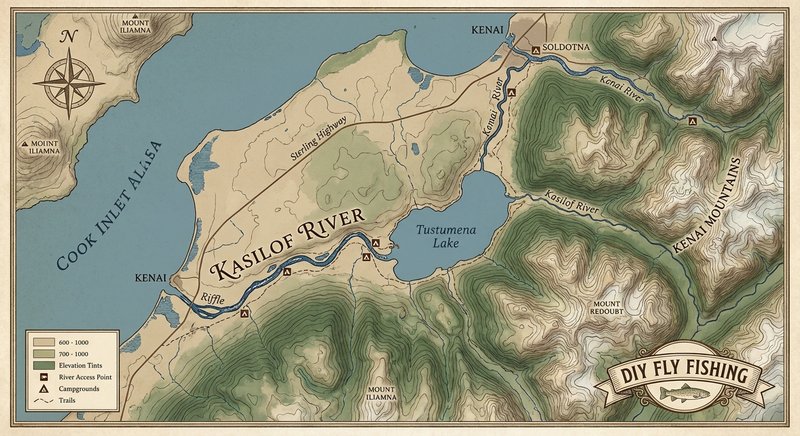
The Kasilof River flows approximately 17 miles from the massive, glacier-fed Tustumena Lake to the Cook Inlet. It is a classic glacial river—cold, silt-laden, and characterized by a milky turquoise hue.
What makes the Kasilof special is its drift-only regulation for fishing. While motors are allowed for navigation in certain areas, you cannot fish from a boat under motor power. This creates a rhythmic, peaceful pace of fishing. The river is shallower and swifter than the Kenai, featuring several sections of technical "rock gardens" that require an experienced oarsman. Anglers love it for its wild feel and the fact that the fish, particularly the Kings, often hold in shallower, more reachable water than they do in the deep channels of the Kenai.
🐟 Target Species & Behavior
King Salmon (Chinook)
- Behavior: Kasilof Kings come in two distinct runs. The early run (May–June) consists largely of hatchery-supplemented fish heading for Crooked Creek. The late run (July) features massive, wild "monsters" heading for the mainstem.
- Holding: They prefer the "seams" where fast water meets slow water and deep "slots" behind submerged boulders.
Sockeye Salmon (Red)
- Behavior: Sockeye are "bank runners." They travel in tight schools within 3 to 5 feet of the shoreline to avoid the heavy glacial current.
- Feeding: They don't actively strike flies out of hunger; rather, they are caught using the "flossing" technique as they breathe while moving upstream.
Rainbow Trout & Dolly Varden
- Behavior: These are the opportunists. In the early summer, they are lean and hungry. By late August and September, they are fat and aggressive, following the spawning salmon to gorge on eggs and decaying flesh.
- Holding: Look for them immediately behind active salmon redds (spawning beds) or in the soft water behind islands.
📅 Best Times to Fish
- Mid-May to June: Early Run Kings. This is the best time for those looking to harvest a King, as hatchery regulations are often more liberal.
- July: The "Big" Month. The late-run wild Kings arrive (catch and release is common/mandatory depending on the year) and the Sockeye run hits its peak.
- August to mid-September: The Trout Window. This is the prime time for fly anglers. As the salmon begin to spawn and die, the Rainbow and Dolly Varden fishing becomes world-class.
- Daily Window: Since the Kasilof is tidal near the mouth, the incoming tide often pushes fresh "chrome" fish into the lower river. Generally, first light is best for Kings before the sun hits the water.
🪰 Recommended Flies & Techniques
For King Salmon (Spey/Swing)
While many use conventional gear, fly anglers can find success swinging heavy sink tips.
- Fly Patterns: Large Intruders in Pink/Orange, Blue/Chartreuse, or "Black and Blue."
- Technique: Use a 9-10 weight Spey rod with a heavy Skagit head and T-14 or T-17 sink tips. Swing the fly deep and slow through the lower ends of runs.
For Sockeye Salmon (The "Kasilof Flip")
- Fly Patterns: Sparse "Russian River" flies, Coho flies, or simple Spar-fleye patterns in Red, Chartreuse, or Pink.
- Technique: Short-lining or "flossing." Use a 7-8 weight rod, a long leader (10–12 ft), and just enough weight to bounce off the bottom. You are aiming to put the line into the fish’s mouth as it travels.
For Rainbows & Dolly Varden (Nymphing)
- Fly Patterns:
- Beads: 8mm and 10mm plastic beads in "Mottled Roe," "Orange Clear," or "Peach."
- Flesh Flies: "The Bunny Leech" in white, ginger, or dirty orange (simulating decaying salmon meat).
- Technique: Dead-drift under an indicator. You must stay in the "strike zone"—right along the bottom.
💡 Pro Tips & Local Knowledge
- The Tustumena Breeze: Tustumena Lake creates its own weather. In the afternoon, a fierce wind often blows down the river valley. If you are rowing a drift boat, get your miles in early before the headwind makes the lower river a grueling "row-fest."
- Focus on the "People’s Hole": Near the confluence with Crooked Creek, there is a high concentration of hatchery Kings. While it can be crowded, it is the most productive spot for early-season Kings.
- The "Inside Out" Approach: Because the Kasilof is smaller, many anglers over-cast. For Sockeye and even Trout, the fish are often much closer to the bank than you think. Start your drifts close and work your way out.
- Glacial Visibility: The water is rarely clear. Use high-contrast flies (black/chartreuse) or highly fluorescent beads so the fish can find your offering in the silt.
⚠️ Important Information
Access
- Upper River: Take out at the "Riverbend" or "Kasilof River State Recreation Site."
- Lower River: Most drifts end at the "Truili" (Kasilof River Landing) near the Sterling Highway bridge.
- Caution: The Kasilof has several "rock gardens" (especially near the Tustumena Lodge area) that can pin a drift boat. If you aren't an experienced rower, hire a guide for your first trip.
Regulations & Permits
- Licensing: You need an Alaska Sport Fishing License and a King Salmon Stamp if you are targeting Chinook.
- Emergency Orders (EOs): Alaska ADF&G frequently changes regulations mid-season based on fish counts. Always check the ADF&G website for the "Southcentral" region before hitting the water.
- Single-Hook Only: Much of the river is restricted to single-hook, unbaited, artificial lures.
Safety
- Bears: This is brown bear country. Always carry bear spray, keep a clean camp/boat, and never splash fish blood near your landing area.
- Cold Water: The Kasilof is glacier-fed. Falling in can lead to hypothermia in minutes. Always wear a PFD while the boat is in motion.
Bug Hatches & Matching Flies
| Hatch | Type | Peak months | Time of day | Hook sizes | Matching flies |
|---|---|---|---|---|---|
| Chironomids Chironomidae | midge | May, June, September | All Day | #18-24 | Zebra Midge #18-22, Griffith's Gnat #20-22, Ice Midge #20 |
| Blue-Winged Olive Baetis spp. | mayfly | August, September | Overcast Afternoons | #16-20 | RS2 #18-20, Parachute Adams #16-20, Pheasant Tail #16-18 |
| Golden Stonefly Hesperoperla pacifica | stonefly | June, July | Morning/Evening | #6-10 | Pats Rubber Legs #6-10, Golden Rogue Stone #8-10, 20 Incher Stone #8-12 |
| Mother's Day Caddis Brachycentrus occidentalis | caddis | May, June | Afternoon | #14-16 | Peacock Caddis #14-16, Deep Sparkle Pupa #14-16, Elk Hair Caddis #14-16 |
| Spotted Sedge Hydropsyche | caddis | July, August | Evening | #12-16 | Caddis Larva (Green) #12-14, Godzilla Caddis #12-14, Soft Hackle Hare's Ear #14-16 |
| March Brown Rhithrogena morrisoni | mayfly | May | Mid-day | #12-14 | March Brown Western #12-14, Gold Ribbed Hare's Ear #12-14, March Brown Wet #14 |
| Giant Black Stonefly Pteronarcys californica | stonefly | June | Night/Early Morning | #4-8 | Kaufmann's Stone #4-8, Chubby Chernobyl #6-10, Girdle Bug #6-8 |
| Mosquito Aedes spp. | terrestrial | June, July | All Day | #12-16 | Alaska Mosquito #12-14, Royal Wulff #14-16 |