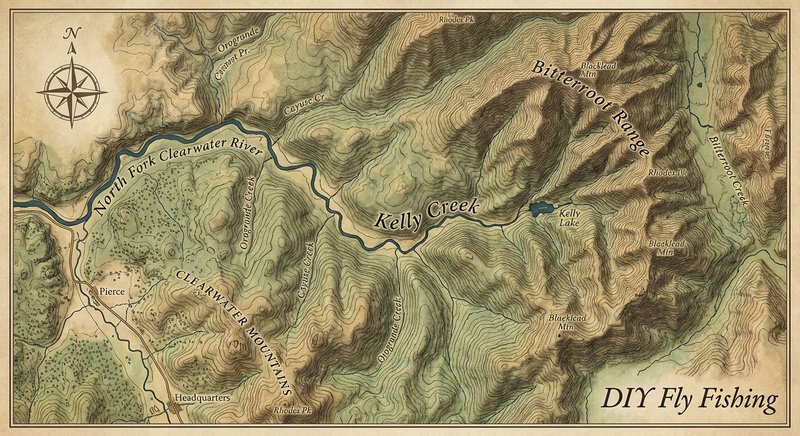
Kelly Creek
Fly fishing in Idaho · Intermediate · Best seasons: Summer, Fall
Target Species
Cutthroat Trout
About This Water
Tributary of the North Fork Clearwater. Famous catch-and-release cutthroat fishery.
Fishing Recommendations
Welcome to Kelly Creek, one of the crown jewels of Idaho’s "Blue Ribbon" waters. As a guide, I consider Kelly Creek the quintessential Westslope Cutthroat fishery. It is remote, rugged, and offers some of the most consistent dry-fly action in the lower 48.
Here is your comprehensive guide to fishing this legendary freestone stream.
🎣 Location Overview
Located in the heart of the Clearwater National Forest in North-Central Idaho, Kelly Creek is a major tributary to the North Fork of the Clearwater River. What makes it special is its history: in 1970, it became the first stream in Idaho to be managed under catch-and-release regulations, allowing the Westslope Cutthroat population to reach impressive sizes (14–20 inches).
The water is crystal clear and classic "freestone" in character—expect a mix of plunging pools, long glassy runs, and pocket water created by massive granite boulders. It is a high-mountain environment surrounded by cedar forests and steep canyons, offering a true wilderness experience.
🐟 Target Species & Behavior
The primary target here is the Westslope Cutthroat Trout. You may also encounter the occasional Bull Trout (which must be released immediately without being removed from the water) and Mountain Whitefish.
- Behavior: Cutthroat in Kelly Creek are notoriously "surface-oriented." Because the growing season is short, they are opportunistic feeders. They aren't as spooky as spring creek rainbows, but they demand a good drift.
- Where they hold: Look for the "soft" water. They love the foam lines (the "bubble line"), the cushion of water just in front of a large boulder, and the tail-outs of long pools during the evening rise.
- Feeding: They are famous for rising to large attractors, but as the season progresses and pressure increases, they can become more selective toward specific mayfly or caddis stages.
📅 Best Times to Fish
While the season officially opens in late May, the "real" fishing begins after the spring runoff.
- Summer (July – August): This is the prime window. The water drops, clears, and warms enough to trigger massive insect activity. Expect consistent dry fly action from 10:00 AM until dark.
- Fall (September – early October): This is the local favorite. The crowds vanish, the huckleberry leaves turn red, and the fish move into deeper holes to prepare for winter. The Mahogany Dun and Blue Winged Olive hatches can be spectacular.
- Best Time of Day: In mid-summer, the "morning doldrums" are real. Don't rush to the water at dawn. The best fishing usually starts around 11:00 AM when the sun hits the water and triggers insect movement.
🪰 Recommended Flies & Techniques
Top Fly Patterns
- Attractors: Royal Wulff, H&L Variant, and the Purple Haze (a Kelly Creek staple). Size 12-16.
- Terrestrials: Chernobyl Ants, Morrish Hoppers, and Dave’s Hoppers. August is "Hopper Time."
- Mayflies: Parachute Adams, Sparkle Duns (PMDs), and Mahogany Duns for fall.
- Caddis: Elk Hair Caddis (Tan or Olive) and the October Caddis (Size 8-10) for late September.
- Droppers: Copper John, Pheasant Tail, or a Perdigon (Size 14-18) trailed 2 feet behind a hopper.
Effective Techniques
- Dry-Dropper: This is the most productive method. Use a high-floating hopper or a large foam fly as your "indicator" and hang a weighted nymph below it.
- The "Skate": Cutthroats often react to movement. If a dead drift doesn't work, give your caddis or hopper a tiny twitch or "skate" it across the surface at the end of your drift to trigger a strike.
- Stealth: Even though they are aggressive, the water is gin-clear. Long leaders (9–12 feet) and 5X tippet are generally required to avoid lining the fish.
💡 Pro Tips & Local Knowledge
- The "Roadless" Area: Most people fish near the road. If you want the monsters, drive to the end of the road at the Kelly Creek Trailhead and hike in. The further you walk, the less pressure the fish see, and the more likely you are to find 18-inchers.
- The "Cushion" Cast: When fishing large boulders, don't just fish the eddy behind the rock. Cast into the "cushion" of water on the upstream face of the boulder. Large Cutthroats often sit there to get first dibs on drifting insects.
- Look for Bull Trout: If you see a 20-inch Cutthroat suddenly disappear or "spook" for no reason, there’s likely a large Bull Trout in the hole. While you cannot target them, they are a sign of a healthy ecosystem.
⚠️ Important Information
- Regulations: Kelly Creek is Catch and Release only. Barbless hooks are required (or pinched barbs). No bait is allowed.
- Access: It is a long drive on gravel roads from Pierce or Orofino, Idaho. Ensure you have a full tank of gas and a spare tire. There is no cell service.
- Wildlife: This is North Idaho wilderness. Bear spray is a must, as both black bears and grizzlies inhabit the Clearwater National Forest.
- Permits: You will need a valid Idaho Fishing License. If you are coming from out of state, you can purchase these online via the Idaho Fish and Game website.
Guide’s Final Word: Kelly Creek is a place to slow down. Don't just rush from hole to hole. Watch the water, observe the hatches, and enjoy the scenery. It’s one of the few places left where the fishing is as good as it was 50 years ago. Tight lines!
Bug Hatches & Matching Flies
| Hatch | Type | Peak months | Time of day | Hook sizes | Matching flies |
|---|---|---|---|---|---|
| Salmonfly Pteronarcys californica | stonefly | June | All Day | #4-8 | Rogue River Salmonfly #4-6, Pat's Rubber Leg Stone #6-8 |
| Golden Stonefly Hesperoperla pacifica | stonefly | June, July | Morning/Afternoon | #8-12 | Clark's Stone #8-10, Golden Twenty Incher #10-12 |
| Green Drake Drunella doddsii | mayfly | July | Afternoon | #10-12 | Hackle Stacker Green Drake #10-12, Drake Cripple #12 |
| Pale Morning Dun (PMD) Ephemerella excrucians | mayfly | June, July, August | Late Morning/Afternoon | #14-18 | Sparkle Dun #16-18, Pheasant Tail #14-18 |
| Yellow Sally Isoperla spp. | stonefly | July, August | Afternoon/Evening | #14-16 | Yellow Stimulator #14-16, Little Yellow Sloan #16 |
| October Caddis Dicosmoecus gilvipes | caddis | September, October | Afternoon/Evening | #8-12 | Orange Stimulator #8-10, Peeking Caddis #10-12 |
| Spotted Sedge Hydropsyche spp. | caddis | July, August, September | Evening | #14-16 | Elk Hair Caddis (Tan) #14-16, LaFontaine's Deep Sparkle Pupa #14-16 |
| Hopper/Terrestrials Orthoptera/Formicidae | terrestrial | August, September | Afternoon | #8-16 | Morrish Hopper #10-12, Cinnamon Ant #14-16 |