Kenai River
Fly fishing in Alaska · Intermediate · Best seasons: Summer, Fall
Target Species
King Salmon, Rainbow Trout, Dolly Varden
About This Water
World-famous for its king salmon runs. Rainbow trout, Dolly Varden, and multiple salmon species in stunning glacial waters.
Fishing Recommendations
The Kenai River is the crown jewel of Alaskan fly fishing. Known for its distinct glacial-turquoise water and world-record-sized fish, it is a high-volume river that demands respect and specific tactics. Whether you are chasing "chrome" Kings in the lower river or trophy "leopard" Rainbows in the upper stretches, the Kenai is a bucket-list destination.
🎣 Location Overview
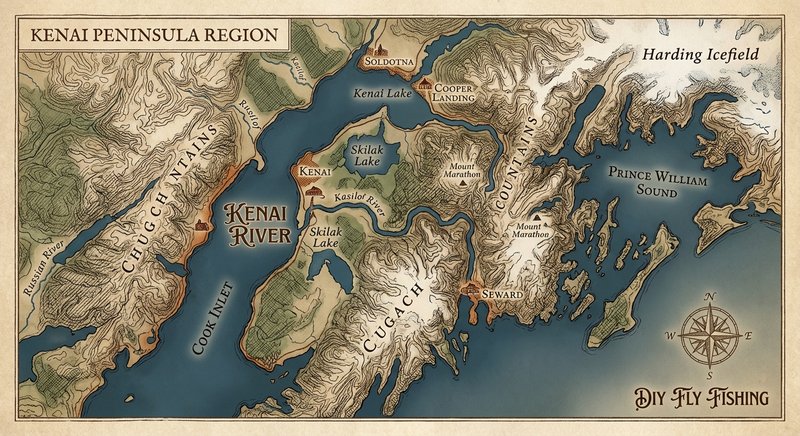
The Kenai River runs 82 miles from Kenai Lake to the Cook Inlet. It is divided into three distinct sections:
- The Upper Kenai: A "drift-only" (no motors) section from Kenai Lake to Skilak Lake. This is prime fly fishing territory, offering a mountain-valley setting and classic riffle-and-run structure.
- The Middle Kenai: From Skilak Lake down to Soldotna. This section is much larger and deeper, holding massive Rainbow Trout that move out of the lake to feast.
- The Lower Kenai: From Soldotna to the ocean. This is the land of the giants, where the heaviest King Salmon in the world are found.
The water is cold and silty due to glacial runoff, which creates low visibility. This means fish aren't "spooky" in the traditional sense, but you have to put your fly right in their faces.
🐟 Target Species & Behavior
King Salmon (Chinook)
Kenai Kings are legendary for their size (the world record 97-lb fish came from here). They enter the river in two distinct runs (May/June and July). They hold in deep, "heavy" water—usually in the main channel or behind structural breaks where they can rest. They don't feed actively in freshwater, so you are fishing for a territorial "reflex" strike.
Rainbow Trout
These are not your average trout. Because of the massive influx of protein from salmon eggs and decaying flesh, Kenai Rainbows grow to over 30 inches. They are nomadic, following the salmon runs. When salmon are spawning, the trout sit directly behind the beds (redds) to intercept drifting eggs.
Dolly Varden
Often found in the same water as Rainbows, Dollies are stunningly colored char. They are aggressive feeders and will often congregate in massive numbers in the Upper River during the late summer "egg drop."
📅 Best Times to Fish
- June – Early July: Prime time for King Salmon (Early Run) and the opening of the trout season (June 11th).
- Late July: The peak of the Late Run King Salmon. The river is crowded, but the fish are massive.
- August – September (The Golden Window): This is the "Egg Drop." As Sockeye and Pink salmon begin to spawn, the Rainbow and Dolly Varden fishing becomes world-class.
- October: The "Flesh" season. As salmon die off, trout switch from eating eggs to eating decaying salmon meat. This is the time for huge, hungry Rainbows.
🪰 Recommended Flies & Techniques
For King Salmon (The Swing)
- Patterns: Large, weighted "Intruders" in Blue/Black, Chartreuse, or Cerise. Squid-like profiles with plenty of movement.
- Technique: Use a 10-12wt Spey rod with a heavy Skagit head and T-14 or T-17 sink tips. Swing the fly deep and slow through the runs.
For Rainbows & Dollies (The "Bead" Game)
- The Pattern: 8mm to 10mm plastic beads are the gold standard. You must match the color to the stage of the salmon spawn (e.g., "Fresh Orange" when salmon are spawning, "Pale/Washout" later in the season).
- Technique: High-stick nymphing or indicator nymphing. You must use enough weight (split shot) to get the bead bouncing along the bottom.
- Flesh Flies: In late September/October, switch to "Bunny Leech" patterns in white, ginger, or "dirty" cream to mimic rotting salmon meat.
💡 Pro Tips & Local Knowledge
- Match the Bead: This is the most important rule on the Kenai. If you aren't catching fish during the spawn, change the shade of your bead. A slight shift from "Mottled Orange" to "Light Roe" can be the difference between a 50-fish day and a 0-fish day.
- The "Walking Speed" Rule: When looking for Kings or Trout, find water that moves at the speed of a brisk walk. That is the comfort zone for most Kenai fish.
- Find the Sockeye: In August, look for Sockeye Salmon splashing in the shallows. The Trout and Dollies will be 10–20 feet downstream of them.
- Short Leaders: Because the water is silty, you don't need 12-foot leaders. A 6–9 foot leader of 12lb to 15lb fluorocarbon is standard for trout to ensure you can horse them out of the heavy current.
⚠️ Important Information
- Regulations: The Kenai is highly regulated. Always check the ADF&G (Alaska Dept. of Fish & Game) Emergency Orders before fishing, as King Salmon closures can happen overnight.
- Gear Restrictions: Much of the river is "Unweighted single-hook, artificial lure only." This means no treble hooks and sometimes restrictions on where you can place your split shot.
- Boating Safety: The Kenai is a powerful, cold river. If you are rowing the Upper, be extremely careful at "Kenai Canyon" before entering Skilak Lake—it is no place for beginners.
- Bear Safety: You are in Grizzly country. Always carry bear spray, make noise, and never leave fish remains or food near your fishing spot.
- Permits: You need an Alaska Sport Fishing License and a King Salmon Stamp if you are targeting Chinook. These can be purchased online or at local shops in Soldotna or Cooper Landing.
Bug Hatches & Matching Flies
| Hatch | Type | Peak months | Time of day | Hook sizes | Matching flies |
|---|---|---|---|---|---|
| Chironomids Chironomidae | midge | March, April, May, September, October | All day | #18-24 | Zebra Midge #18-22, Griffith's Gnat #20-22, Ice Midge #20-24 |
| Blue-Winged Olive Baetis | mayfly | May, September | Mid-day | #16-20 | BWO Parachute #18-20, RS2 #18-20, Pheasant Tail #16-20 |
| Golden Stonefly Hesperoperla pacifica | stonefly | June, July | Morning/Evening | #6-10 | Pat's Rubber Leg #6-10, Chubby Chernobyl #8-10, 20 Incher Stone #8-12 |
| Spotted Sedge Hydropsyche | caddis | July, August | Late Afternoon/Evening | #12-16 | Elk Hair Caddis #14-16, Holy Grail Caddis #14-16, LaFontaine's Deep Sparkle Pupa #14-16 |
| Pale Morning Dun Ephemerella | mayfly | July, August | Mid-day | #14-18 | PMD Sparkle Dun #16-18, Military May #16-18, Split Case PMD #14-16 |
| American Grannom Brachycentrus | caddis | May, June | Evening | #14-16 | Peacock Caddis #14-16, Green Weenie #14-16, CDC Caddis Emerger #14-16 |
| Little Brown Stonefly Zapada | stonefly | April, May | Afternoon | #14-18 | Copper John #14-18, Stimulator #14-16, Hare's Ear Nymph #14-18 |
| Green Sedge Rhyacophila | caddis | August, September | All day | #10-14 | Caddis Green Larva #10-14, Breadcrust Nymph #12-14, Iris Caddis #12-14 |