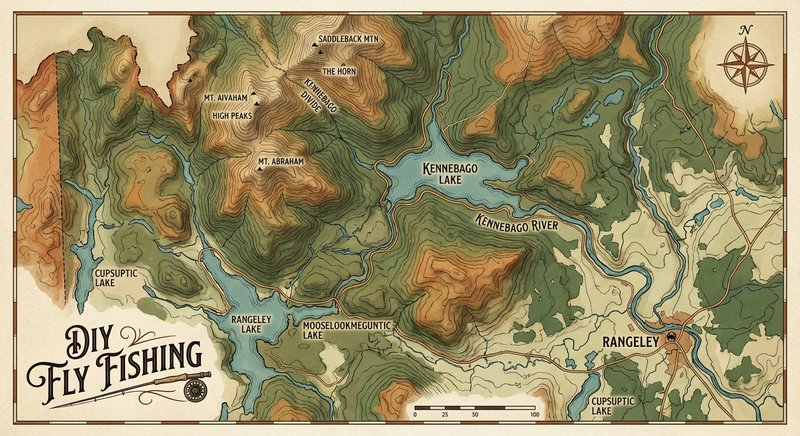
Kennebago Lake
Fly fishing in Maine · Intermediate · Best seasons: Spring, Summer, Fall
Target Species
Brook Trout, Landlocked Salmon
About This Water
Franklin County lake with brook trout and salmon. Rangeley region fishing.
Fishing Recommendations
Welcome to the legendary waters of Kennebago Lake. As a guide, I consider this "Holy Water." Located in the Western Mountains of Maine, north of Rangeley, Kennebago is a place where time seems to have stood still. It is arguably the most famous fly-fishing-only destination in the Eastern United States, boasting the largest run of wild Brook Trout in the lower 48.
Here is your comprehensive guide to fishing this iconic Maine fishery.
🎣 Location Overview
Kennebago Lake is a five-mile-long gem surrounded by the majestic peaks of the Longfellow Mountains. What makes it special is its wildness. Unlike many other lakes, Kennebago has never been stocked with hatchery fish; its Brook Trout and Landlocked Salmon are entirely native and wild.
The water is remarkably cold and clear, oxygenated by several tributaries, most notably the Kennebago River. The lake is divided into "Big Kennebago" and "Little Kennebago," connected by a slow-moving stretch of river. The area is famous for its "Fly Fishing Only" (FFO) designation, a tradition that has protected these waters for over a century.
🐟 Target Species & Behavior
Wild Brook Trout (Salvelinus fontinalis)
These aren't your average brookies. In Kennebago, fish ranging from 14 to 20 inches are common, with "trophies" reaching 3 to 5 pounds.
- Behavior: In spring, they cruise the shorelines and rocky points. As the water warms in summer, they retreat to "spring holes" or the deep thermocline. In the fall, they congregate at the river mouths in spectacular spawning colors.
Landlocked Salmon (Salmo salar sebago)
Kennebago salmon are known for their aerial acrobatics and aggressive takes.
- Behavior: They are pelagic, meaning they follow the schools of Smelt (their primary food source). They are often found near the inlets in the spring and moving into the river in September.
📅 Best Times to Fish
Spring (Ice-Out to Late June) – The Prime Window
This is the most popular time. As the ice leaves (usually mid-May), the smelt begin to spawn. Brookies and Salmon gorge themselves in the shallows.
- Conditions: High water, cool temperatures.
- Peak: The "Smelt Run" (usually the last two weeks of May).
Summer (July to August) – The Technical Season
As the lake surface warms, fish go deep.
- Conditions: Early morning and late evening are the only productive times for surface action.
- Focus: Look for "spring holes" or fish the deeper water of Big Kennebago with sinking lines.
Fall (September) – The Trophy Hunt
September is magical. The Brook Trout turn fiery orange, and the Salmon become aggressive as they prepare to spawn.
- Conditions: Cooling air, crisp mornings.
- Note: The river fishing peaks now, as fish move out of the lake and into the Kennebago River.
🪰 Recommended Flies & Techniques
Top Fly Patterns
- Streamers (The Maine Tradition):
- Grey Ghost, Black Ghost, and Mickey Finn.
- Herb Johnson’s Kennebago Smelt (A local must-have).
- Governor Aiken (Specifically for Brookies).
- Dry Flies:
- Kennebago Smut (A tiny midge pattern for flat water).
- Goddard Sedge (Great for the caddis hatches in June/July).
- Hornberg (Fished as a dry or stripped as a streamer).
- Royal Wulff & Stimulators (High visibility for riffles).
- Nymphs:
- Pheasant Tail (Size 14-18).
- Prince Nymph (Weighted).
Techniques
- Trolling Streamers: A classic Maine technique. Use a full-sinking line or a sink-tip, let out 50-70 feet of line, and paddle or motor slowly. This is the most effective way to cover water on the Big Lake.
- The "Kennebago Twitch": When fishing streamers from a stationary boat or shore, use a jerky, erratic retrieve to mimic a wounded smelt.
- Dead Drifting: In the river sections, traditional nymphing with a strike indicator works well, but don't overlook "swinging" a soft-hackle wet fly through the tail-outs.
💡 Pro Tips & Local Knowledge
- The Log Yard: Focus your efforts near the "Log Yard" area and the mouth of the Kennebago River. These are natural staging areas for fish moving between the lake and the river.
- Little Kennebago: If the wind is howling on the Big Lake, head to Little Kennebago. It’s smaller, more sheltered, and feels like a massive trout pond. It’s perfect for canoes and kayaks.
- Watch the Loons: If you see loons diving repeatedly in one area, they are on a school of smelt. The Salmon and Trout are almost certainly right underneath them.
- The "Smutting" Rise: You will often see fish rising to nearly invisible midges on a glass-calm lake. This is "smutting." Use a 6x or 7x tippet and a size 22 midge—it’s frustrating but rewarding fishing.
⚠️ Important Information
Access
Kennebago is unique because it is behind a private gate.
- Vehicle Access: You generally must be a guest at Grant’s Kennebago Camps or Kennebago Lake Camps, or own a cabin, to drive behind the gate.
- Public Access: You can bike or hike in from the gate, but it is a long haul. Most anglers find staying at the camps is the best way to truly experience the water.
Regulations & Permits
- Fly Fishing Only (FFO): No lures, no bait. No exceptions.
- Barbless Hooks: While not always strictly required by state law in every inch, it is highly encouraged and often required by the local camps to protect the wild population.
- License: A valid Maine freshwater fishing license is required.
- Boats: Be aware of "Internal Combustion Engine" bans in certain sections (especially Little Kennebago and the upper river).
Special Considerations
- Moose Safety: The Kennebago River Road is famous for moose. Drive slowly, especially at dawn and dusk.
- Weather: The weather in the Rangeley area can change in minutes. Always carry a rain shell and be prepared for "whitecaps" on the Big Lake if the wind kicks up.
Guide’s Final Word: Kennebago is a place of reverence. Treat the fish with respect, practice catch and release on the large spawners, and take a moment to put the rod down and listen to the loons. There is nowhere else like it.
Bug Hatches & Matching Flies
| Hatch | Type | Peak months | Time of day | Hook sizes | Matching flies |
|---|---|---|---|---|---|
| Hendrickson Ephemerella subvaria | mayfly | May, June | Mid-afternoon | #12-14 | Red Quill #12-14, Hendrickson Nymph #12-14, Hendrickson Emerger #12-14 |
| Hex Hexagenia limbata | mayfly | June, July | Dusk and Night | #6-8 | Hexagenia Dry #6-8, Hex Nymph #6-8, Wiggle Hex #6-8 |
| Green Drake Ephemera guttulata | mayfly | June | Late Afternoon/Evening | #8-10 | Green Drake Paradox #8-10, Green Drake Cripple #10, Coffin Fly #8-10 |
| Blue-Winged Olive Baetis spp. | mayfly | May, September, October | Late Morning/Afternoon | #18-22 | BWO Sparkle Dun #18-20, Pheasant Tail #18-22, RS2 #20-22 |
| Grannom Caddis Brachycentrus spp. | caddis | May | Morning/Evening | #14-16 | Grannom Pupa #14-16, Elk Hair Caddis (Dark) #14-16 |
| Light Cahill Stenacron / Stenonema | mayfly | June, July, August | Evening | #12-14 | Light Cahill Dry #12-14, Gold Ribbed Hare's Ear #14 |
| Flying Ants Formicidae | terrestrial | August, September | Afternoon | #16-20 | Black Flying Ant #16-18, Cinnamon Ant #18-20 |
| Quill Gordon Epeorus pleuralis | mayfly | May | Mid-day | #12-14 | Quill Gordon Dry #12-14, Quill Gordon Wet Fly #12-14 |
| Spotted Sedge Hydropsyche | caddis | June, July, August | Evening | #14-18 | LaFontaine's Deep Sparkle Pupa #14-16, Tan Elk Hair Caddis #14-18 |
| Alder Fly Sialis spp. | caddis | June, July | All Day | #10-12 | Alder Fly #10-12, Dark Montana Nymph #10-12 |