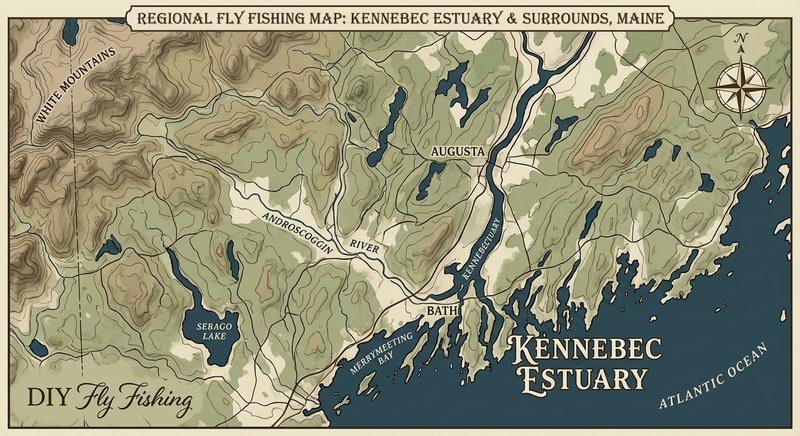
Kennebec Estuary
Fly fishing in Maine · Intermediate · Best seasons: Summer, Fall
Target Species
Striped Bass, Bluefish
About This Water
Mid-coast estuary with striped bass. Also bluefish and mackerel.
Fishing Recommendations
As an expert fly fishing guide who has spent years navigating the complex currents of the Pine Tree State, I can tell you that the Kennebec Estuary is the crown jewel of New England saltwater fly fishing. This isn't just a river mouth; it is a massive, complex system where the power of the Atlantic meets the drainage of roughly one-third of Maine.
Here is your comprehensive guide to fly fishing the Kennebec Estuary.
🎣 Location Overview
The Kennebec Estuary is a "hydrologic marvel." Located primarily between the city of Bath and the open ocean at Popham Beach, it is characterized by the meeting of six different rivers (including the Kennebec and Androscoggin) into the Merrymeeting Bay, which then flushes through a narrow, rocky canyon known as the Lower Kennebec.
What makes it special is the sheer volume of water. The tides here are massive (8–10 foot swings), creating "river-within-the-ocean" conditions. You’ll find everything from expansive sandy flats and salt marshes to deep, turbulent rocky "gates" and ledges. Anglers love it because it offers a diverse range of fishing—you can sight-fish a sand flat in 2 feet of water in the morning and dredge a 40-foot deep ledge in a 5-knot current in the afternoon.
🐟 Target Species & Behavior
Striped Bass (Stripers)
The undisputed king of the Kennebec.
- Behavior: They are highly migratory. In the early season, they push up-river into the fresh water to feed on spawning alewives. In the summer, they settle into "stations"—ledges, points, and flats.
- Holding Spots: Look for "seams" where fast water meets slow water, boulder fields, and the edges of eelgrass beds.
- Feeding: They are opportunistic but can become selective. They hunt river herring (early), sand eels (on the flats), and "mackerettes" or silversides (late season).
Bluefish
The "Yellow-Eyed Devils" usually arrive in late July or August.
- Behavior: Aggressive, fast-moving, and destructive. They often "blitz" baitfish on the surface, creating a chaotic froth.
- Feeding: They will eat anything that moves. If you see birds diving and water churning like a washing machine, it’s likely Blues.
📅 Best Times to Fish
Optimal Seasons
- June (The Migration): High numbers of fish, including large "cows," follow the river herring upstream. This is peak season for big fish.
- July & August (Summer Patterns): The flats fishing peaks. Early mornings and late evenings are essential as the midday sun can push fish deep.
- September & October (The Fall Blitz): Fish begin staging for their southern migration. They feed heavily to bulk up. This is the best time for surface action and Bluefish.
Prime Windows
- Tide is Everything: In the Kennebec, "No flow, no go." The outgoing tide is generally preferred, as it flushes baitfish out of the marshes and into the waiting mouths of bass.
- Time of Day: Low light is your friend. Dawn and dusk are prime. However, for sight-fishing the flats (like those near Popham or Morse Mountain), a high sun between 10 AM and 2 PM is actually helpful for visibility.
🪰 Recommended Flies & Techniques
Top Fly Patterns
- The Hollow Fleye / Deceiver (Size 2/0 - 4/0): White/Chartreuse or Blue/White. Mimics larger baitfish like alewives.
- Clouser Minnow: The "all-purpose" fly. Tan/White mimics sand eels; Chartreuse/White for stained water.
- Gurglers & Bob’s Bangers: For heart-stopping surface strikes.
- Ray’s Fly: A classic Maine epoxy-style fly that mimics small silversides perfectly.
Effective Techniques
- Intermediate Lines: The workhorse for the Kennebec. It keeps the fly just under the surface in the current.
- Fast Sinking (350-500 grain): Necessary for fishing the "Hell Gates" or deep channels where the current is ripping. You need to get the fly down to the "strike zone" near the rocks.
- The "Swing": Cast across the current, let the line belly, and allow the fly to swing through the seam—much like steelhead fishing.
💡 Pro Tips & Local Knowledge
- The "Hell Gates": The area around the Sasanoa River junction and Upper/Lower Hell Gate features intense whirlpools and standing waves. If you are in a boat, be extremely careful. If you are on shore, fish the eddies behind the massive boulders.
- Back-Eddy Logic: In high-current areas, big stripers sit in the "dead water" right behind a rock or point. Cast into the fast water and let your fly drift into the calm pocket.
- Match the Hatch: If you see "micro-bait" (tiny 1-inch fish), don't throw a 6-inch Deceiver. Downsize to a small #4 Clouser or a Crease Fly.
- The "Popham" Walk: For shore anglers, walking the beach at Popham at low tide allows you to reach the "Fox Island" area. Fish the troughs between the sandbars.
⚠️ Important Information
Access
- Boat Ramps: The Bath Town Landing (under the bridge) and the Phippsburg (Basin) ramp are the primary access points.
- Shore Access: Popham Beach State Park is world-class but gets crowded with swimmers in summer. Fort Popham offers great rocky shore access.
Regulations & Permits
- Saltwater Registry: You MUST register with the Maine Saltwater Recreational Fishing Registry (usually $1–$2 or included with a freshwater license).
- Striped Bass Rules: Maine has strict "Slot Limit" laws. Currently, it is generally 1 fish between 28" and less than 31". Circle hooks are required when using bait, though not for flies. Always check the latest MDMR (Maine Dept. of Marine Resources) updates before heading out.
Safety
- The Current: The Kennebec is no joke. The current can exceed 5-6 knots. Ensure your motor is reliable and your wading belt is tight.
- Fog: Maine's "Pea Soup" fog can roll in in minutes. If you are in a boat, a GPS/Chartplotter is a life-saving piece of equipment.
Tight lines, and remember: Watch the birds—they’ll find the fish before you do!
Bug Hatches & Matching Flies
| Hatch | Type | Peak months | Time of day | Hook sizes | Matching flies |
|---|---|---|---|---|---|
| Hex (Giant Mayfly) Hexagenia limbata | mayfly | June, July | Dusk/Night | #4-8 | Hexagenia Dry #6-8, Wiggle Nymph #6-10 |
| Hendrickson Ephemerella subvaria | mayfly | May | Afternoon | #12-14 | Red Quill #12-14, Hendrickson Emerger #14 |
| Blue Winged Olive Baetis | mayfly | May, September, October | Mid-day/Overcast | #18-22 | BWO Parachute #18-22, RS2 #20 |
| Spotted Sedge Hydropsyche | caddis | June, July | Evening | #14-16 | Elk Hair Caddis #14-16, LaFontaine's Deep Sparkle Pupa #14-16 |
| Slate Drake Isonychia bicolor | mayfly | July, August, September | Afternoon/Evening | #10-12 | Isonychia Parachute #10-12, Zug Bug #10-12 |
| Midges Chironomidae | midge | April, May, September, October | Anytime/Morning | #20-24 | Zebra Midge #20-22, Griffith's Gnat #20-24 |
| Carpenter Ants Camponotus | terrestrial | June, July | Afternoon | #10-16 | Black Foam Ant #12-16, Chernobyl Ant #10-12 |
| Light Cahill Stenacron canadense | mayfly | June, July | Evening | #12-14 | Light Cahill #12-14, Gold Ribbed Hare's Ear #12-14 |
| White Miller Ephoron leukon | mayfly | August | Dusk | #12-14 | White Wulff #12-14, White Miller Soft Hackle #14 |