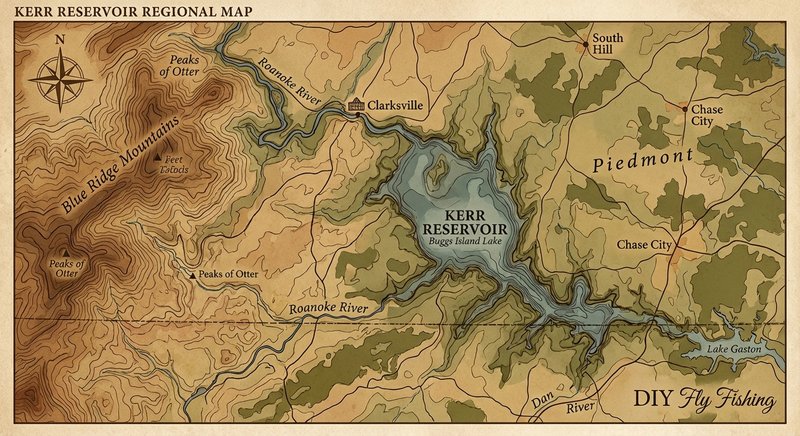
Kerr Reservoir
Fly fishing in Virginia · Intermediate · Best seasons: Spring, Summer, Fall
Target Species
Largemouth Bass, Striped Bass, Crappie
About This Water
Virginia-NC border lake with excellent bass fishing. Striped bass and crappie.
Fishing Recommendations
Welcome to Kerr Reservoir, known to every local as Buggs Island Lake. As your guide, I can tell you that this is one of the most formidable warm-water fly fishing destinations in the Mid-Atlantic. Straddling the Virginia-North Carolina border, this 50,000-acre behemoth offers over 800 miles of shoreline, much of it wild and undeveloped.
While many consider this "gear-chunker" territory, a fly angler who understands water fluctuations and shad migrations can have career-defining days here.
🎣 Location Overview
Kerr Reservoir is a massive impoundment of the Roanoke and Dan Rivers. It is characterized by its "red clay" banks, vast fields of flooded timber, and—most importantly—"The Buckbrush" (willow bushes).
What makes it special for the fly angler is the variety. You can be casting a 3-weight for slab crappie in a quiet cove one hour and double-hauling an 9-weight for schooling Stripers on a main-lake point the next. The water clarity varies from "chocolate milk" in the upper river arms to relatively clear near the dam.
🐟 Target Species & Behavior
Largemouth Bass
Kerr is a legendary bass fishery. These fish are highly attuned to the water level.
- Behavior: When the lake level is high (above 300'), bass move deep into the flooded willow bushes.
- Forage: They primary target Gizzard and Threadfin Shad, but also feast on bluegill and crawfish.
Striped Bass (Rockfish)
These are landlocked monsters. Unlike their saltwater cousins, they spend much of their time following massive schools of shad in open water.
- Behavior: In spring, they migrate up the Roanoke and Dan rivers to spawn. In summer and fall, they "school up" and push baitfish to the surface in "blow-ups."
Crappie
Buggs Island is arguably the best crappie lake in the region.
- Behavior: They are structure-oriented. Look for them on bridge pilings, submerged brush piles, and docks. During the spring spawn, they move into 2–4 feet of water, making them perfect targets for a fly rod.
📅 Best Times to Fish
- Spring (March – May): The Trophy Window. This is when the Stripers run up the rivers (March/April) and the Largemouth and Crappie move into the shallows to spawn (April/May).
- Summer (June – August): Focus on the first two hours of daylight and the last hour before dark. Night fishing under bridge lights can be incredible for Stripers and Crappie.
- Fall (September – November): The "Shad Kill" and migration. As temperatures drop, shad move into the backs of creeks. The bass and stripers follow them in a feeding frenzy.
- Prime Conditions: A stable or slowly rising water level is ideal. Rapidly dropping water pushes fish out of the cover and makes fly fishing significantly harder.
🪰 Recommended Flies & Techniques
For Largemouth Bass
- Flies: BoogleBugs (size 4) in yellow or white for topwater; Gamechangers (white/chartreuse) to mimic shad; Dahlberg Divers for working the edges of the bushes.
- Technique: "Bush Whacking." Use a heavy 8-weight rod with a weedless fly. Cast deep into the flooded willows, let it sit, and give it a sharp "pop."
For Striped Bass
- Flies: Clouser Minnows (Chartreuse/White or Grey/White) are the gold standard. Hollow Fleyes or Bob's Banger (foam popper) when they are busting bait on top.
- Technique: Use an Intermediate or Type 3 Sinking line. Stripers rarely sit on the bottom; they suspend. Look for birds diving on bait and cast into the "boils."
For Crappie
- Flies: Crappie Candy, Micro-Woolly Buggers (size 8-10) in pink, white, or chartreuse.
- Technique: Use a 3-weight or 4-weight rod with a slow-sinking tip. Retrieve with very short, erratic strips near submerged timber or dock pilings.
💡 Pro Tips & Local Knowledge
- The "Full Pool" Rule: If the lake level is at or above 300 feet (above sea level), the fish will be in the "Buckbrush." This is the most fun you can have with a fly rod—flipping weedless poppers into bushes just like you're fishing for snook in mangroves.
- The River Run: In late March, head to the Staunton River State Park area. The Stripers and White Bass congregate here for the spawn. Large streamers swung through the current can result in 20-lb fish on the fly.
- Watch the Wind: Because the lake is so large, wind can create dangerous swells. Always have a "leeward" creek planned as a backup.
- Blue Line Hunting: After a rain, look for the "mud line" where dirty water meets clear water. Predators sit on the clear side of this line to ambush bait drifting out of the murk.
⚠️ Important Information
- Access: There are dozens of boat ramps. Occoneechee State Park (Clarksville, VA) is the central hub and offers great access to the mid-lake area. North Bend Park is excellent for fishing near the dam.
- Regulations: Virginia and North Carolina have a reciprocal license agreement. You can fish the main body of the lake with a valid license from either state. However, this does not apply to the tributary rivers above the main lake.
- Safety: This is a "stump" lake. If you are operating a boat, stay in the marked channels until you are in a cove. Submerged trees can be just inches below the surface and will ruin a lower unit (or a kayak hull) quickly.
- Check the Levels: Always check the USACE Wilmington District website for current lake levels before heading out.
Tight lines, and remember: at Buggs Island, if you aren't getting your fly stuck in a willow bush occasionally, you aren't fishing where the big ones live!
Bug Hatches & Matching Flies
| Hatch | Type | Peak months | Time of day | Hook sizes | Matching flies |
|---|---|---|---|---|---|
| Giant Mayfly (Hex) Hexagenia limbata | mayfly | June, July | Evening/Night | #6-10 | Hexagenia Spinner #6-8, Burrowing Mayfly Nymph #8-10 |
| White Mayfly Ephoron leukon | mayfly | August, September | Evening | #12-14 | White Wulff #12-14, White Miller #12 |
| Chironomids (Midges) Chironomidae | midge | March, April, October | All Day | #18-24 | Zebra Midge #18-22, Griffith's Gnat #20-24 |
| Damselfly Enallagma | terrestrial | June, July, August | Afternoon | #10-14 | Adult Damsel #10-12, Marabou Damsel Nymph #12-14 |
| Cicadas Magicicada / Neotibicen | terrestrial | July, August | Daytime | #4-8 | Project Cicada #6-8, Foam Cicada #6 |
| Trico Tricorythodes | mayfly | July, August, September | Morning | #20-24 | Trico Spinner #20-24, RS2 #22 |
| Cinnamon Caddis Hydropsyche | caddis | May, June | Evening | #14-16 | Elk Hair Caddis #14-16, Pupa Sparkle Caddis #16 |
| Blue-Winged Olive Baetis | mayfly | March, April, October, November | Afternoon | #18-22 | BWO Parachute #18-20, Pheasant Tail #18-22 |