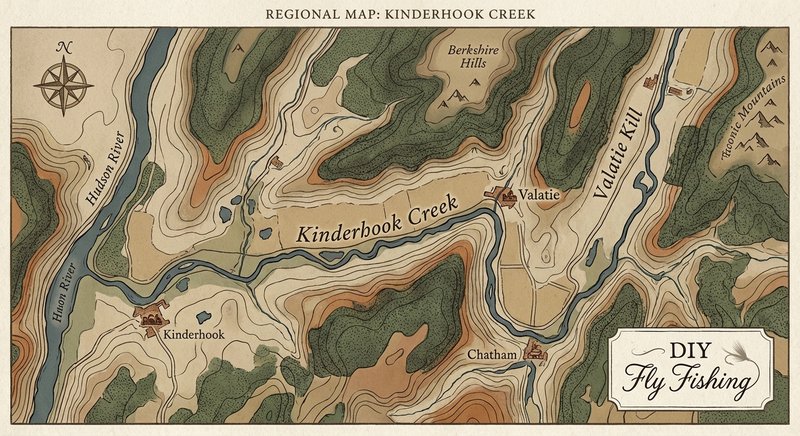
Kinderhook Creek
Fly fishing in New York · Beginner · Best seasons: Spring, Summer, Fall
Target Species
Brown Trout, Rainbow Trout
About This Water
Columbia County stream with wild brown trout. Good fishing in scenic Hudson Valley.
Fishing Recommendations
Welcome to one of the "hidden gems" of the Capital Region and Upper Hudson Valley. As your guide, I’m excited to walk you through Kinderhook Creek. While it may not have the international fame of the nearby Beaverkill or Delaware, the Kinderhook is a classic New York freestone stream that offers exceptional fishing for those who know how to read its moods.
🎣 Location Overview
Kinderhook Creek flows through Rensselaer and Columbia Counties, originating near the Massachusetts border and winding its way toward the Hudson River. It is a quintessential Northeast freestone stream characterized by a mix of fast-moving pocket water, long glassy glides, and deep, dark pools carved into shale and limestone.
What makes the Kinderhook special is its diversity of character. The upper sections near Stephentown feel like a mountain brook—cold, tumbling, and intimate. As it moves toward Malden Bridge and Valatie, it widens into a substantial river with big-water challenges. It offers a "Catskill-style" experience without the crushing crowds often found further south.
🐟 Target Species & Behavior
The Kinderhook is primarily managed as a brown trout fishery, though you will find plenty of rainbows, especially in the spring.
- Brown Trout: These are the kings of the creek. You’ll find a mix of heavily stocked fish and a surprising number of "holdovers" that have survived several seasons. These holdovers become dark, buttery, and incredibly wary. They tuck tight into undercut banks, beneath overhanging hemlocks, and at the very head of deep pools.
- Rainbow Trout: Mostly stocked in the spring, these fish are more opportunistic. Look for them in the faster "oxygenated" water—the riffles and the "white water" at the top of runs.
- Behavior: In the spring, fish are hungry and aggressive. By mid-summer, the "Kinderhook Ph.D." trout emerge; they will inspect your 6X tippet and refuse anything that doesn't have a perfect dead drift.
📅 Best Times to Fish
Spring (April – June)
- The Window: This is the prime time. Once the spring runoff subsides (usually late April), the insect activity explodes.
- Conditions: Look for water temps to hit the 50°F mark for the best action.
- Peak: The Hendrickson hatch in early May is legendary here, followed by the March Browns and Sulfurs in late May and June.
Summer (July – August)
- The Window: Early mornings (dawn until 10:00 AM) and "the magic hour" at dusk.
- Warning: As a freestone stream, the lower Kinderhook can get too warm for trout in mid-summer (over 70°F). During this time, head to the shaded, spring-fed upper reaches near Stephentown or focus on the mouth of colder tributaries.
Fall (September – October)
- The Window: After the first few frosts have cooled the water.
- Conditions: This is streamer season. Brown trout become aggressive as they prepare to spawn. The colors of the foliage reflecting off the water make this the most beautiful time to be on the creek.
🪰 Recommended Flies & Techniques
Dry Flies
- Mayflies: Adams (Standard and Parachute) #12-18, Hendrickson #12-14, Light Cahill #14, Sulfur #16-18.
- Caddis: Elk Hair Caddis (Tan or Olive) #14-16.
- Terrestrials: In late summer, don't overlook a #14 Black Ant or a #10-12 Foam Grasshopper dropped tight to the banks.
Nymphs
The Kinderhook is a nymph-heavy stream for 80% of the day.
- Patterns: Pheasant Tail #14-18, Gold-Ribbed Hare’s Ear #12-16, Prince Nymph #12-14, and Zebra Midges #18-20.
- Pro Tip: Use a Pat’s Rubber Legs (Stonefly nymph) in black or brown as your "lead" fly in a two-nymph rig.
Streamers
- Patterns: Woolly Buggers (Olive or Black) #6-10, Black Nose Dace, and Muddler Minnows.
- Technique: "Swing and strip." Cast toward the far bank, let it swing through the current, and give it short, erratic strips as it reaches the soft water.
💡 Pro Tips & Local Knowledge
- The "Stephentown Stretch": If the lower river is high or muddy from rain, the upper sections near Stephentown clear faster and stay much cooler. This is the place to be during a heatwave.
- The Shale Shelves: Much of the Kinderhook bottom is made of shale shelves. Trout love to sit in the "slots" between these shelves. If you aren't bouncing your nymph along the bottom of these slots, you're fishing over the fish's heads.
- Stealth Matters: Because the water can get very clear in the summer, long leaders (9-12 feet) and light tippets (5X or 6X) are essential. Approach pools from downstream to avoid casting a shadow over the fish.
- Check the Gauge: Check the USGS gauge at West Lebanon or Kinderhook. If the flow is spiking, the water will be turbid; if it's dropping and clearing, it's game on.
⚠️ Important Information
Access
New York State has purchased many Public Fishing Rights (PFR) along the Kinderhook. Look for the yellow and black "Public Fishing Stream" signs.
- Key Access Points: Route 66, Route 43, and several bridges in Stephentown, New Lebanon, and Malden Bridge have pull-offs.
- Map Resource: Use the NYS DEC "DECinfo Locator" map to find exact PFR boundaries.
Regulations
- Licensing: A valid New York State Freshwater Fishing License is required for everyone 16 and older.
- Limits: While most of the Kinderhook falls under statewide inland trout regulations (5 fish/day, any size), practicing Catch and Release is highly encouraged to protect the holdover population.
- Special Zones: Always check the latest NYS DEC syllabus for any recent changes to "Artificial Lures Only" or "Catch and Release" sections, though most of the Kinderhook is open to general regs.
Safety
The rocks in the Kinderhook are notorious for being slippery. Studded wading boots and a wading staff are highly recommended, especially in the swifter sections near the "Step" or falls.
Tight lines, and enjoy the beauty of Columbia County!
Bug Hatches & Matching Flies
| Hatch | Type | Peak months | Time of day | Hook sizes | Matching flies |
|---|---|---|---|---|---|
| Blue-Winged Olive (BWO) Baetis / Acerpenna | mayfly | April, October, November | Late Morning/Afternoon | #18-22 | BWO Sparkle Dun #18-22, Pheasant Tail Nymph #18-20, RS2 #20-22 |
| Hendrickson Ephemerella subvaria | mayfly | April, May | Afternoon | #12-14 | Red Quill #12-14, Hendrickson Parachute #14, Hendrickson Wet Fly #12-14 |
| Grannom Caddis Brachycentrus | caddis | April, May | All Day/Evening | #14-16 | LaFontaine's Deep Sparkle Pupa #14-16, Elk Hair Caddis (Green body) #14-16, Peacock Caddis #16 |
| March Brown Maccaffertium vicarium | mayfly | May, June | Mid-day/Afternoon | #10-12 | March Brown Parachute #10-12, Gold Ribbed Hare's Ear #10-12, March Brown Wet Fly #12 |
| Sulphur Ephemerella invaria / dorothea | mayfly | May, June | Evening | #14-18 | Sulphur Parachute #14-18, Pheasant Tail (Flashback) #16-18, Sulphur Spinner #14-16 |
| Tan Caddis Hydropsyche | caddis | June, July, August | Morning/Evening | #14-18 | Tan Elk Hair Caddis #14-18, Holy Grail Caddis Pupa #16, X-Caddis #14-16 |
| Slate Drake Isonychia bicolor | mayfly | June, September | Afternoon/Evening | #10-14 | Isonychia Parachute #12-14, Zug Bug #10-12, Prince Nymph #12-14 |
| Light Cahill Stenacron / Stenonema | mayfly | June, July | Evening | #14-16 | Light Cahill (Traditional) #14-16, Cream Usual #14-16, Gold Ribbed Hare's Ear (Light) #14-16 |
| Terrestrials (Ants/Beetles) Formicidae / Coleoptera | terrestrial | July, August, September | All Day | #12-20 | Cinnamon Ant #16-20, Black Gurgle Pop #12-14, Crowe Beetle #14-16 |