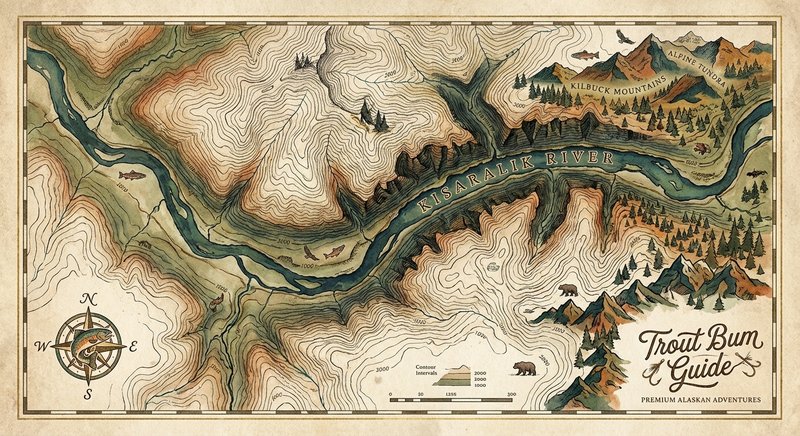
Kisaralik River
Fly fishing in Alaska · Advanced · Best seasons: Summer, Fall
Target Species
Rainbow Trout, Silver Salmon, Arctic Grayling
About This Water
Western Alaska wilderness float with rainbow trout and salmon. Remote adventure.
Fishing Recommendations
The Kisaralik River is one of Alaska’s true wilderness gems. Flowing through the Togiak National Wildlife Refuge in Southwestern Alaska, it offers a quintessential "expedition" style fly fishing experience. It is a river of contrast, starting in the rugged Kilbuck Mountains and winding nearly 100 miles through tundra and boreal forest before reaching the Kuskokwim River delta.
As your guide, here is the breakdown for tackling this remote Alaskan masterpiece.
🎣 Location Overview
The Kisaralik is celebrated for its remoteness and diversity of water. Unlike the more crowded rivers of the Bristol Bay drainage, the Kisaralik offers a solitude that is hard to find elsewhere.
- Character: The upper river is clear, swift, and mountainous with classic riffle-and-pool structures. As it moves downstream, it becomes heavily braided with countless side channels, logjams, and gravel bars.
- The Appeal: Anglers come here for the "Leopard" Rainbow Trout—heavily spotted, vibrant fish that are among the most beautiful in the world—and the thrill of a multi-day wilderness float.
- The Experience: This is almost exclusively a float-trip river. You aren't just fishing; you are navigating a wild ecosystem teeming with grizzly bears, moose, and bald eagles.
🐟 Target Species & Behavior
Leopard Rainbow Trout
- Behavior: These are resident fish, not migratory. In early summer, they are aggressive streamer eaters. By mid-to-late summer, they become "egg-junkies," positioning themselves directly behind spawning Salmon to intercept drifting eggs.
- Holding Water: Look for the "drop-off" at the tail of a gravel bar where Salmon are actively spawning. They also hide under "sweepers" (fallen trees) along the banks.
Silver Salmon (Coho)
- Behavior: Arriving in August, Silvers are the acrobats of the river. They are highly aggressive and will often chase a fly across the surface.
- Holding Water: They prefer "soft" water—sloughs, back eddies, and the slow-moving water near the mouth of side channels. They avoid the heavy mid-river current.
Arctic Grayling
- Behavior: The "Sailfish of the North." They are opportunistic and will rise for dry flies even when there isn't a visible hatch.
- Holding Water: Look for the "seams" where fast and slow water meet, and the glassy tails of pools.
📅 Best Times to Fish
- July (Early Season): Best for Arctic Grayling and high-volume Rainbow Trout on streamers or mouse patterns. The weather is generally milder, and the days are endlessly long.
- August (Peak Season): This is the transition month. Early August is prime for Rainbows and Dolly Varden gorging on Salmon eggs. By mid-to-late August, the Silver Salmon begin their push.
- September (Late Season): The prime window for Silver Salmon and the largest Rainbow Trout. The trout are at their fattest, feeding on "flesh" (decaying salmon). Note: The weather becomes volatile—expect rain and cold winds.
🪰 Recommended Flies & Techniques
For Rainbow Trout
- Technique: Nymphing with beads or swinging/stripping streamers.
- Flies:
- Beads: 8mm and 10mm plastic beads in "mottled orange" or "peach" (matching the Salmon spawn).
- Flesh Flies: "Ginger" or "White" bunny strips (resembling decaying salmon meat).
- Mouse Patterns: Mr. Hankey or the Morrish Mouse. Skating a mouse against the bank is the most exhilarating way to catch a Leopard Rainbow.
For Silver Salmon
- Technique: Stripping streamers or "wogging."
- Flies:
- Pink/Purple Hareball Leeches: Silvers love pink.
- Pink Softies: Weighted flies to get down in the sloughs.
- Pink Pink Wog: A foam surface fly. Stripping this across the surface causes explosive strikes.
For Arctic Grayling
- Technique: Dry fly presentation.
- Flies: Elk Hair Caddis, Parachute Adams, or Black Gnats (Size 12-16).
💡 Pro Tips & Local Knowledge
- The "Mouse" Factor: Don't wait for evening to fish a mouse. In Alaska, Rainbows will crush a mouse in the middle of a sunny day. Cast tight to the overhanging willows and "chug" it back.
- The Kisaralik Falls: There is a major Class III/IV rapid (the Falls) about 1/3 of the way down. Most DIY floaters portage this. Never run it without scouting; it has claimed rafts and gear.
- Find the "Kitchen": When Salmon are spawning, the river becomes a "kitchen." If you find a group of bright red Sockeye or Chum on a redd, the Rainbows and Dollies are guaranteed to be 5–10 feet downstream in the deeper water.
- The Braids: In the middle section, the river splits into dozens of channels. The smaller, "skinny" side channels often hold the best Rainbows because they are overlooked by less experienced anglers.
⚠️ Important Information
- Access: This is a fly-in, fly-out destination. You typically take a bush plane (Cessna 206 or DeHavilland Beaver) from Bethel, Alaska. Logistics are expensive and require advance planning.
- Regulations:
- The Kisaralik has specific Single-Hook, No-Bait restrictions to protect the wild trout populations.
- Rainbow Trout are generally catch and release only to preserve the "Leopard" genetics.
- Check current ADF&G (Alaska Dept. of Fish and Game) emergency orders before your trip.
- Bear Safety: This is high-density Brown Bear country. You must practice strict camp hygiene. Keep a clean kitchen, store food in bear-proof containers away from sleeping areas, and always carry bear spray or a firearm.
- Gear:
- Rods: 5wt or 6wt for Grayling/Trout; 8wt for Silvers.
- Clothing: High-quality Gore-Tex waders and a heavy-duty wading jacket. Even in July, hypothermia is a risk if you get wet.
Bug Hatches & Matching Flies
| Hatch | Type | Peak months | Time of day | Hook sizes | Matching flies |
|---|---|---|---|---|---|
| Giant Salmonfly Pteronarcys californica | stonefly | June, July | All day | #4-8 | Chubby Chernobyl #6-8, Pats Rubber Legs #4-8 |
| Blue Winged Olive Baetis | mayfly | June, August, September | Midday | #16-20 | Parachute Adams #16-20, RS2 #18-20 |
| Yellow Sally Isoperla | stonefly | July, August | Afternoon/Evening | #12-16 | Yellow Sally Foam Dry #14-16, Iron Lotus #14-16 |
| Green Sedge Rhyacophila | caddis | July, August | Evening | #12-16 | LaFontaine's Deep Sparkle Pupa #14-16, Elk Hair Caddis #12-16 |
| Midges Chironomidae | midge | May, June, July, August, September | Morning/Evening | #18-24 | Zebra Midge #18-22, Griffith's Gnat #20-22 |
| Golden Stonefly Hesperoperla pacifica | stonefly | July | Afternoon | #8-12 | Golden Twenty-Incher #8-12, Rogue River Stone #8-10 |
| Grannom Caddis Brachycentrus | caddis | June, July | Morning/Evening | #14-16 | Peacock Caddis #14-16, Holy Grail #14-16 |
| October Caddis Dicosmoecus | caddis | August, September | Afternoon | #8-12 | Orange Stimulator #8-12, Morrish October Caddis Pupa #10-12 |