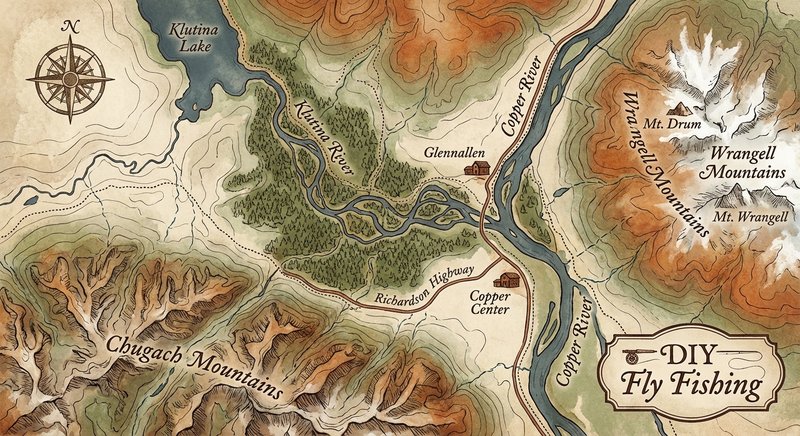
Klutina River
Fly fishing in Alaska · Intermediate · Best seasons: Summer
Target Species
Sockeye Salmon, King Salmon
About This Water
Copper River tributary with excellent sockeye fishing. Road accessible from Copper Center.
Fishing Recommendations
The Klutina River is not for the faint of heart. Located in Copper Center, Alaska, it is legendary among fly anglers for two things: its incredible runs of massive Salmon and its treacherous, high-velocity glacial water. As a guide, I tell clients that the Klutina is a "power" river—everything here is faster, heavier, and more intense than your typical trout stream.
Here is your comprehensive guide to mastering the Klutina.
🎣 Location Overview
The Klutina River is a major tributary of the Copper River. It originates from Klutina Lake and drops rapidly over its 25-mile course to the confluence. What makes it special is its gradient. It is one of the fastest-flowing rivers of its size in North America.
The water is "glacial milk"—a turquoise-grey hue filled with fine silt (glacial flour). This means visibility is low (usually less than 12 inches), which dictates how we fish. The river is characterized by large boulders, heavy "sweepers" (fallen trees), and a current that can easily knock an unprepared wader off their feet. Anglers love it because it offers a legitimate shot at 50lb+ King Salmon and a world-class Sockeye run in a rugged, spectacular setting.
🐟 Target Species & Behavior
Sockeye (Red) Salmon
- Behavior: Sockeye do not "feed" once they enter the river. However, they travel in massive schools, hugging the riverbanks to find the path of least resistance against the heavy current.
- Holding: They stay within 3–6 feet of the shore in the "soft" water. If you are wading waist-deep, you are likely standing on the fish.
- Feeding: They are caught via the "flossing" technique (explained below), though they will occasionally strike out of aggression.
King (Chinook) Salmon
- Behavior: These are some of the hardest-fighting fish on the planet. They are aggressive and territorial.
- Holding: Kings prefer deeper "slots," the edges of main channels, and the "tailouts" of large pools. They look for structure (large boulders) that breaks the current.
- Feeding: They will strike large, flashy flies out of pure territorial aggression.
📅 Best Times to Fish
- Optimal Months: Late June through early August.
- Sockeye Window: The first run typically arrives in mid-June, but the prime "Second Run" is July 10th – July 31st. This is when the river is black with fish.
- King Window: July is the month. The season usually closes on July 31st (check ADF&G for emergency orders). The peak is typically the second and third weeks of July.
- Best Time of Day: First light (around 3:00 AM in the Alaskan summer) is the "golden hour." Salmon move more freely during low light before the sun hits the water.
🪰 Recommended Flies & Techniques
Sockeye Techniques: "The Alaska Flip"
Since Sockeye aren't actively feeding and visibility is low, we use a technique called the "Klutina Flip" or flossing.
- The Setup: A 8-weight or 9-weight rod, a heavy sink-tip or weighted line, and a long leader (6–10 feet) of 20lb-25lb fluorocarbon.
- The Fly: Sparse is better. Use Sockeye Specials, Coho Flies, or even just a hook with a small bit of chartreuse or orange yarn.
- Technique: Cast out at a 45-degree angle, let the weight hit the bottom, and let the current sweep the line across the "highway" of fish hugging the bank. When the line tightens, set the hook!
King Salmon Techniques: Swinging Big Junk
- The Setup: 10-weight to 12-weight rods. If using a Spey rod, you need a heavy Skagit head with T-14 or T-17 sinking tips to get the fly down in the fast water.
- The Fly: Intruders, Prom Dress, or Bunny Leaches in hot pink, chartreuse, or "Black & Blue." They need to be big (3–5 inches) and weighted with lead eyes.
- Technique: The "Swing." Cast across the current, mend hard upstream to let the fly sink, then let it swing through the holding slot. Hold on tight—a King strike on the swing feels like a freight train.
💡 Pro Tips & Local Knowledge
- Don't Over-Wade: I cannot stress this enough. For Sockeye, stand on the bank or in ankle-deep water. For Kings, the current is incredibly dangerous. If you fall in the Klutina, the silt in your waders and the current speed make self-rescue very difficult.
- Heavy Gear is Mandatory: This is not the place for your 5-weight trout rod. You need high-quality reels with "stopping power" drags. A Klutina King will peel 100 yards of backing off in seconds if it gets into the main current.
- The "Ahtna" Land factor: Much of the riverbank is owned by the Ahtna Native Corporation. You must purchase an Ahtna day-use permit to fish from their lands. Most guides and locals fish the areas near the Richardson Highway Bridge or access via jet boat.
- The "Lead" Secret: Because the water is so fast, fly line alone often won't get you deep enough. Many locals use "slinky weights" or split shot above their flies to ensure they are bouncing off the bottom.
⚠️ Important Information
- Regulations: The Klutina falls under the Upper Copper River/Upper Upper Susitna River regulations. King Salmon rules change annually based on escapement counts. Always check the Alaska Department of Fish & Game (ADF&G) website for Emergency Orders before you head out.
- Permits: You need an Alaska State Fishing License AND a King Salmon Stamp if you are targeting Chinook.
- Bears: This is high-density Brown Bear (Grizzly) country. They are there for the salmon just like you. Carry bear spray, make noise, and never leave your fish or bags unattended on the bank.
- Fish Handling: If you plan on keeping Sockeye, have a cooler with ice ready. The glacial water is cold, but the Alaskan sun can be warm, and Sockeye meat spoils quickly.
Guide’s Final Word: The Klutina is a "workhorse" river. It’s loud, it’s fast, and it’s physically demanding. But when you hook into a 40-pound King or a limit of fresh Sockeye, there is nowhere else on earth you’d rather be. Tight lines!
Bug Hatches & Matching Flies
| Hatch | Type | Peak months | Time of day | Hook sizes | Matching flies |
|---|---|---|---|---|---|
| Giant Salmonfly Pteronarcys californica | stonefly | June, July | All Day | #2-6 | Pats Rubber Legs #4-8, Rogue River Stone #4-6, Bitch Creek #6-8 |
| Golden Stonefly Hesperoperla pacifica | stonefly | July, August | Afternoon/Evening | #8-12 | Golden Twenty-Incher #8-12, Chubby Chernobyl (Gold) #8-10, Kaufmanns Stone #8-12 |
| Blue-Winged Olive (BWO) Baetis tricaudatus | mayfly | May, September | Mid-day/Afternoon | #16-20 | Parachute Adams #16-20, Pheasant Tail #18-20, RS2 #18-22 |
| Chironomids (Midges) Chironomidae | midge | April, May, September | Morning | #18-24 | Zebra Midge #18-22, Griffith's Gnat #20-22, Black Beauty #20-24 |
| Grannom Caddis Brachycentrus occidentalis | caddis | June | Evening | #12-16 | Elk Hair Caddis #14-16, Peacock Caddis #12-16, Holy Grail #14-16 |
| Little Black Stonefly Capniidae | stonefly | April, May | Mid-day | #14-18 | Prince Nymph #14-18, Black Sparkle Dun #16-18 |
| Yellow Sally Isoperla spp. | stonefly | July, August | Evening | #14-16 | Yellow Sally Dry #14-16, Little Yellow Sloan #14-16 |
| Spotted Sedge Hydropsyche spp. | caddis | August, September | Evening | #12-14 | Hydropsyche Larva #12-14, Goddard Caddis #12-14 |