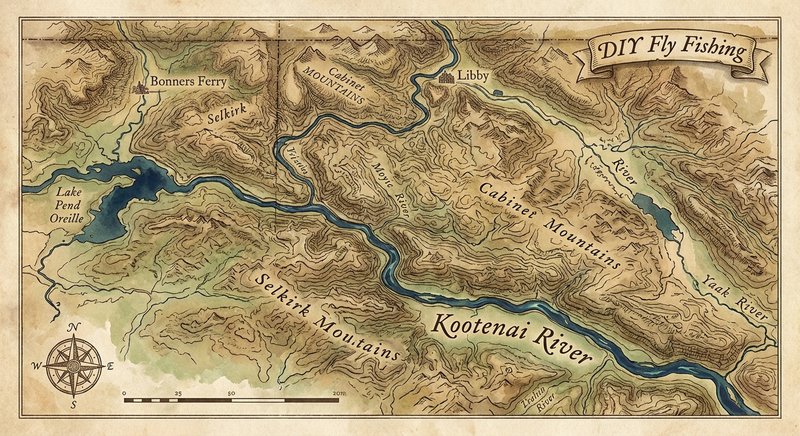
Kootenai River
Fly fishing in Idaho · Intermediate · Best seasons: Spring, Summer, Fall
Target Species
Rainbow Trout, Bull Trout
About This Water
Below Libby Dam with large rainbow trout. Idaho's northernmost quality trout fishery.
Fishing Recommendations
The Kootenai River in the Idaho Panhandle is one of the most underrated blue-ribbon fisheries in the American West. Flowing out of the Libby Dam in Montana, it enters Idaho as a massive, powerful tailwater that winds through the spectacular Cabinet and Selkirk Mountains.
As your guide, I’m here to tell you: if you like big water, hard-fighting wild trout, and the chance to hook into a true river monster, the Kootenai is your destination.
🎣 Location Overview
The Kootenai is a "big shoulder" river. Unlike the intimate spring creeks of the South, the Idaho stretch of the Kootenai is wide, deep, and majestic. It is characterized by massive boulder gardens, long glassy slicks, and heavy riffles.
What makes it special is its wildness. While the river is tailwater-influenced (via Libby Dam), by the time it reaches Idaho, it feels like a massive freestone. It is home to the Columbia River Redband Trout, a subspecies of rainbow known for its vibrant lateral line and legendary fighting endurance. Because the river is so large, it is best fished from a drift boat or a jet boat, though limited wading is possible during low-flow periods.
🐟 Target Species & Behavior
Columbia River Redband (Rainbow) Trout
These are the stars of the show. They are exceptionally hardy and prefer fast, highly oxygenated water.
- Holding Water: Look for "heavy" water—the seams between fast and slow currents, the heads of deep pools, and right against the rocky banks.
- Behavior: They are aggressive opportunistic feeders. They are famous for "smashing" dries rather than sipping them.
Bull Trout
The Kootenai is one of the few places where you can consistently find these apex predators.
- Holding Water: Bullies prefer deep, dark holes and the confluences where colder tributaries enter the main stem.
- Behavior: They are piscivorous (fish-eaters). If you hook a 10-inch whitefish and a "log" suddenly starts chasing it, that’s a Bull Trout. They are often targeted with large, articulated streamers.
📅 Best Times to Fish
Spring (March – May)
- Conditions: Before the high-country runoff begins.
- Highlights: The Skwala Stonefly hatch in late March and April is the first major dry fly event of the year. Blue Winged Olives (BWO) are also prolific on overcast days.
Summer (July – September)
- Conditions: This is the prime window. Flows stabilize after runoff.
- Highlights: July brings the Golden Stoneflies and Caddis. By August, it’s Terrestrial Season. High-floating foam hoppers and ants fished tight to the banks provide some of the most exciting visual takes of the year.
Fall (Late September – November)
- Conditions: Cooling water temperatures and thinning crowds.
- Highlights: The October Caddis (massive orange flies) emerge. This is also the best time for "Streamer Junkies" to target large Rainbows and Bull Trout as they become more aggressive before winter.
🪰 Recommended Flies & Techniques
Dry Fly Fishing (The Local Favorite)
The Kootenai is a "big fly" river. You don't often need 7X tippet and a size 24 midge.
- Patterns: Chubby Chernobyl (Gold, Olive, Purple), Morrish Hopper, Elk Hair Caddis (Size 12-16), and the Purple Haze.
- Technique: "Twitching" the fly. On the Kootenai, a little movement on the fly often triggers a strike from a Redband.
Nymphing
When the fish aren't looking up, go deep.
- Patterns: Pat’s Rubber Legs (Black/Tan), Prince Nymphs, and San Juan Worms (especially after rain).
- Technique: Use a long leader (9-12ft) with a heavy indicator. You need to get the fly down quickly in the heavy current.
Streamer Stripping
- Patterns: Galloup’s Sex Dungeon, Sparkle Minnows, and White Zonkers.
- Technique: Use a sink-tip line. Cast toward the bank or into deep eddies, and use a "strip-strip-pause" retrieve to mimic a wounded sculpin or whitefish.
💡 Pro Tips & Local Knowledge
- The "Inside Out" Approach: Because the river is so wide, many anglers try to cast to the middle. Don't. 90% of the fish are within 15 feet of the bank, hiding in the "cushion" created by boulders and logs.
- Watch the Flows: Check the USGS flow rates for Libby Dam. If the dam is "ramping up" (increasing flow), fishing can turn off. If flows are steady or dropping, the fishing is usually lights-out.
- The "Purple" Rule: For some reason, fish in the Kootenai love purple. Whether it’s a Purple Haze or a Purple Chubby, always have something violet in your box.
- Target the "Seams": Look for where fast water meets slow water. Redbands sit in the slow water and dart into the fast water to grab food.
⚠️ Important Information
Access
- Boating: High-clearance boat ramps are available at Deep Creek and Bonners Ferry.
- Wading: Wading is difficult and can be dangerous due to the river's volume. Stick to the gravel bars near the bridge in Bonners Ferry or the public access points along Highway 2.
Regulations
- License: An Idaho fishing license is mandatory.
- Bull Trout: They are a protected species under the ESA. While you can catch them in the Idaho stretch, you must release them immediately. Do not take them out of the water for photos.
- Barbless Hooks: Highly recommended to ensure the survival of the wild Redband population.
Special Considerations
- Safety: This is a powerful river. Always wear a PFD (Life Jacket) if you are in a boat. The water is cold year-round; hypothermia is a real risk if you take a spill.
- Wildlife: This is North Idaho. Grizzly bears and moose are common along the riverbanks. Carry bear spray and be aware of your surroundings.
The Kootenai isn't a river that gives up its secrets easily, but for the angler who masters its heavy currents, the rewards are some of the strongest, most beautiful trout in the world. Tight lines!
Bug Hatches & Matching Flies
| Hatch | Type | Peak months | Time of day | Hook sizes | Matching flies |
|---|---|---|---|---|---|
| Blue Winged Olive Baetis tricaudatus | mayfly | March, April, September, October | Afternoon | #16-22 | BWO Sparkle Dun #18-20, RS2 #18-22, Pheasant Tail #16-20 |
| Pale Morning Dun Ephemerella excrucians | mayfly | June, July, August | Late Morning/Afternoon | #14-18 | PMD Parachute #16-18, Split Case PMD #16-18, Quigley Cripple #14-16 |
| Skwala Stonefly Skwala americana | stonefly | March, April | Afternoon | #8-12 | Bullet Head Skwala #10-12, Pat's Rubber Leg #8-12, Skwala Chubby Chernobyl #12 |
| Golden Stonefly Hesperoperla pacifica | stonefly | June, July | Morning/Evening | #6-12 | Water Walker #8-10, Girdle Bug #6-10, Golden Chubby #8-12 |
| Spotted Sedge Hydropsyche spp. | caddis | July, August, September | Evening | #14-18 | Elk Hair Caddis #14-16, LaFontaine's Deep Sparkle Pupa #14-16, X-Caddis #16-18 |
| Western March Brown Rhithrogena morrisoni | mayfly | April, May | Afternoon | #12-14 | March Brown Parachute #12-14, Gold Ribbed Hare's Ear #12-14, Soft Hackle March Brown #14 |
| Mother's Day Caddis Brachycentrus occidentalis | caddis | May | Mid-day/Evening | #14-16 | Peacock Caddis #14-16, Z-Wing Caddis #14-16, Iris Sedge #14-16 |
| Trico Tricorythodes spp. | mayfly | August, September | Morning | #20-24 | Trico Spinner #20-24, Sunken Trico Spinner #22, Drowned Trico #22 |
| Grasshoppers Acrididae | terrestrial | August, September | Late Morning/Afternoon | #6-12 | Morrish Hopper #8-12, Pantone Hopper #10-12, Dave's Hopper #10-14 |
| Midges Chironomidae | midge | January, February, March, November, December | All Day | #18-24 | Griffith's Gnat #18-22, Zebra Midge #18-22, Morgan's Midge #20-22 |