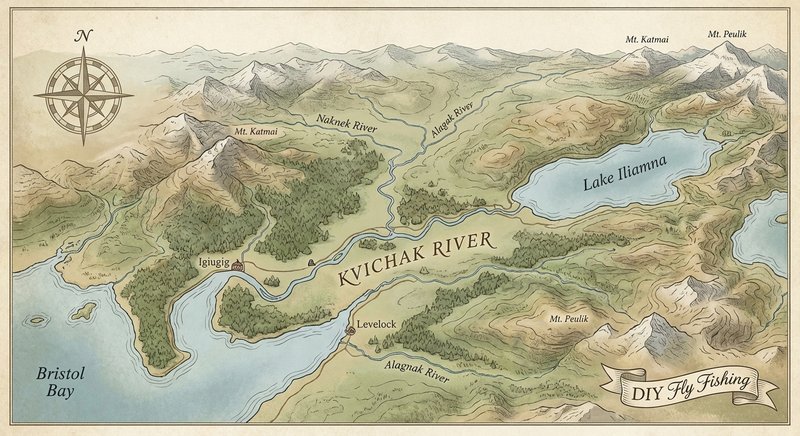
Kvichak River
Fly fishing in Alaska · Intermediate · Best seasons: Summer, Fall
Target Species
Sockeye Salmon, Rainbow Trout, Arctic Char
About This Water
Bristol Bay giant draining Iliamna Lake. Massive sockeye runs and trophy rainbows.
Fishing Recommendations
The Kvichak River (pronounced kwee-jack) is widely considered the crown jewel of the Bristol Bay watershed. Flowing roughly 50 miles from Lake Iliamna—Alaska’s largest freshwater lake—to Kvichak Bay, this river is the primary artery for the world’s largest Sockeye salmon run. For a fly angler, it represents one of the few places on earth where you can legitimately target "Grand Slam" caliber Rainbow Trout, often exceeding 30 inches, in a pristine wilderness setting.
🎣 Location Overview
The Kvichak is a "big water" river. Unlike the narrow, technical creeks of the interior, the Kvichak is wide, powerful, and remarkably clear. Because it is lake-fed, the water remains stable and filtered, offering exceptional visibility even when other area rivers are blown out by rain.
What makes it special is its role as a biological corridor. Millions of Sockeye salmon must pass through the Kvichak to reach their spawning grounds in Lake Iliamna. This massive influx of biomass fuels an ecosystem that produces some of the fastest, strongest, and largest "leopard" Rainbow Trout in the world. The river transitions from a deep, swift main channel near the village of Igiugig to a complex network of braided channels and gravel bars further downstream.
🐟 Target Species & Behavior
Sockeye Salmon (Red Salmon)
The Kvichak is the Sockeye capital of the world. They arrive in staggering numbers.
- Behavior: They are focused on upstream migration. They do not actively feed once they enter freshwater, but they are highly territorial and will "snap" at flies.
- Holding: They hug the banks to stay out of the heaviest current. Look for "black water"—massive schools so dense the river bottom disappears.
Rainbow Trout
The "Iliamna strain" Rainbows are legendary. These are not your average stream trout; they are shaped like footballs and fight like steelhead.
- Behavior: Their behavior shifts with the season. In early summer, they hunt salmon smolt migrating to the sea. In late summer/fall, they become sedentary "egg vacuum cleaners," sitting behind spawning salmon.
- Holding: Look for them in the "braids," behind active salmon beds (redds), and in the soft seams near heavy current.
Arctic Char
Vibrant, beautiful, and often overlooked.
- Behavior: Similar to Rainbows, they follow the food. They are often found in the tail-outs of runs and in the slightly deeper, slower water of the braided sections.
- Feeding: They are highly opportunistic, feeding on eggs, nymphs, and small fish.
📅 Best Times to Fish
- June to Early July (The Smolt Run): This is for the streamer enthusiast. As millions of salmon smolt migrate from the lake to the ocean, the Rainbows congregate at the river mouth to gorge. Expect explosive takes on the surface and mid-column.
- July (Sockeye Peak): This is the window for Sockeye. The river is alive with red fish. It is high-energy, high-volume fishing.
- August to September (The Egg & Flesh Window): This is Prime Time for trophy Rainbow Trout and Arctic Char. As salmon begin to spawn and die, the trout key in exclusively on salmon eggs and "flesh" (decaying salmon meat).
- Time of Day: In the land of the midnight sun, "time of day" matters less than tide (in the lower river) and light bush-plane schedules. However, low-light conditions often bring the biggest trout out of the deep holes into shallower riffles.
🪰 Recommended Flies & Techniques
For Sockeye Salmon
- Technique: The "Kvichak Flip" (flossing). Use a heavy sink tip or split shot to get the fly to the bottom quickly.
- Flies: Sparsely tied patterns. Montana Red Eye, Sockeye Special, or a simple size 4-6 Gamakatsu hook with a bit of pink or chartreuse crystal flash.
For Rainbow Trout & Char
- The "Bead" (Late July–Sept): This is the most effective method in Alaska. Using a 6mm or 8mm plastic bead painted to match the color of natural salmon eggs (from "fresh orange" to "washed-out peach").
- Technique: Nymphing under an indicator, dead-drifting precisely behind spawning salmon.
- Streamers (June–Early July): Thunder Creek Smolt, Zirdles, and Sculpzilla. Use a sink-tip line and swing these through the current or strip them erratically.
- Flesh Flies (September): Large, ginger or white "bunny" flies that mimic decaying salmon meat. The "Battle Bunny" is a local favorite.
💡 Pro Tips & Local Knowledge
- Find the "Nervous Water": When targeting Sockeye, look for ripples on the surface near the banks that move upstream. These are moving pods.
- The Braids are Gold: While the main stem is impressive, the braided sections (where the river splits into multiple smaller channels) offer the best wading and the most concentrated trout fishing.
- Wade With Caution: The Kvichak is deceptively powerful. The bottom is mostly "golf ball to bowling ball" sized rocks that can be slippery. A wading staff is not optional here—it’s a necessity.
- Match the Egg: Carry a variety of bead colors. The trout can be incredibly picky. If you aren't getting hits behind a pod of spawning salmon, change your bead color or size. Look at the real eggs in the water to match the stage of development.
⚠️ Important Information
Access
The Kvichak is remote. Access is almost exclusively via floatplane from Anchorage or King Salmon. Most anglers stay at fly-out lodges (like those in Igiugig or nearby) or use a jet-boat taxi service.
Regulations & Permits
- License: You need a valid Alaska Sport Fishing License. If you target King Salmon (though rare on the main Kvichak), you need a King Stamp.
- Trout Regulations: The Kvichak is largely Catch and Release for Rainbow Trout to preserve the trophy genetics.
- Gear: Single-point barbless hooks are highly recommended (and often required in certain sections) to protect the fish.
Bear Safety
You are in the heart of Brown Bear country. They are there for the salmon just like you.
- Always give bears the right of way.
- Carry bear spray and know how to use it.
- Never leave fish or food unattended on the bank.
Gear Recommendations
- Rods: 7 or 8-weight for Sockeye (they are incredibly strong); 6 or 7-weight for Rainbows and Char.
- Layers: Even in July, temperatures can drop into the 40s with rain and wind. High-quality GORE-TEX waders and jackets are mandatory.
Bug Hatches & Matching Flies
| Hatch | Type | Peak months | Time of day | Hook sizes | Matching flies |
|---|---|---|---|---|---|
| Blue-Winged Olive (BWO) Baetis tricaudatus | mayfly | May, September | Late Morning/Afternoon | #16-20 | BWO Parachute #16-18, RS2 #18-20, BWO Emerger #16-18 |
| Chironomids Chironomidae | midge | May, June, August | All Day | #18-24 | Zebra Midge #18-22, Griffith's Gnat #18-22, Ice Midge #20 |
| American Grannom Brachycentrus occidentalis | caddis | June, July | Evening | #14-16 | Elk Hair Caddis (Dark) #14-16, Peacock Caddis #16, Deep Sparkle Pupa #14-16 |
| Golden Stonefly Hesperoperla pacifica | stonefly | June, July | Morning/Afternoon | #6-10 | Pat's Rubber Legs #6-8, Golden Rogue Stone #8-10, Kaufmann's Stone #6-10 |
| Pale Morning Dun (PMD) Ephemerella excrucians | mayfly | July, August | Midday | #14-18 | PMD Sparkle Dun #16-18, Pheasant Tail Nymph #14-18, PMD Quigley Cripple #16 |
| Black Fly Simuliidae | midge | June, July, August | All Day | #18-22 | Black Fly Larva #18-20, Beadhead Midge Larva #20-22 |
| Spotted Sedge Hydropsyche | caddis | July, August, September | Evening | #12-16 | Godzilla Caddis #12-14, Holy Grail Caddis #14-16, E C Caddis #14-16 |
| Brown Dun Ameletus | mayfly | June, July | Afternoon | #12-14 | Ameletus Nymph #12-14, Adams #12-14 |