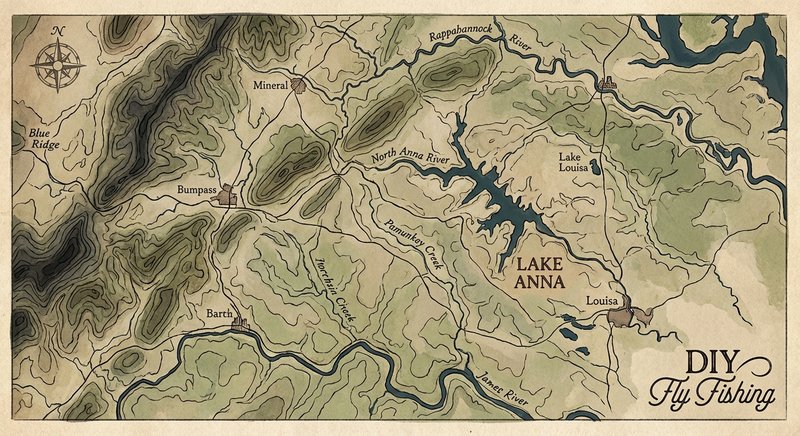
Lake Anna
Fly fishing in Virginia · Intermediate · Best seasons: Spring, Summer, Fall
Target Species
Largemouth Bass, Striped Bass, Crappie
About This Water
Central Virginia reservoir with diverse fishing. Largemouth bass and striped bass.
Fishing Recommendations
Welcome to Lake Anna, Virginia, one of the largest freshwater reservoirs in the Commonwealth. As a fly fishing guide, I view Lake Anna as a unique "tale of two lakes." Because it serves as a cooling source for the North Anna Nuclear Generating Station, the lake is divided into the Public Side (main lake) and the Private Side (the "warm" side).
For the fly angler, Lake Anna offers a massive playground of structure, willow grass, and hard-fighting species that translate beautifully to a long rod.
🎣 Location Overview
Lake Anna spans over 13,000 acres with over 200 miles of shoreline. What makes it special for fly fishing—aside from its sheer size—is the diversity of habitat. You’ll find rocky points, thousands of boat docks, deep channels, and most importantly, extensive beds of willow grass.
The water is generally clear to stained, depending on recent rainfall and your proximity to the headwaters of the North Anna and Pamunkey arms. While it is a popular recreational lake, its complex shoreline offers plenty of "skinny water" bays and coves where a fly fisher can find solitude and hungry fish.
🐟 Target Species & Behavior
Largemouth Bass
The king of the lake. Anna’s bass are highly structure-oriented. In the spring, they move into the willow grass and under docks to spawn. During summer and fall, they transition to deeper points and submerged brush piles, but they will always return to the shallows during low-light hours to feed on bluegill and threadfin shad.
Striped Bass (and Hybrids)
Lake Anna is heavily stocked with Striped Bass and some Hybrids. These are nomadic schoolers. They follow the "bait balls" of shad. In the spring and fall, they can be found busting bait on the surface in the mid-lake region. In the heat of summer, they drop into the thermocline (20–30 feet deep).
Crappie
Often overlooked by fly fishers, Anna has a massive population of "slabs." They hold tight to submerged timber, bridge pilings, and the "dark" corners of boathouses. They are highly responsive to small, flashy streamers that mimic minnows.
📅 Best Times to Fish
- Spring (March – May): The Prime Window. This is when the fish are shallowest. As water temps hit 55°F, bass move to the willow grass. April is the peak for the spawn.
- Summer (June – August): Early bird gets the worm. You must be on the water at daybreak. The topwater bite lasts about 90 minutes. After that, you'll need sinking lines to reach fish in 10-15 feet of water.
- Fall (September – November): As temps drop, shad migrate to the backs of coves. Bass and Stripers follow them. This is the best time for "blitz" fishing where you see birds diving and fish boiling on the surface.
- Best Times of Day: Dawn and dusk are mandatory for topwater. On the "Private Side," winter fishing is actually excellent because the water stays 15 degrees warmer.
🪰 Recommended Flies & Techniques
For Largemouth Bass
- Topwater: BoogleBugs (Size 2 or 4) in chartreuse or white. Large foam poppers and frog patterns are lethal when twitched along the edges of willow grass.
- Subsurface: Gamechangers (white/shad) or Dahlberg Divers. These allow you to "hover" the fly near dock pilings.
- The "Anna Special": A Clouser Minnow in blue/white or chartreuse/white. It mimics the threadfin shad perfectly.
For Striped Bass
- Patterns: Bob's Banger (for surface activity) and Half-and-Halfs (Deceiver/Clouser hybrid). Use flies with plenty of flash.
- Technique: Use a Fast-Sinking Integrated Tip line (250–350 grain). Cast across points or over submerged humps, let it sink, and use a fast, erratic strip to mimic a fleeing shad.
For Crappie
- Patterns: Wooly Buggers (Size 8-10) in white, pink, or chartreuse. Micro-jig flies under a strike indicator.
- Technique: "Dipping" the fly around bridge pilings or using a slow, steady retrieve near submerged brush.
💡 Pro Tips & Local Knowledge
- The Willow Grass Strategy: Look for the vibrant green grass growing in the water. This is the primary nursery for Lake Anna. Cast your fly into the "pockets" of the grass. Use a weedless fly; otherwise, you'll spend more time cleaning your hook than fishing.
- Dock Skipping: Many of the biggest bass live under the massive boathouses. If you can master the "skip cast" with a fly rod (using a flat-sided bug like a Sneaky Pete), you will outfish everyone else.
- The Bridge Pillars: The 208 Bridge and the various railroad trestles act as funnels for bait. Stripers and Crappie hang in the eddies created by the pilings.
- Watch the Birds: If you see gulls diving, drop everything and get there. It means Stripers have pushed shad to the surface.
⚠️ Important Information
- Regulations: A valid Virginia Freshwater Fishing License is required. You can purchase this online via the DWR website.
- The Public/Private Divide: You cannot boat between the two sides. The Private Side (Waste Heat Treatment Facility) is only accessible if you live there or stay at a rental property on that side. It is significantly warmer and great for winter fly fishing.
- Boat Traffic: Lake Anna is notorious for heavy wakeboat and jet ski traffic from 10:00 AM to 6:00 PM in the summer. For your safety and sanity, fish the "skinny" water in the upper branches or be off the water by mid-morning.
- Access: Lake Anna State Park offers great bank access and a boat ramp. For the mid-lake area, Anna Point Marina or Sturgeon Creek Marina are excellent hubs for information and launching.
Guide’s Final Word: Lake Anna is a "power" fly fishing lake. Bring your 7-weight or 8-weight rods, be prepared to cover water, and always keep a white Clouser Minnow tied on. Tight lines!
Bug Hatches & Matching Flies
| Hatch | Type | Peak months | Time of day | Hook sizes | Matching flies |
|---|---|---|---|---|---|
| Chironomids (Midges) Chironomidae | midge | March, April, May, September, October | All Day | #18-24 | Zebra Midge #18-22, Griffith's Gnat #20-24, Palomino Midge #20-22 |
| Giant Mayfly (Hex) Hexagenia limbata | mayfly | June, July | Evening/Night | #6-10 | Hexagenia Spinner #6-8, Large Pheasant Tail #8-10, Bubbleback Hex #8 |
| White Winged Black Mayfly Tricorythodes (Tricos) | mayfly | July, August, September | Morning | #20-24 | Trico Spinner #22-24, RS2 #20-22 |
| Speckled Spinner Callibaetis | mayfly | May, June, September | Morning/Afternoon | #14-16 | Callibaetis Cripple #14-16, Parachute Adams #14-18, Hare's Ear Nymph #14-16 |
| Cinnamon Sedge Oecetis | caddis | June, July, August | Evening | #14-18 | Elk Hair Caddis (Tan) #14-16, LaFontaine's Deep Sparkle Pupa #16 |
| Black Carpenter Ants Camponotus | terrestrial | July, August, September | Afternoon | #12-16 | Black Foam Ant #12-16, Chernobyl Ant #10-14 |
| Japanese Beetle Popillia japonica | terrestrial | June, July | Afternoon | #10-14 | Foam Beetle #12-14, Coffee's Sparkle Beetle #12 |
| Tiny White Winged Mayfly Caenis | mayfly | July, August | Dawn | #24-28 | Caenis Spinner #24-26, Micro Midge Larva #24 |