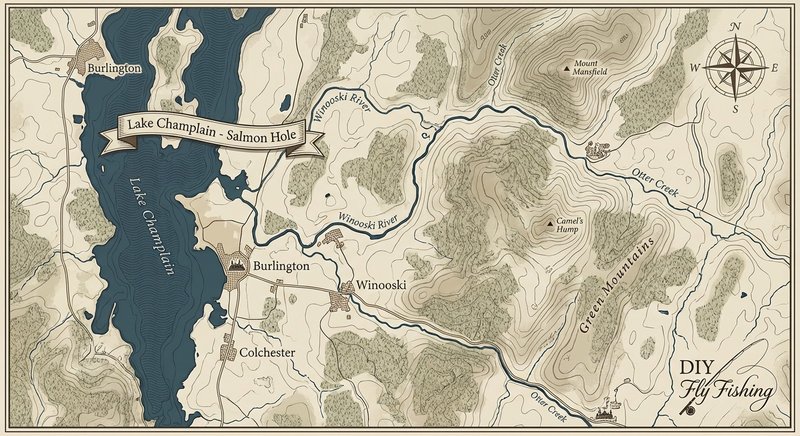
Lake Champlain - Salmon Hole
Fly fishing in Vermont · Intermediate · Best seasons: Spring, Fall
Target Species
Steelhead, Landlocked Salmon, Smallmouth Bass
About This Water
Burlington's urban fishery at the mouth of the Winooski. Steelhead, salmon, and bass throughout the year.
Fishing Recommendations
As an expert guide who has spent years navigating the rocky ledges of the Winooski River, I can tell you that Salmon Hole is one of the most storied and productive stretches of water in the Northeast. Located on the border of Burlington and Winooski, Vermont, it is the first major barrier for fish migrating out of Lake Champlain.
Here is your comprehensive guide to fly fishing the Salmon Hole.
🎣 Location Overview
The Salmon Hole is a massive, deep limestone pool located just below the Winooski One Dam. This is "big water" by Vermont standards. It serves as a natural collection point for lake-run species that are stopped by the dam’s impassable barrier.
What makes it special is the sheer diversity of water. You have heavy plunges near the dam, deep slow-moving "guts" in the center, and technical pocket water and ledge runs as the river widens downstream. It feels like an urban canyon; despite being minutes from downtown Burlington, the steep limestone cliffs provide a sense of isolation. It is a high-energy environment with high oxygen levels, making it a sanctuary for predatory fish.
🐟 Target Species & Behavior
Landlocked Atlantic Salmon
These are the "stars of the show." Unlike their sea-run cousins, these salmon spend their lives in Lake Champlain but run up the Winooski to spawn or chase bait.
- Behavior: They are highly aggressive and move in "pods." They love oxygenated water—look for them in the "white water" seams or the transition zones where fast water meets deep pools.
Steelhead (Rainbow Trout)
The Winooski sees a solid run of lake-run rainbows.
- Behavior: They tend to hug the bottom more than the salmon. They hold in the "cushion" in front of large boulders or in the deep tail-outs of the main pool.
Smallmouth Bass
While the salmonids get the glory, the Smallmouth fishing here is world-class during the warmer months.
- Behavior: They hold in the eddies and behind the limestone ledges. They are opportunistic, feeding on crayfish and emerald shiners.
📅 Best Times to Fish
The Spring Window (April – Early June)
- The Draw: This is the "Smelt Run." As the ice melts, salmon follow schools of smelt upriver.
- Conditions: High water is common. You want the river to be "dropping and clearing" after a rain event.
The Fall Window (September – November)
- The Draw: The primary spawning run for Landlocked Salmon and the arrival of "fall-run" Steelhead.
- Conditions: Late October is often the "Golden Week." Cooler water temperatures (below 55°F) trigger aggressive strikes.
Time of Day
- Low Light: Because the water can be clear and the area sees some foot traffic, dawn and dusk are exponentially more productive. On overcast, drizzly days, the fish will stay active in the shallows all day long.
🪰 Recommended Flies & Techniques
Technique: The "Winooski Swing" (Streamers)
Salmon Hole is classic streamer water. Use a 6 or 7-weight rod with a sink-tip line.
- Patterns: Black or Olive Woolly Buggers (size 4-8), Grey Ghosts, Mickey Finns, and articulated streamers like the "Galloup’s Dungeon" in white (to mimic smelt).
- Presentation: Cast 45 degrees downstream, let it sink, and swing it through the current seams. Give it short, erratic strips at the end of the swing.
Technique: Indicator Nymphing
When the fish are sulking in the deep holes, you have to go to them.
- Patterns: Egg patterns (Glo-bugs) in orange or champagne, Prince Nymphs (size 10-14), and large Stonefly patterns in black or gold.
- Presentation: Use a heavy fluorocarbon leader (2X or 3X) and enough split shot to get the fly to the bottom quickly.
Technique: Topwater (Smallmouth Bass)
- Patterns: Boogle Bugs or foam poppers.
- Presentation: Cast into the soft eddies near the cliffs and twitch them slowly.
💡 Pro Tips & Local Knowledge
- Watch the Gauge: Check the USGS gauge for "Winooski River at Essex Junction."
- Under 1,500 cfs: Perfect wading conditions.
- 2,000 - 4,000 cfs: High but fishable from the banks.
- Over 5,000 cfs: Dangerous. Stay home.
- The "Ledge Walk": The bottom of the Salmon Hole is made of treacherous, slippery limestone ledges. Studded wading boots are non-negotiable. Felt soles help, but studs are better for the "slime" that coats the rocks.
- Target the "Tail-out": Everyone crowds the dam. The most experienced anglers head 200 yards downstream to the tail-out where the water thins. Fish often rest here before making the final push to the dam.
- The "Drop-off": There is a significant shelf about 30 feet out from the Burlington side. Fish love to cruise right along this drop-off. You don't always need to cast to the middle of the river.
⚠️ Important Information
Access
- Salmon Hole Park: Located off Riverside Avenue in Burlington. There is a marked parking lot and a steep trail leading down to the water.
- Winooski Side: Limited access via the Winooski River Walk, but most fly anglers prefer the Burlington side for better casting room.
Regulations & Permits
- Vermont Fishing License: Required for anyone 15 or older.
- Special Exceptions: Salmon Hole often has specific seasonal closures (typically in early spring) to protect spawning Walleye. Always check the current Vermont Fish & Wildlife Law Digest before heading out.
- No Snagging: This area is strictly monitored. Ensure your flies are hooked in the mouth; lake-run fish are prone to accidental foul-hooking in heavy current.
Safety
- Dam Releases: This is a hydroelectric dam. Water levels can rise rapidly without warning. If you see the water start to rise or get muddy, exit the river immediately.
- Wading Staff: I highly recommend using a wading staff here. The "potholes" in the limestone can be 4 feet deep and invisible in murky water.
Guide’s Final Word: Salmon Hole is a "reward" fishery. It can be frustrating one day and world-class the next. Bring a heavy enough rod, watch your footing, and keep your fly in the water!
Bug Hatches & Matching Flies
| Hatch | Type | Peak months | Time of day | Hook sizes | Matching flies |
|---|---|---|---|---|---|
| Blue-Winged Olive (BWO) Baetis spp. | mayfly | April, May, September, October | Mid-day/Overcast | #18-22 | RS2 #20-22, Parachute Adams #18-22, BWO Emerger #18-20 |
| Hendrickson Ephemerella subvaria | mayfly | May | Afternoon | #12-14 | Red Quill #12-14, Hendrickson Nymph #12-14, Pheasant Tail #12-14 |
| Grannom Caddis Brachycentrus | caddis | May | Morning/Evening | #14-16 | Elk Hair Caddis (Olive/Tan) #14-16, Deep Sparkle Pupa #14-16, LaFontaine's Emerger #14-16 |
| Sulphur Ephemerella invaria/dorothea | mayfly | June | Evening | #14-18 | Sulphur Parachute #16-18, Sulphur Cripple #16-18, Gold Ribbed Hare's Ear #14-16 |
| Great Olive Winged Drake Hexagenia limbata | mayfly | June, July | Dusk/Night | #6-10 | Hexagenia Dry #6-8, Wiggle Hex Nymph #8-10 |
| Slate Drake Isonychia bicolor | mayfly | July, August, September | Afternoon/Evening | #10-12 | Iso Parachute #10-12, Prince Nymph #10-12, Zug Bug #12 |
| White Miller Ephoron leukon | mayfly | August | Late Evening | #12-14 | White Wulff #12-14, Ephoron Spinner #12-14 |
| Trico Tricorythodes spp. | mayfly | August, September | Early Morning | #22-26 | Trico Spinner #22-26, Trico Nymph #24 |