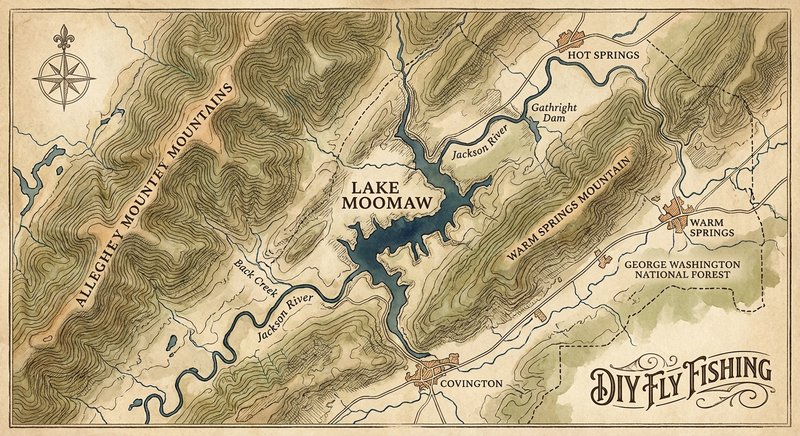
Lake Moomaw
Fly fishing in Virginia · Intermediate · Best seasons: Spring, Summer, Fall
Target Species
Brown Trout, Rainbow Trout, Largemouth Bass
About This Water
Bath County reservoir with excellent trout fishing. Source of Jackson River tailwater.
Fishing Recommendations
Welcome to Lake Moomaw, one of the most unique "two-story" fisheries in the Mid-Atlantic. Tucked away in the Allegheny Mountains of western Virginia, this 2,530-acre reservoir is formed by the Gathright Dam on the Jackson River.
As a guide, I consider Moomaw a "PhD level" lake. It is deep, clear, and cold, offering a rare opportunity to catch trophy-sized trout and hard-hitting bass in the same outing.
🎣 Location Overview
Lake Moomaw is a masterpiece of the U.S. Army Corps of Engineers, surrounded by the George Washington National Forest. What makes it special is its cold-water habitat. Because the Jackson River is a limestone-influenced stream, the lake stays oxygenated and cold even at great depths.
The water is remarkably clear, often providing 10–15 feet of visibility. The shoreline is rugged, dominated by steep drop-offs, submerged standing timber, and shale cliffs. It feels more like a mountain lake in the Pacific Northwest than a typical Virginia reservoir.
🐟 Target Species & Behavior
Brown & Rainbow Trout
Unlike most Virginia lakes where trout are stocked only in winter, Moomaw's trout thrive year-round.
- Behavior: They are pelagic hunters. They follow the massive schools of Alewives (shad-like baitfish).
- Hold: In spring and fall, they may be in the top 10–15 feet of water. In summer, they retreat to the thermocline, usually 25–40 feet deep near the dam or the mid-lake humps.
Largemouth Bass
Moomaw isn't a "numbers" lake for bass, but it is a "size" lake.
- Behavior: They use the submerged standing timber as ambush points.
- Hold: Look for "points on points"—where a secondary point meets the main channel. They often suspend in the trees, making them a challenge for fly anglers.
📅 Best Times to Fish
- Spring (April – June): Prime Time. This is when the trout are highest in the water column. As the water hits 55–60°F, the bass move into the shallows of the Bolar Mountain area to spawn.
- Summer (July – August): Best for night fishing or "crack of dawn" sessions. Trout are deep and usually require heavy sinking lines. Bass will cruise the shorelines under the cover of darkness.
- Fall (September – November): The "Second Season." As the water cools, Brown Trout begin to cruise the shoreline and move toward the headwaters (the Jackson River and Back Creek arms) in an instinctive spawning run.
- Optimal Window: Low-light conditions are mandatory. If the sun is high and the water is glass, the fishing is tough. Look for overcast days or a "Moomaw Breeze" that puts a ripple on the surface.
🪰 Recommended Flies & Techniques
For Trout (The Alewife Mimicry)
Everything revolves around the Alewife. If your fly doesn't look like a 3-inch silver baitfish, you’re wasting time.
- Patterns:
- Game Changers (White/Pearl): 3–4 inches long.
- Clouser Minnows: Gray/White or Blue/White with plenty of flash.
- Kinky Muddlers: To create a silhouette and vibration.
- Technique: Use a Type 5 or Type 7 sinking line. Cast toward the banks or over submerged humps, let it sink for a count of 15–20, and use a fast, erratic "strip-strip-pause" retrieve.
For Largemouth Bass
- Patterns:
- BoogleBugs or Large Poppers: Early morning near the brush.
- Half-and-Halfs: A cross between a Lefty’s Deceiver and a Clouser.
- Crayfish Patterns: Heavy lead-eyed flies fished deep along the shale ledges.
- Technique: Focus on "Vertical Structure." Bass at Moomaw love to sit halfway down a submerged tree. You have to get your fly tight to the wood.
💡 Pro Tips & Local Knowledge
- The "Moomaw Jump": In the early morning during May and June, keep your eyes peeled for "the jump." Trout and Bass will pin Alewives against the surface. If you see a splash, get a white streamer there immediately.
- The Back Creek Arm: In the late fall, the Brown Trout congregate in the Back Creek arm. This is your best chance at a 5lb+ Brown on a fly rod. Use large, articulated streamers in olive or gold.
- Count Down: Professional guides at Moomaw live by the clock. If you catch a fish at a "20-second sink," stay at that depth. The thermocline is precise; being five feet too high or too low means a skunked day.
- Fish the "Dead Standing": There are forests of dead trees underwater. Use a weedless fly construction (monofilament guard) or you will lose your entire fly box.
⚠️ Important Information
- Access: The best ramps are Coles Point (Southern end, near the dam/deep water) and Bolar Flat (Northern end, better for bass and spring trout).
- Regulations:
- A valid Virginia Fishing License is required.
- There is a National Forest Permit required for parking/access in some areas.
- Special Trout Regs: Check the current VDWR (Virginia Dept. of Wildlife Resources) digest, as there are specific length and creel limits for trout at Moomaw.
- Safety: This is a mountain reservoir. Cell service is non-existent in most of the lake. Wind can kick up "whitecaps" quickly; if you are in a small boat or a kayak, keep a close eye on the weather.
Guide’s Final Word: Bring your heaviest sinking lines and your longest casts. Lake Moomaw rewards patience and technical precision. Tight lines!
Bug Hatches & Matching Flies
| Hatch | Type | Peak months | Time of day | Hook sizes | Matching flies |
|---|---|---|---|---|---|
| Midges Chironomidae | midge | January, February, March, December | All day | #18-24 | Zebra Midge #18-22, Griffith's Gnat #20-24, Smoke Jumper #20-22 |
| Blue Winged Olives Baetis | mayfly | March, April, October, November | Mid-day/Afternoon | #18-22 | RS2 #20-22, Parachute BWO #18-20, BWO CDC Emerger #18-22 |
| Hexagenia (Giant Michigan Mayfly) Hexagenia limbata | mayfly | June, July | Dusk/Evening | #6-10 | Hexagenia Spinner #6-8, Hex Nymph #8-10, Crippled Hex #8 |
| Sulphurs Ephemerella invaria | mayfly | May, June | Evening | #14-18 | Sulphur Parachute #16-18, Pheasant Tail Nymph #14-18, Sulphur Snowshoe Emerger #16 |
| Tan Caddis Hydropsyche | caddis | April, May, June, September | Evening | #14-18 | Elk Hair Caddis #14-16, LaFontaine's Deep Pupa #14-18, Iris Caddis #16 |
| Damselflies Enallagma | other | June, July, August | Morning/Afternoon | #10-14 | Marabou Damsel Nymph #10-12, Adult Damsel #12 |
| Terrestrials (Ants & Beetles) Formicidae / Coleoptera | terrestrial | July, August, September | Afternoon | #12-18 | Black Foam Ant #14-18, Cinnamon Ant #16-18, Black Foam Beetle #12-16 |
| Scuds Gammarus | other | March, April, May | All day | #14-18 | Ray Charles #14-18, Flashback Scud #16-18 |