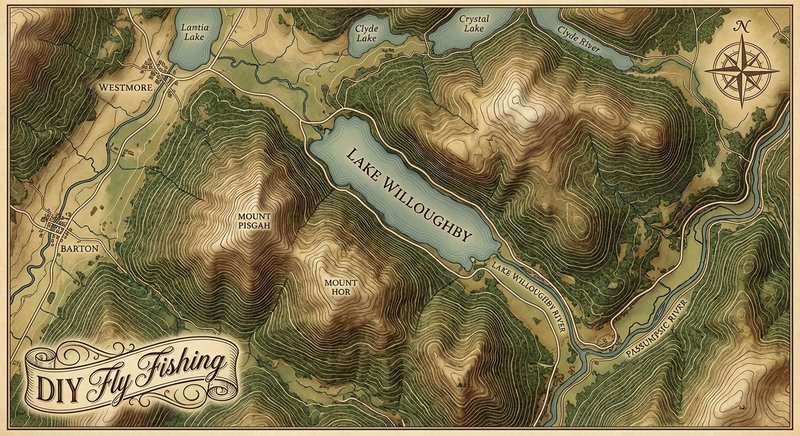
Lake Willoughby
Fly fishing in Vermont · Intermediate · Best seasons: Spring, Fall
Target Species
Landlocked Salmon, Lake Trout, Rainbow Trout
About This Water
Deep glacial lake in the Northeast Kingdom. Landlocked salmon, lake trout, and rainbow trout.
Fishing Recommendations
Lake Willoughby is often called the "Lucerne of America" because of its startling resemblance to a Swiss alpine lake. Located in the Northeast Kingdom of Vermont, it is a deep, cold, glacial masterpiece carved between the sheer cliffs of Mount Pisgah and Mount Hor. For the fly angler, it represents one of the most unique challenges and rewards in New England.
🎣 Location Overview
Lake Willoughby is a "Category 1" trout water, famous for its incredible clarity and immense depth (over 300 feet in some spots). Unlike many shallower Vermont lakes, Willoughby stays cold year-round, allowing cold-water salmonids to thrive.
What makes it special is the sheer verticality. You can stand on a rock ledge and have 50 feet of water beneath your feet within a few steps. For fly anglers, the action centers around the northern and southern ends where the shelves are slightly shallower, and specifically the Willoughby River, which serves as the primary spawning tributary for the lake’s legendary run of "steelhead-style" Rainbow Trout and Landlocked Salmon.
🐟 Target Species & Behavior
Landlocked Atlantic Salmon
These are the "silver bullets" of the lake. In the spring, they follow the smelt (their primary forage) toward the shallower shorelines and river mouths as the ice melts. They are aggressive, jump frequently when hooked, and cruise the upper 10–20 feet of the water column when temperatures are below 55°F.
Lake Trout (Lakers)
Willoughby holds some of the largest naturally reproducing Lake Trout in Vermont. While they spend summers in the abyss, they move into the shallows (5–20 feet) in the late fall to spawn on rocky shoals. During this window, they are accessible to fly anglers using heavy sinking lines.
Rainbow Trout
The lake is famous for its wild population of Rainbows. These fish behave much like Great Lakes steelhead. In the spring (late April/May), they migrate out of the lake and into the Willoughby River to spawn. In the lake itself, they cruise the rocky shorelines feeding on insects and small baitfish.
📅 Best Times to Fish
Spring (Ice-out through early June)
- Prime Window: This is the peak for Landlocked Salmon and the Rainbow run.
- Conditions: Immediately after ice-out, salmon congregate at the southern end (South Beach) and near the mouth of the Willoughby River at the north end.
- Time of Day: Low light is your friend. Early morning (dawn to 9:00 AM) and overcast days are best due to the extreme water clarity.
Fall (September through October)
- Prime Window: Late September until the season closes (check current VT fish & wildlife dates, usually Oct 31 for the lake).
- Conditions: As water temperatures drop, Lake Trout move onto the shallow rocky reefs. Salmon also begin staging near the river mouths again.
- Time of Day: Mid-day can be productive in the fall as the sun warms the surface slightly, activating baitfish.
🪰 Recommended Flies & Techniques
For Landlocked Salmon (Spring/Fall)
- Technique: "Stripping Streamers." Use a 6-weight or 7-weight rod with a clear intermediate sinking line or a Sink-Tip (Type 3). Cast toward the drop-offs and retrieve with erratic, fast strips.
- Patterns:
- Gray Ghost or Black Ghost (Classic New England streamers)
- Magog Smelt (A local favorite)
- Joe’s Smelt
- Size 4–8 articulated streamers in white/silver or olive.
For Rainbow Trout (River Run)
- Technique: High-stick nymphing or indicator nymphing in the Willoughby River.
- Patterns:
- Glo-Bugs (Egg patterns) in peach, orange, or pink.
- Prince Nymphs and Pheasant Tails (Size 12–16).
- Stonefly Creepers (Size 8–10).
For Lake Trout (Late Fall)
- Technique: Use a heavy 300–400 grain sinking line to get large, weighted streamers down to 15–20 feet along the rocky shelves at the base of Mt. Pisgah.
- Patterns: Large White Zonkers or Gamechangers. Anything that mimics a 4–6 inch cusk or smelt.
💡 Pro Tips & Local Knowledge
- Focus on the "Shelf": Because the lake drops off so fast, the fish cruise right along the transition where the light-colored shallow sand/rock turns to deep "Willoughby Blue." Position your boat or yourself to cast across this transition zone.
- The Willoughby River Run: If you are there in the spring, the "Steelhead" run in the Willoughby River is a spectacle. Focus on the sections in Orleans, VT. Look for deep pools and runs. Note: These fish are spooky; use long fluorocarbon leaders (4X or 5X).
- Wind is Your Friend: A "Willoughby Chop" (light ripples on the water) breaks up the surface and makes the fish less wary of your line and leader. On dead-calm days, fishing can be incredibly difficult due to the water’s gin-like clarity.
- The South End: The South Beach area has a more gradual shelf than the cliffs. This is a prime spot for wading fly anglers to target Salmon in the spring.
⚠️ Important Information
- Access:
- North End: Boat ramp and parking near the Westmore store.
- South End: Public beach area with good wading access.
- Route 5A: Runs along the east side of the lake; there are several pull-offs where you can scramble down to the rocks, but be careful—the terrain is steep.
- Regulations: Lake Willoughby is managed specifically for its lake trout and salmon.
- Check the VT Digest: Always check the current Vermont Fishing Guide for size limits and season dates, as the river has different regulations (and opening dates) than the lake.
- Lead Ban: Vermont has strict laws regarding the use of lead sinkers and jigs. Ensure your flies and split shot are lead-free.
- Safety: The water is dangerously cold. If you are fishing from a kayak or float tube, a dry suit or high-quality waders with a wading belt are mandatory. The wind can whip up between the mountains instantly, creating large swells.
Guide’s Final Thought: Willoughby is a "quality over quantity" fishery. You may only get two or three takes in a day, but they are likely to be some of the strongest, most beautiful wild fish in the eastern United States. Bring your camera; the scenery is as good as the fishing.
Bug Hatches & Matching Flies
| Hatch | Type | Peak months | Time of day | Hook sizes | Matching flies |
|---|---|---|---|---|---|
| Chironomids (Midges) Chironomidae | midge | April, May, September, October | All Day | #18-24 | Zebra Midge #18-22, Griffith's Gnat #20-24, Ice Cream Cone #16-18 |
| Speckled Spinner / Speckled Dun Callibaetis | mayfly | June, July, August | Morning/Afternoon | #14-16 | Callibaetis Cripple #14-16, Parachute Adams #14-16, Hare's Ear Nymph #14-16 |
| Giant Michigan Mayfly (Hex) Hexagenia limbata | mayfly | June, July | Evening/Dusk | #6-10 | Hexagenia Dry #6-8, Hex Nymph #6-10 |
| Grannom Caddis Brachycentrus | caddis | May | Morning/Afternoon | #12-16 | Elk Hair Caddis (Olive) #14-16, Holy Grail #12-14 |
| Flying Ants Formicidae | terrestrial | August, September | Afternoon | #14-20 | Black Flying Ant #16-18, Cinnamon Ant #14-16 |
| White Miller Caddis Nectopsyche | caddis | July, August | Evening | #12-16 | White Elk Hair Caddis #12-14, White Miller Soft Hackle #14-16 |
| Blue Winged Olive Baetis | mayfly | May, September, October | Afternoon | #18-22 | BWO Sparkle Dun #18-20, Pheasant Tail Nymph #18-22 |
| Black Beetle Coleoptera | terrestrial | July, August | All Day | #12-16 | Foam Beetle #14-16, Crowe Beetle #12-14 |