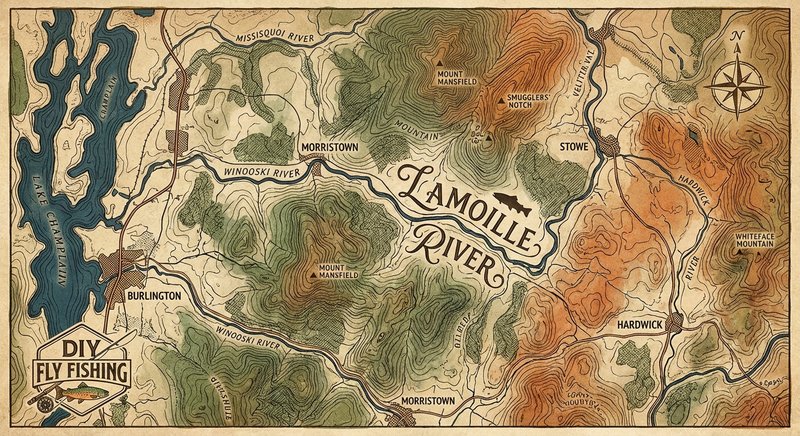
Lamoille River
Fly fishing in Vermont · Beginner · Best seasons: Spring, Summer, Fall
Target Species
Rainbow Trout, Brown Trout
About This Water
Northern Vermont river with rainbow and brown trout. Beautiful Green Mountain scenery and excellent hatches.
Fishing Recommendations
The Lamoille River is one of Vermont’s premier trout fisheries, offering a diverse landscape that transitions from tumbling mountain water to broad, fertile valley runs. Flowing from Greensboro through the heart of the Green Mountains before emptying into Lake Champlain, it provides a classic New England fly fishing experience.
🎣 Location Overview
The Lamoille is a river of two characters. The upper reaches (above Morrisville) are smaller and more intimate, while the lower sections (below Morrisville and Johnson) broaden out into a classic freestone river with large boulders, deep pools, and long glassy glides.
What makes the Lamoille special is its productivity. It is one of the most fertile rivers in the state, supported by a mix of wild populations and a robust stocking program by Vermont Fish & Wildlife. Anglers love it because it offers "big water" feel without the overwhelming crowds often found on the nearby Winooski. Whether you want to high-stick through a boulder garden or sight-fish to rising browns in a slow meadow stretch, the Lamoille has a beat for you.
🐟 Target Species & Behavior
- Brown Trout: The "kings" of the Lamoille. The river holds some truly large, wild-born browns, particularly in the deeper holes and undercut banks near Johnson and Jeffersonville. They are wary and often nocturnal or crepuscular, holding in heavy cover during bright sun.
- Rainbow Trout: These are the primary target for many. They are found in the faster oxygenated water—riffles, pocket water, and the heads of pools. They are more opportunistic than the browns and will often move several feet to intercept a fly.
Behavior: In the spring, fish are tight to the bottom in slower wintering holes. As water temps hit the 50s and 60s, they move into the "skinny" water and riffles. During the heat of summer, they seek out "thermal refuges"—cooler tributary mouths and deep, aerated plunge pools.
📅 Best Times to Fish
- Spring (Late April – June): This is prime time. Once the spring runoff (mud season) recedes, the Hendrickson and March Brown hatches begin. Late May to June offers the most consistent action.
- Summer (July – August): Focus on early mornings and late evenings. The Lamoille can get warm in the mid-sections; if water temps exceed 68°F, head to the upper sections or higher-elevation tributaries to avoid stressing the fish.
- Fall (September – October): A spectacular time to be on the water. Brown trout become aggressive and territorial as they prepare for the spawn. Streamer fishing is at its peak.
Prime Window: The "Evening Rise" during June and July is legendary on the Lamoille. Being on the water from 7:00 PM until dark can produce the biggest fish of the season.
🪰 Recommended Flies & Techniques
Top Fly Patterns
- Dry Flies: Hendrickson (Size 12-14), Light Cahill (14-16), Elk Hair Caddis (12-18), and the "Lamoille Special" (a localized variation of a Royal Wulff). For late summer, use Terrestrials (size 10-14 Foam Ants and Beetles).
- Nymphs: Prince Nymph (12-16), Pheasant Tail (14-18), Girdle Bug/Pat’s Rubber Legs (8-12) for high water, and Zebra Midges (18-22) for picky fish.
- Streamers: Woolly Bugger (Olive or Black, 6-10), Black Ghost, and articulated patterns like the Sex Dungeon for targeting trophy browns in the fall.
Techniques
- European Nymphing: Extremely effective in the pocket water stretches between Morrisville and Johnson. Keeping a tight line and heavy tungsten nymphs allows you to reach fish in the deep slots.
- Dry-Dropper: The go-to method for summer. A buoyant hopper or Stimulator with a small Pheasant Tail dropped 18-24 inches below covers both the surface and the subsurface.
- Streamer Stripping: In the lower river, cast toward the banks and "strip-stop-strip" to trigger an instinctual strike from big browns.
💡 Pro Tips & Local Knowledge
- The "Dogs" of Summer: When the main stem gets warm, look for "cold water bubbles" where tributaries enter the main river. Fish will stack up in these oxygen-rich, cooler zones.
- The Morrisville Loop: The stretch below the dam in Morrisville is a local favorite. It has excellent oxygenation and holds fish even when other parts of the river are slow.
- Watch the Gauge: The Lamoille is subject to power generation dams. Always check the USGS gauge at Johnson. If the water is rising rapidly, it can become dangerous and the fishing will turn off. A steady or slightly dropping flow is ideal.
- Shadow Management: The Lamoille is wide in many places. Pay attention to where your shadow falls. On the glassy flats near Jeffersonville, a long leader (12ft+) and a delicate presentation are mandatory.
⚠️ Important Information
- Access: Much of the Lamoille flows through private land, but Vermont has generous access laws. Look for VFWD "Fishing Access" signs. Popular spots include the bridge in Johnson, the Dog Team stretch, and the areas along Route 15. Always respect "Posted" signs.
- Regulations: The Lamoille has specific sections with different rules. Some stretches are "Catch and Release Only" or "Artificial Lures Only." Always consult the Vermont Fishing Guide & Regulations before heading out.
- Safety: The riverbed can be extremely slippery. Studded wading boots and a wading staff are highly recommended, especially in the swifter sections near Morrisville.
- License: A valid Vermont Fishing License is required for everyone 15 years of age and older. These can be purchased online or at local fly shops in Stowe or Morrisville.
Bug Hatches & Matching Flies
| Hatch | Type | Peak months | Time of day | Hook sizes | Matching flies |
|---|---|---|---|---|---|
| Blue-Winged Olive (BWO) Baetis / Acerpenna | mayfly | April, May, September, October | Midday | #18-22 | RS2 #20-22, BWO Parachute #18-20, Pheasant Tail Nymph #18-20 |
| Hendrickson Ephemerella subvaria | mayfly | May | Afternoon | #12-14 | Hendrickson Dark #12-14, Red Quill #12-14, Hare's Ear Nymph #12-14 |
| Grannom Caddis Brachycentrus | caddis | May | Late Afternoon/Evening | #14-16 | Elk Hair Caddis #14-16, LaFontaine's Deep Sparkle Pupa #14-16, Peacock Caddis #16 |
| March Brown Maccaffertium vicarium | mayfly | May, June | Afternoon | #10-12 | March Brown American #10-12, March Brown Emerger #12, Gold Ribbed Hare's Ear #10-12 |
| Sulphur / Pale Evening Dun Ephemerella dorothea | mayfly | June, July | Evening | #16-18 | Sulphur Parachute #16-18, Sulphur CDC Emerger #16-18, Pheasant Tail #16-18 |
| Golden Stonefly Acroneuria | stonefly | June, July | Morning/Evening | #8-12 | Pat's Rubber Legs #8-12, Stimulator (Yellow) #10-12, Golden Stone Nymph #10 |
| Light Cahill Stenacron interpunctatum | mayfly | June, July | Evening/Dusk | #12-14 | Light Cahill Dry #12-14, Cream Variant #14, Gold Ribbed Hare's Ear #14 |
| Trico Tricorythodes | mayfly | August, September | Early Morning | #22-26 | Trico Spinner #22-24, Trico Parachute #22-24, Zebra Midge #22-24 |
| White Miller Nectopsyche | caddis | August | Late Evening | #14-16 | White Elk Hair Caddis #14-16, White Miller Soft Hackle #14-16, Prince Nymph #14 |
| Terrestrials Formicidae / Gryllidae | terrestrial | July, August, September | All Day | #10-18 | Cinnamon Ant #16-18, Black Foam Beetle #14-16, Dave's Hopper #10-12 |