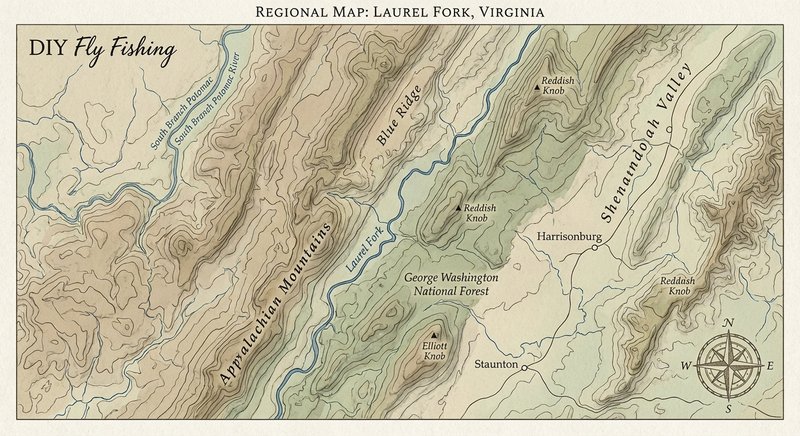
Laurel Fork
Fly fishing in Virginia · Advanced · Best seasons: Spring, Summer, Fall
Target Species
Brook Trout
About This Water
Highland County stream with wild brook trout. Remote wilderness area.
Fishing Recommendations
Welcome to one of the true gems of the Mid-Atlantic. As your guide, I’m excited to introduce you to Laurel Fork, located in the remote northwest corner of Highland County, Virginia. This isn't just another trout stream; it is a high-elevation plateau ecosystem that feels more like the Canadian bush or the Adirondacks than the Blue Ridge Mountains.
Here is your comprehensive guide to fly fishing Laurel Fork.
🎣 Location Overview
Laurel Fork is a headwater tributary of the Cheat River system, making it unique as it flows north toward West Virginia rather than east toward the Chesapeake. Located within the Laurel Fork Special Management Area of the George Washington National Forest, it is one of the most remote and pristine wild trout fisheries in Virginia.
The water is characterized by low-gradient, tea-colored "tannic" flows, meandering through high-altitude spruce forests and mountain meadows at elevations above 3,000 feet. Unlike the steep, tumbling freestone streams typical of the Blue Ridge, Laurel Fork features long, quiet pools, undercut banks, and tight rhododendron tunnels. Anglers love it for its "solitude and soul"—it is a place where you are more likely to see a black bear or a northern flying squirrel than another person.
🐟 Target Species & Behavior
Species: 100% Wild Southern Appalachian Brook Trout.
- Behavior: These are "salvelinus fontinalis" in their purest form. Because the water is tannic and relatively nutrient-poor, these fish are opportunistic but incredibly wary. In the slow-moving meadow sections, they behave more like "creek chalk-stream" trout—they will see you long before you see them.
- Holding Patterns: Look for them tucked deep under overhanging banks, beneath submerged logs, or at the very tail-outs of pools during a hatch. In the tighter, forested sections, they hold in the "pillows" of water in front of boulders.
- Diet: Their diet consists mainly of small stoneflies, caddis, and terrestrials (ants and beetles). Due to the acidity of the tannic water, mayfly diversity is lower than in limestone streams, but the fish are less picky about pattern than they are about presentation.
📅 Best Times to Fish
- Spring (April – June): This is the prime window. As the high-country snow melts and the water warms into the 50s, the Brookies become aggressive. This coincides with the most reliable aquatic insect hatches.
- Summer (July – August): While many VA streams get too hot, Laurel Fork’s high elevation keeps it cooler. However, water levels can get very low. This is Terrestrial Season. Focus on the shaded, timbered sections rather than the open meadows to find cooler water.
- Fall (September – October): A magical time. The Brook trout take on their brilliant spawning colors (vibrant oranges and reds). The fish are aggressive, protecting territory. Note: Please avoid stepping on "redds" (spawning beds) in late October.
- Time of Day: During Spring/Fall, 10:00 AM to 4:00 PM is best. In the heat of Summer, focus on the "grey light" of early morning and dusk.
🪰 Recommended Flies & Techniques
Top Fly Patterns
- Dry Flies:
- Royal Wulff or Royal Coachman (Size 14-16): The white wings are easy to see in the dark, tannic water.
- Elk Hair Caddis (Size 16-18): A staple for the afternoon rises.
- Parachute Adams (Size 16-20): For those flat-water meadow sections where the fish are picky.
- Terrestrials:
- Black Ants or Cinnamon Ants (Size 18-22): Essential in late summer.
- Dave’s Hopper or Foam Beetles (Size 12-16): Great for "splatting" against undercut banks.
- Nymphs/Wet Flies:
- Pheasant Tail (Size 16-18): Best for mimicking the small dark nymphs found here.
- Gold-Ribbed Hare’s Ear (Size 14-16).
Techniques
- The "Crouch and Creep": Because the water is slow and clear, you must stay low. If your shadow hits a pool, the fishing is over for 20 minutes.
- Dries Over Nymphs: Laurel Fork is a dry-fly paradise. These fish look up. A "Dry-Dropper" rig with a small unweighted nymph 12 inches below a buoyant dry is the most effective way to cover the water.
- Short Accuracy: You rarely need to cast more than 20 feet. Mastery of the "roll cast" and "bow-and-arrow cast" is mandatory for the brushy sections.
💡 Pro Tips & Local Knowledge
- The "Meadow vs. Forest" Rule: The meadow sections offer easier casting but require much more stealth. The forested sections (further downstream/uphill from road access) are a "rhodo-bash" but the fish are less wary and easier to fool.
- Light Tackle: Bring a 2-weight or 3-weight rod, 6 to 7.5 feet in length. A standard 9-foot 5-weight is too much "gun" for this water and will get hung up in the trees.
- The "Tannic" Factor: The water looks like tea. Use fluorocarbon 6x or 7x tippet. Even though the water is dark, it is very clear; the fish have excellent vision.
- Keep Moving: Brook trout are communal. If you catch one, there are likely three more nearby. If you get no strikes after five good drifts, move to the next pocket.
⚠️ Important Information
- Access: Access is via Route 642 and Route 601 in Highland County. Be prepared for gravel roads that can be rough after heavy rain. The Locust Spring Recreation Area is a great starting point with trail access.
- Regulations: This is a Wild Trout Stream. Generally, Virginia state regulations apply, but most of this area is "Catch and Release Only" or has very specific size/creel limits. Single-hook artificial lures only. Always check the VADWR website before your trip.
- Safety: This is true wilderness. There is no cell service. Carry a map, a compass/GPS, and a first-aid kit. Tell someone where you are going.
- Gear: Waders are optional in summer (wet wading is great), but a good pair of felt or high-traction rubber boots is essential—the rocks are slick and the banks can be "boggy."
Laurel Fork is a place for the angler who values the beauty of the fish and the silence of the woods more than the size of the catch. Respect the resource, and it will give you a world-class experience. Tight lines!
Bug Hatches & Matching Flies
| Hatch | Type | Peak months | Time of day | Hook sizes | Matching flies |
|---|---|---|---|---|---|
| Blue-Winged Olive Baetis tricaudatus | mayfly | March, April, October, November | Late Morning/Afternoon | #18-22 | RS2 #18-22, Parachute BWO #18-20, Pheasant Tail #18-20 |
| Quill Gordon Epeorus pleuralis | mayfly | March, April | Midday | #12-14 | Quill Gordon Dry #12-14, Hare's Ear Nymph #12-14 |
| Grannom Caddis Brachycentrus | caddis | April | Afternoon/Evening | #14-16 | Elk Hair Caddis (Olive) #14-16, Peacock Caddis Larva #14-16, LaFontaine Emerger #14-16 |
| March Brown Maccaffertium vicarium | mayfly | May | Afternoon | #10-14 | March Brown Dry #10-12, Gold Ribbed Hare's Ear #10-12 |
| Sulfur Ephemerella invaria | mayfly | May, June | Evening | #14-18 | Sulfur Parachute #14-18, Pheasant Tail Sulfur #14-16, CDC Sulfur Emerger #16-18 |
| Yellow Sally Isoperla | stonefly | June, July | Late Afternoon/Evening | #14-16 | Yellow Sally Dry #14-16, Little Yellow Stone Nymph #14-16 |
| Cinnamon Caddis Hydropsyche | caddis | June, July, August | Morning/Evening | #14-18 | Elk Hair Caddis (Tan) #14-18, Pupa (Tan) #16-18 |
| Terrestrials Formicidae / Coleoptera | terrestrial | July, August, September | All Day | #12-20 | Black Foam Ant #16-20, Beetle (Foam) #12-16, Cricket #12-14 |
| Little Black Stonefly Allocapnia | stonefly | February, March | Midday | #16-18 | Little Black Stone #16-18, Zebra Midge #18-20 |