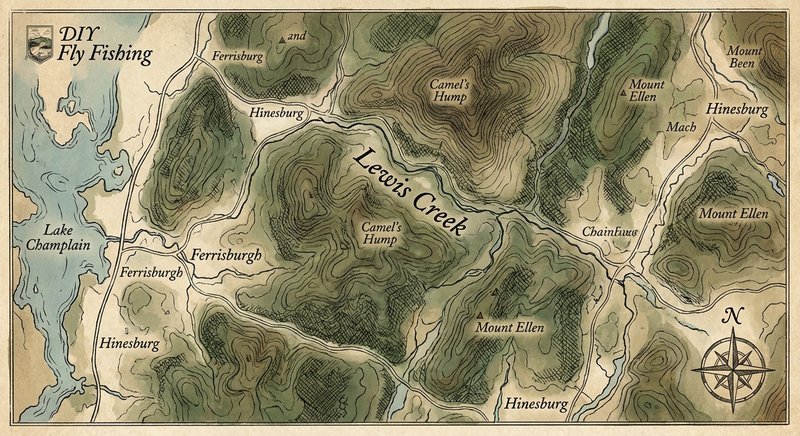
Lewis Creek
Fly fishing in Vermont · Advanced · Best seasons: Spring, Summer, Fall
Target Species
Brown Trout, Brook Trout
About This Water
Small Champlain Valley stream with wild brown trout. Technical fishing in pastoral Vermont countryside.
Fishing Recommendations
Lewis Creek is one of the "hidden gems" of the Champlain Valley. While many anglers flock to the larger Winooski or Lamoille rivers, Lewis Creek offers a more intimate, classic Vermont freestone experience. It meanders through the foothills of the Green Mountains before slowing down as it reaches the Lake Champlain lowlands.
Here is your comprehensive guide to fly fishing Lewis Creek, Vermont.
🎣 Location Overview
Lewis Creek is a medium-sized freestone stream that flows through the towns of Starksboro, Hinesburg, Charlotte, and Ferrisburgh. What makes it special is its transition: the upper reaches near Starksboro have a high-gradient, mountain-brook feel, while the middle sections near Hinesburg flow through pastoral meadows with deep undercut banks and classic pool-riffle sequences.
Unlike many Vermont rivers that are purely granitic, Lewis Creek benefits from some limestone influence in its geology. This leads to slightly higher pH levels and better insect productivity than your average mountain stream. Anglers love it for its technical dry-fly water and the chance to land a surprisingly large wild Brown Trout in a relatively small setting.
🐟 Target Species & Behavior
- Brook Trout: Found predominantly in the upper reaches (upstream of Starksboro). They are wild, opportunistic, and vibrant. They hold in the "pockets" behind boulders and in the bubbly plunges at the head of pools.
- Brown Trout: These are the kings of the middle and lower-middle sections. Lewis Creek Browns are notoriously "spooky." They favor undercut banks, overhanging logs, and deep "tail-outs" during the evening hatch.
- Behavior: During the day, trout hold deep in the shadows or in the faster "oxygenated" water of the riffles. As the sun dips, they move into the flats and the heads of pools to feed on active hatches.
📅 Best Times to Fish
- Spring (May – June): This is the "Golden Era" on Lewis Creek. The water levels have usually settled from the spring runoff, and the insect activity is at its peak.
- Summer (July – August): This is a sensitive time. Lewis Creek can get low and warm. Focus your efforts on the early morning (sunrise to 10:00 AM) or late evening. Pro Tip: If the water temperature exceeds 68°F, head to the higher elevations or stop fishing to protect the trout from heat stress.
- Fall (September – October): A fantastic time for Brown Trout as they become aggressive before the spawn. The foliage makes for a scenic backdrop, and "hopper-dropper" rigs are highly effective.
🪰 Recommended Flies & Techniques
Top Fly Patterns
- Dry Flies: Elk Hair Caddis (Tan/Olive, #14-18), Parachute Adams (#12-20), Light Cahill (#14-16), and Stimulators (Orange/Yellow, #12).
- Nymphs: Bead-head Pheasant Tail (#14-18), Gold-ribbed Hare’s Ear (#12-16), and Prince Nymphs. Don't forget small Zebra Midges (#18-22) for picky fish in the flats.
- Streamers: Woolly Buggers (Black or Olive, #8-10) and the classic Mickey Finn for the Brookies.
- Terrestrials: Dave’s Hopper or Foam Ants/Beetles (Late July – September).
Effective Techniques
- Dry Fly Stealth: In the meadow sections, the water moves slowly. Use a long leader (9ft to 12ft) and 5x or 6x tippet. Stay low—if you can see the fish, they have likely already seen you.
- Tight-Line Nymphing: In the rocky sections near Starksboro, use a high-sticking or Euro-nymphing technique to probe the deep pockets behind rocks.
- The "Swing": On the lower reaches, swinging a small wet fly or soft hackle during a caddis hatch can be deadly.
💡 Pro Tips & Local Knowledge
- Focus on the "Shady Side": Because Lewis Creek has significant canopy cover in spots, trout will often hold on the shaded bank even if the current is better on the sunny side.
- The Bridge Strategy: Many locals park at bridge crossings along Route 116. To find the better fish, be prepared to walk at least 15-20 minutes away from the bridge. The pressure drops significantly once you get out of sight of the road.
- The "Hinesburg Pocket": The stretch just south of Hinesburg village offers some of the best meadow-style fishing. Look for the "bends" in the river; the deep water on the outside of the curve is where the 14-inch+ Browns live.
- After a Rain: If the creek is slightly stained (tea-colored) after a light rain, throw a medium-sized black Woolly Bugger toward the banks. The big Browns lose their caution in murky water.
⚠️ Important Information
- Access: Much of Lewis Creek runs through private land. Vermont has generous "implied access" laws, but you should always look for "Posted" signs. If you see a landowner, ask permission—it goes a long way in keeping the creek open for everyone.
- Regulations: Lewis Creek is generally under General Management rules, but Vermont fishing regulations can change. Always check the current Vermont Fish & Wildlife Law Digest.
- Wading Safety: The rocks in Lewis Creek can be surprisingly "greasy" with algae. Felt soles or studs are highly recommended.
- Catch & Release: While not all sections are mandatory catch-and-release, the wild trout population is a fragile resource. Practicing C&R ensures the creek remains a top-tier fishery for the next generation.
Tight lines on Lewis Creek! Respect the water, stay stealthy, and enjoy the beauty of the Champlain Valley.
Bug Hatches & Matching Flies
| Hatch | Type | Peak months | Time of day | Hook sizes | Matching flies |
|---|---|---|---|---|---|
| Blue Winged Olive Baetis spp. | mayfly | April, May, September, October | Mid-day | #18-22 | RS2 #18-22, Parachute BWO #18-20, Pheasant Tail Nymph #18-20 |
| Hendrickson Ephemerella subvaria | mayfly | May | Afternoon | #12-14 | Red Quill #12-14, Hendrickson Emerger #12-14, Gold Ribbed Hare's Ear #12-14 |
| Grannom Caddis Brachycentrus | caddis | May | Morning/Afternoon | #14-16 | Elk Hair Caddis (Olive) #14-16, LaFontaine's Deep Sparkle Pupa #14-16, Green Weenie #14-16 |
| Sulphur Ephemerella invaria/dorothea | mayfly | June | Evening | #14-18 | Sulphur Parachute #16-18, CDC Sulphur Emerger #14-18, Pheasant Tail #16-18 |
| Light Cahill Stenacron interpunctatum | mayfly | June, July | Evening | #12-14 | Light Cahill Dry #12-14, Cream Usual #12-14 |
| Slate Drake Isonychia bicolor | mayfly | June, September | Afternoon/Evening | #10-12 | Iso Parachute #10-12, Prince Nymph #10-12, Zug Bug #10-12 |
| Cinnamon Caddis Hydropsyche spp. | caddis | June, July, August | Evening | #14-16 | Elk Hair Caddis (Tan) #14-16, Pupa-Tan #14-16, Soft Hackle Hare's Ear #14-16 |
| Terrestrials (Ants & Beetles) Formicidae / Coleoptera | terrestrial | July, August | All Day | #12-18 | Black Foam Ant #14-18, Crowe Beetle #12-16, Chernobyl Ant #10-14 |
| Trico Tricorythodes | mayfly | August, September | Early Morning | #22-26 | Trico Spinner #22-26, Griffith's Gnat #20-24 |