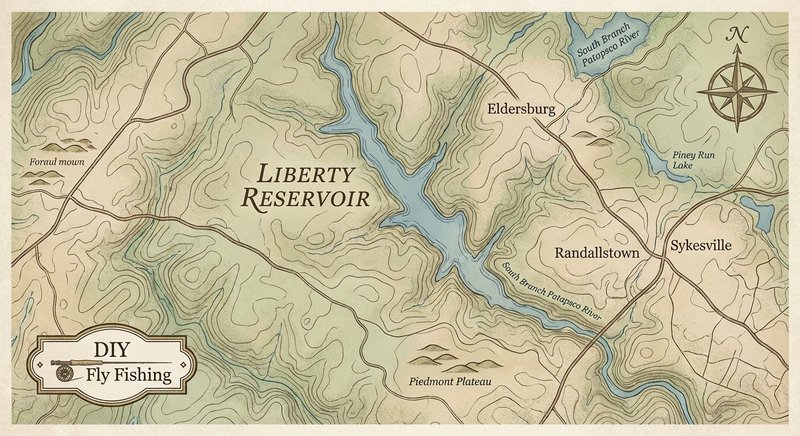
Liberty Reservoir
Fly fishing in Maryland · Intermediate · Best seasons: Spring, Summer, Fall
Target Species
Largemouth Bass, Striped Bass, Crappie
About This Water
Carroll County reservoir with excellent bass fishing. Trophy potential.
Fishing Recommendations
Welcome to Liberty Reservoir. As an expert guide in the Mid-Atlantic, I can tell you that Liberty is one of the most rewarding—yet challenging—fly fishing destinations in Maryland. Spanning over 9,000 acres across Baltimore and Carroll Counties, it is a deep, clear, and "quiet" reservoir due to the prohibition of gasoline engines.
Here is your comprehensive guide to fly fishing these pristine waters.
🎣 Location Overview
Liberty Reservoir is a premier destination because of its clarity and structure. Unlike many silty East Coast reservoirs, Liberty often offers visibility up to 10–15 feet. It is characterized by steep drop-offs, rocky points, submerged roadbeds, and vast forests of standing timber that were flooded when the Patapsco River was dammed.
What makes it special for the fly angler is the peace. Because only electric trolling motors or paddle craft are allowed, you won't be fighting wake from speedboats. It feels like a wilderness experience just minutes from the suburbs. The fish here are "wilder" and more sensitive to pressure, requiring a stealthy approach and technical precision.
🐟 Target Species & Behavior
Striped Bass (Landlocked)
Liberty is famous for its "landlocked" Stripers. These fish are nomadic and follow schools of Alewives (shad).
- Behavior: They move from the deep main lake channels to the flats and points to hunt.
- Holdings: They love current breaks near the dam or "the bridge" (Rt. 26), and deep points.
- Diet: Primarily Alewives.
Largemouth Bass
Liberty holds trophy-sized bass that utilize the abundant woody cover.
- Behavior: They are ambush predators. In the clear water, they often hold deeper than you expect—frequently sitting in 10–20 feet of water near submerged timber.
- Holdings: Coves with downed trees, rocky ledges, and transition zones where the bottom turns from mud to rock.
Crappie (Black & White)
Liberty is a "slab" factory.
- Behavior: Highly school-oriented.
- Holdings: They are almost always associated with wood. Look for "crappie houses"—submerged brush piles or fallen trees on steep banks.
📅 Best Times to Fish
- Spring (April – Early June): The Golden Window. As water warms to 55–65°F, Stripers move into the shallows of the northern arms to "spawn" (though they are generally unsuccessful at reproducing, the instinct remains). Crappie move to the shorelines to spawn in May.
- Summer (Late June – August): Focus on Low Light. Mid-day is tough due to the high sun and clear water. Fish the "witching hour"—the 60 minutes before sunset and after sunrise. Stripers will often "blitz" baitfish on the surface during summer evenings.
- Fall (September – November): As water temperatures drop, fish become aggressive to bulk up for winter. This is the best time for big Largemouths on streamers and Stripers chasing shad in the creek arms.
🪰 Recommended Flies & Techniques
For Striped Bass
- Flies: Half-and-Halfs (Clouser/Left's Deceiver hybrid) in white/chartreuse or grey/white. Game Changers (4–6 inch) to mimic large alewives.
- Technique: Use a Sinking Tip or Full Sinking Line (Type 3 or 5). You must get the fly down to the 15-20 foot range unless you see surface activity. Use a "strip-strip-pause" retrieve to mimic a wounded shad.
For Largemouth Bass
- Flies: Dahlberg Divers (for morning topwater), Murdich Minnows, and weighted Crawfish patterns.
- Technique: Focus on "vertical" structure. Cast past a fallen log and strip the fly parallel to the trunk. In the clear water, long leaders (9–12 feet) are often necessary to avoid spooking fish.
For Crappie
- Flies: Wooly Buggers (Size 8-10) in white or pink, and Micro-Clousers.
- Technique: Use a slow, "pendulum" swing. Cast past a brush pile, let the fly sink on a tight line, and slowly swim it through the branches.
💡 Pro Tips & Local Knowledge
- The "Electric" Rule: Since you can't use gas motors, range is limited. Launch near the area you want to fish. The Nicodemus Road area is great for crappie and bass, while the Rt. 26 Bridge area is better for Stripers.
- Look for the Birds: In the Fall and Summer evenings, watch for gulls. If they are diving, it means Stripers have pushed Alewives to the surface. Switch to an intermediate line and a white Deceiver immediately.
- The "Clear Water" Strategy: On bright days, fish the "shady side" of the reservoir. The high banks of Liberty create long shadows; bass will hug these shadows to remain concealed from prey.
- Stealth Matters: Because there is no engine noise, the fish are very attuned to "hull slap" (waves hitting your boat). Stay off the bank and use your long casts.
⚠️ Important Information
Access
- Main access points are off Route 26 (Liberty Rd) and Nicodemus Rd.
- There are limited boat ramps. Most anglers use kayaks or small boats with electric motors.
Regulations & Permits
- Baltimore City Reservoir Permit: To put any boat (including a kayak) into Liberty, you must have a specific Baltimore City Reservoir Season Permit. They do not sell daily passes.
- No Gasoline Engines: Even if the motor is tilted up, it is generally prohibited on the water.
- Maryland Fishing License: A standard Maryland non-tidal (freshwater) license is required for everyone over 16.
Special Considerations
- No Wading/Swimming: Liberty is a primary drinking water source for Baltimore. You cannot wade into the water or swim. You must fish from a boat or from the bank (where shore access is permitted).
- Tick Safety: If hiking into remote coves, the brush around Liberty is notorious for ticks. Wear long pants and use repellent.
Liberty is a "thinking man's" fishery. It won't give up its secrets easily, but a 30-inch Striper on a 9-weight fly rod in the middle of a quiet Maryland forest is an experience you won't soon forget. Tight lines!
Bug Hatches & Matching Flies
| Hatch | Type | Peak months | Time of day | Hook sizes | Matching flies |
|---|---|---|---|---|---|
| Midges Chironomidae | midge | March, April, November | All day | #18-24 | Zebra Midge #18-22, Griffith's Gnat #20-24, Top Secret Midge #20-22 |
| Great Olive Winged Drake Hexagenia limbata | mayfly | June, July | Dusk/Night | #6-10 | Hexagenia Spinner #6-8, Burrowing Mayfly Nymph #8-10, Paradrake #8-10 |
| Damselfly Enallagma | terrestrial | June, July, August | Afternoon | #10-14 | Adult Damselfly #10-12, Marabou Damsel Nymph #12-14 |
| White Miller Ephoron leukon | mayfly | August | Evening | #12-14 | White Wulff #12-14, Snowshoe Emerger #14 |
| Cinnamon Caddis Hydropsyche | caddis | May, June, September | Evening | #14-18 | Elk Hair Caddis (Tan) #14-16, LaFontaine's Deep Sparkle Pupa #14-18 |
| Japanese Beetle Popillia japonica | terrestrial | July, August | Mid-day | #10-14 | Foam Beetle #12-14, Coffee's Sparkle Beetle #10-12 |
| Trico Tricorythodes | mayfly | July, August, September | Morning | #20-24 | Trico Spinner #22-24, RS2 #20-22 |
| Black Carpenter Ant Camponotus pensylvanicus | terrestrial | May, September | Afternoon | #12-18 | Black Foam Ant #14-18, Fur Ant #16-18 |