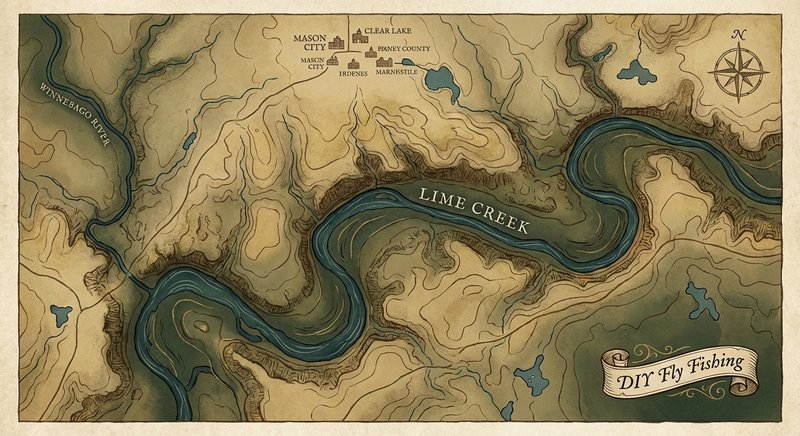
Lime Creek
Fly fishing in Iowa · intermediate · Best seasons: spring, summer, fall
Target Species
Brown Trout
About This Water
Howard County stream with wild trout. Limestone spring creek habitat.
Fishing Recommendations
Welcome to the Driftless Area of Northeast Iowa. As your guide, I’m excited to walk you through Lime Creek in Winneshiek County. While Iowa might not be the first state people associate with trout, this specific corner of the state is a limestone-rich paradise that produces some of the most beautiful wild Brown Trout in the Midwest.
Lime Creek is a tributary of the Upper Iowa River. It is a classic "spring-fed" stream, meaning it stays cold when other rivers warm up, and it remains clear when others are muddy.
🎣 Location Overview
Lime Creek is a quintessential Driftless stream located north of Dorchester. What makes it special is its limestone influence. The water filters through ancient rock, emerging rich in minerals that support a massive biomass of insects and crustaceans.
The creek is characterized by its intimate size—you can jump across it in many places—and its diverse structure. You’ll find deep, carved-out "limestone elbow" bends, long riffles, and undercut banks hidden by tall prairie grasses. Anglers love it because it offers a "small water" challenge; it requires stealth and precision rather than long-distance casting. It feels private, wild, and remarkably serene.
🐟 Target Species & Behavior
The star of the show here is the Wild Brown Trout. While some stocking occurs in certain Iowa reaches, Lime Creek has excellent natural reproduction.
- Behavior: These fish are notoriously "spooky." In the crystal-clear water, they can see a fisherman’s silhouette from a distance.
- Holding Patterns: Look for them tight against undercut banks or tucked under log jams during the day. In the evenings, they move into the tail-outs of pools to feed on emerging insects.
- Diet: Their diet is heavy on scuds (freshwater shrimp) and sowbugs, which thrive in the limestone water. They are also highly opportunistic, keyed into terrestrial insects (grasshoppers/ants) in the summer.
📅 Best Times to Fish
Optimal Seasons
- Spring (April – May): This is the "Goldilocks" zone. Water levels are usually good, and the first major hatches (Blue Winged Olives and Hendricksons) bring fish to the surface.
- Summer (June – August): Excellent for terrestrial fishing. The "Trico" hatch (tiny mayflies) in the early morning is legendary and highly technical.
- Fall (September – October): Pre-spawn. The Browns become aggressive and turn a vibrant buttery gold. This is your best chance to land a "trophy" on a streamer.
Best Times of Day
- Low Light is King: In clear Driftless water, the best fishing is usually 30 minutes before sunrise and the hour leading up to sunset. Cloudy, drizzly days are actually "blue ribbon" days on Lime Creek.
🪰 Recommended Flies & Techniques
Top Fly Patterns
- Nymphs:
- The Pink Squirrel (Size 14-16): An absolute Driftless staple. The flash and pink bead are irresistible to Iowa Browns.
- Ray Charles/Scud (Size 14-18): Olive or orange. Fish these deep along the bottom.
- Zebra Midge (Size 18-22): Black or Red.
- Dry Flies:
- Elk Hair Caddis (Size 14-18): Great for "skittering" across riffles.
- Hippie Stomper (Size 12-14): A fantastic high-visibility attractor/terrestrial.
- Trico Spinner (Size 20-24): For the early morning summer technical hatches.
- Streamers:
- Black or Olive Wooly Bugger (Size 8-12): Keep them small to match the creek size.
Techniques & Presentation
- The "Crouch and Cast": Because the banks are often higher than the water, stay low. If you can see the fish, they have already seen you and stopped feeding.
- Tight-Line Nymphing: In the deeper runs, use a light Euro-nymphing setup or a very small indicator to keep your flies in the "strike zone" near the bottom.
- Dry-Dropper: This is the most effective way to cover Lime Creek. Use a buoyant dry fly (like a Chubby Chernobyl) and hang a Pink Squirrel 18 inches below it.
💡 Pro Tips & Local Knowledge
- The "Upper Iowa" Connection: If the Upper Iowa River is high and muddy after a rain, Lime Creek often clears up much faster. Trout from the main river will sometimes "duck into" the mouth of Lime Creek for relief, leading to some surprisingly large fish near the confluence.
- Watch the Grass: In mid-summer, the bank grass gets tall. Use it as a blind. Reach your rod out over the grass to drop your fly in the water without your shadow hitting the surface.
- The "Plop" Factor: When fishing hoppers in August, don't be afraid to let the fly hit the water with a "splat." This mimics a grasshopper falling off the bank and triggers an instinctive strike.
⚠️ Important Information
Access
Most public access is via Iowa DNR land and specific easements. Look for the green "Public Fishing" signs. Be wary of private property boundaries; always respect "No Trespassing" signs as many stretches of Lime Creek run through active cattle pastures.
Regulations & Permits
- License: You need a valid Iowa Fishing License AND a Trout Fee (Trout Stamp).
- Barbless Hooks: While not always required by law, it is highly recommended for the health of the wild trout population.
- Limits: Check the current Iowa DNR Fishing Regulations for daily bag limits, as they can change seasonally.
Special Considerations
- Cattle: You may encounter cows in the water or along the banks. Give them a wide berth; they are generally harmless but can muddy the water if they spook.
- Gear: A 3-weight or 4-weight fly rod (7'6" to 8'6") is perfect. Use 5X or 6X fluorocarbon tippet for the best results in the clear water.
Guide's Final Word: Lime Creek rewards the patient angler. Don't rush from pool to pool. Pick a good bend, stay low, and observe the water for a few minutes before making your first cast. Good luck!
Bug Hatches & Matching Flies
| Hatch | Type | Peak months | Time of day | Hook sizes | Matching flies |
|---|---|---|---|---|---|
| Blue Winged Olive Baetis tricaudatus | mayfly | April, May, September, October | Late Morning/Afternoon | #18-22 | RS2 #18-22, Parachute BWO #18-22, BWO Emerger #20 |
| Grannom Caddis Brachycentrus occidentalis | caddis | April, May | Afternoon/Evening | #14-16 | Peacock Caddis #14-16, LaFontaine Sparkle Pupa #14-16, Deep Sparkle Pupa #14-16 |
| Sulphur Ephemerella invaria | mayfly | May, June | Evening | #14-18 | Sulphur Parachute #16-18, Pheasant Tail Nymph #14-18, Sulphur Snowshoe Emerger #16 |
| Trico Tricorythodes spp. | mayfly | July, August, September | Early Morning | #20-24 | Trico Spinner #20-24, Trico Dun #22, Zebra Midge #20-22 |
| Light Cahill Stenonema ithaca | mayfly | June, July | Late Evening | #12-16 | Light Cahill #12-16, Gold Ribbed Hare's Ear #12-14 |
| Tan Caddis Hydropsyche | caddis | June, July, August | Evening | #14-18 | Elk Hair Caddis (Tan) #14-18, Hydropsyche Larva #14-16, Caddis Poopah #16 |
| Grasshoppers Orthoptera | terrestrial | July, August, September | Late Morning/Afternoon | #8-12 | Dave's Hopper #10-12, Morrish Hopper #8-12 |
| Midges Chironomidae | midge | January, February, March, December | Mid-day | #20-26 | Griffith's Gnat #20-24, Zebra Midge #18-24, Top Secret Midge #20-22 |