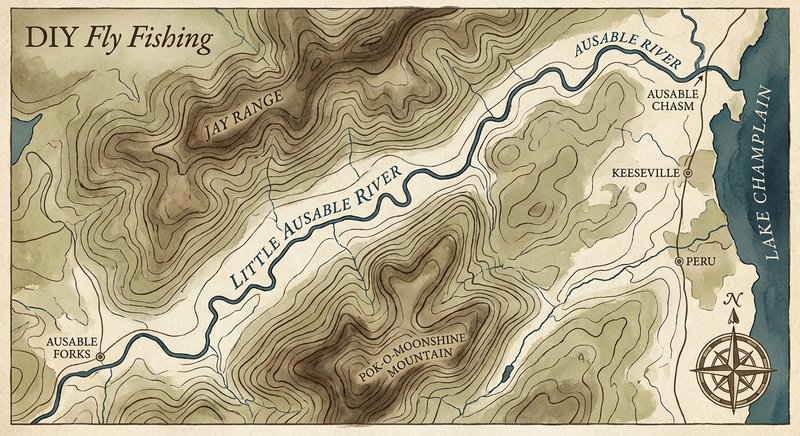
Little Ausable River
Fly fishing in New York · Beginner · Best seasons: Spring, Summer, Fall
Target Species
Brown Trout, Brook Trout
About This Water
Lake Champlain tributary near Plattsburgh. Wild brown and brook trout.
Fishing Recommendations
The Little Ausable River in Clinton County, New York, is often overshadowed by its world-famous cousin, the Ausable River (West and East Branches). However, for the angler who prefers intimacy, solitude, and technical small-water fishing, the Little Ausable is a hidden gem of the Adirondack region.
Here is your comprehensive guide to fly fishing the Little Ausable.
🎣 Location Overview
The Little Ausable is a low-gradient, meandering stream that flows through a mix of agricultural lands and dense woodlands before emptying into Lake Champlain. Unlike the high-energy, boulder-strewn West Branch, the Little Ausable is characterized by sandy bottoms, silty banks, undercut curves, and deep, slow-moving pools.
Anglers love it because it feels like a "secret" river. While the main Ausable can be crowded with tourists, you will often have the Little Ausable entirely to yourself. It requires a different mindset: instead of long, heroic casts, you are playing a game of "stealth and stalks" in a tight, brushy environment.
🐟 Target Species & Behavior
- Brown Trout: The primary resident of the lower and middle sections. These fish are notorious for living under the numerous log jams and deeply undercut banks. They are opportunistic but wary; they stay deep during the day and move into the riffles to feed at dusk.
- Brook Trout: Found predominantly in the cooler headwaters and the smaller feeder tributaries. These are often wild, vibrant fish that are eager to rise to a dry fly but rarely exceed 8–10 inches.
- Behavior: Because the river is smaller, the trout are highly sensitive to "vibrations" on the bank. If you walk heavily, you will see shadows darting away before you even string your rod.
📅 Best Times to Fish
- Spring (Late April – June): This is the "Golden Window." As the snowmelt recedes and the water warms into the 50s, the Hendricksons and Blue-Winged Olives begin to hatch. This is your best chance at a larger Brown Trout.
- Summer (July – August): The river can get low and warm. During this time, focus strictly on the early morning (5 AM – 9 AM) or the last hour of light. Look for areas where cold-water springs enter the main stem.
- Fall (September – October 15): The "Pre-Spawn" season. Brown trout become aggressive and territorial. This is the best time to swing small streamers through the deeper holes near the town of Peru.
🪰 Recommended Flies & Techniques
Top Fly Patterns
- Dries: Parachute Adams (#14–18), Elk Hair Caddis (#12–16), Sulfur Sparkle Dun (#16), and Stimulators (#12) for the pocket water.
- Nymphs: Bead-head Pheasant Tail (#14–18), Gold-Ribbed Hare’s Ear (#14), and Prince Nymphs.
- Terrestrials (Summer): Black Foam Ants and Dave’s Hopper. The river flows through many meadows, making grasshoppers a staple diet in August.
- Streamers: Black or Olive Woolly Buggers (#8–10) and Muddler Minnows.
Effective Techniques
- The "Creeper" Approach: Stay low. Kneel on the bank if you have to. Cast upstream and let your fly drift naturally into the shadows of the undercut banks.
- Nymphing: Use a "High-Stick" technique without a heavy indicator. The water is often shallow enough that a large bobber will spook the fish. A small piece of wool or just watching the end of your fly line is more effective.
- Twitching the Dry: In the slower pools, a slight twitch of a caddis pattern can trigger a strike from a Brown Trout that is otherwise uninterested in a dead drift.
💡 Pro Tips & Local Knowledge
- Focus on the Woody Debris: In the Little Ausable, wood is life. If you see a fallen cedar tree in the water, there is a 90% chance a trout is sitting right under the main trunk.
- The "After Rain" Secret: Because the river flows through farm country, a heavy rain washes worms into the system. If the water is slightly stained (the color of weak tea), a San Juan Worm or a large Squirmy Wormy can be incredibly productive.
- Gear Selection: Leave the 9-foot 5-weight at home. A 7.5-foot to 8-foot 3-weight or 4-weight rod is the tool of choice here. You need a shorter rod to navigate the overhanging branches and tight canopy.
⚠️ Important Information
- Access: Much of the Little Ausable flows through private land. However, New York State has purchased Public Fishing Rights (PFR) along several stretches. Look for the yellow and black "Public Fishing Stream" signs. The area around the village of Peru, NY offers some of the best accessible water.
- Regulations: The Little Ausable generally falls under the North Zone trout regulations (April 1 – Oct 15). However, always check the NYS DEC Freshwater Fishing Regulations for any mid-season changes or specific reach restrictions.
- Wading Safety: The bottom can be very silty and "mucky" in some sections. Test your footing before committing your weight, as it's easy to get a boot stuck in the soft clay/silt.
- Tick Safety: This area is high-density for deer ticks. Wear long sleeves and use Permethrin on your gear, especially when walking through the tall meadow grasses to reach the river.
Guide’s Final Word: The Little Ausable isn't for the angler who wants to brag about 20-inch fish on Instagram. It’s for the angler who loves the smell of cedar, the sound of a quiet woods, and the satisfaction of a perfectly placed 15-foot cast into a tiny pocket of water. Respect the banks, stay low, and the river will reward you.
Bug Hatches & Matching Flies
| Hatch | Type | Peak months | Time of day | Hook sizes | Matching flies |
|---|---|---|---|---|---|
| Blue-Winged Olive Baetis spp. | mayfly | April, May, September, October | Mid-day | #18-22 | BWO Parachute #18-22, RS2 #20-22, Pheasant Tail #18-20 |
| Hendrickson Ephemerella subvaria | mayfly | May | Afternoon | #12-14 | Red Quill #12-14, Hendrickson Emerger #12-14, Hare's Ear #12-14 |
| Grannom Caddis Brachycentrus | caddis | April, May | Morning/Afternoon | #14-16 | Elk Hair Caddis (Dark) #14-16, Peacock Caddis Larva #14-16, Deep Sparkle Pupa #14-16 |
| March Brown Maccaffertium vicarium | mayfly | May, June | Afternoon | #10-12 | March Brown Dry #10-12, Gold Ribbed Hare's Ear #10-12 |
| Light Cahill Stenacron / Stenonema | mayfly | June, July | Evening | #12-14 | Light Cahill #12-14, Cream Usual #14-16 |
| Yellow Sally Isoperla spp. | stonefly | June, July | Evening | #14-16 | Yellow Sally Dry #14-16, Little Yellow Stone Nymph #14-16 |
| Tan Caddis Hydropsyche spp. | caddis | June, July, August | Evening | #14-18 | Tan Elk Hair Caddis #14-18, LaFontaine Sparkle Pupa #16-18, Frenchie #14-18 |
| Terrestrials | terrestrial | July, August, September | Afternoon | #12-18 | Black Foam Ant #16-18, Chernobyl Ant #10-12, Black Beetle #14-16 |