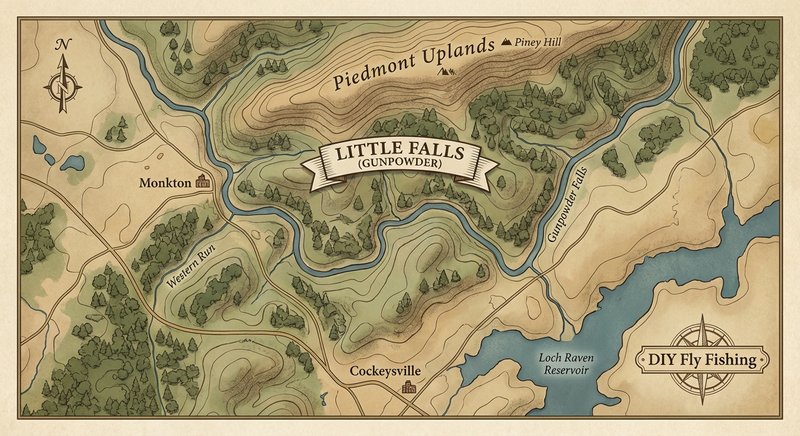
Little Falls (Gunpowder)
Fly fishing in Maryland · Advanced · Best seasons: Spring, Summer, Fall
Target Species
Brown Trout, Brook Trout
About This Water
Gunpowder Falls tributary with wild trout. Technical small stream fishing.
Fishing Recommendations
Welcome to the "Little Brother" of the Maryland fly fishing scene. While the main stem of the Gunpowder Falls gets the national glory, Little Falls is a hidden gem for the angler who prefers intimacy, wild fish, and technical "small water" challenges.
As your guide, here is the deep dive into fishing Little Falls.
🎣 Location Overview
Little Falls is a major tributary to the Gunpowder Falls, flowing through northern Baltimore County near the towns of Hereford and Parkton. Unlike the main stem Gunpowder, which is a tailwater (bottom-release dam), Little Falls is more of a freestone/spring-influenced stream.
What makes it special: It is one of the few places in Maryland where you can find truly wild, stream-born Brown Trout in a setting that feels like the mountains of Vermont, despite being 45 minutes from Baltimore. The water is crystal clear, the canopy is dense, and the fish are notoriously "educated." It’s a place for the purist who values the quality of the stalk over the quantity of the catch.
🐟 Target Species & Behavior
- Wild Brown Trout: These are the kings of Little Falls. They are buttery gold, beautifully spotted, and incredibly wary. They behave like classic wild trout—holding in "prime lies" where they can find maximum protection and minimum current effort.
- Wild Brook Trout: Found primarily in the upper reaches and the tiny "trickle" feeders that enter the main creek. They are smaller (5–8 inches) but possess breathtaking colors.
- Behavior: These fish are spooky. Because the water is often shallow and clear, they have a high sensitivity to shadows and vibration. They hold tight to undercut banks, fallen logs (of which there are many), and the "bubble line" at the head of pools.
📅 Best Times to Fish
- Spring (Mid-March – June): This is the prime window. Water levels are usually stable, and the major hatches occur. Early spring brings Blue Winged Olives (BWO), followed by the legendary Hendricksons and Sulphurs in May.
- Summer (July – August): Fishing becomes very technical. You must fish early morning or late evening. The "Terrestrial" season is huge here—ants and beetles falling from the dense overhead canopy are the primary food source.
- Fall (September – November): A beautiful time to be on the water. Brown trout become more aggressive as they prepare for the spawn. Note: Please avoid stepping on "redds" (clean gravel spawning beds) starting in late October.
🪰 Recommended Flies & Techniques
Top Fly Patterns
- Dry Flies:
- Elk Hair Caddis (Size 16-18): A staple. Use tan or olive.
- Parachute Adams (Size 18-22): The ultimate "searching" pattern.
- Black Ants & Foam Beetles (Size 16-20): Absolute must-haves from June through September.
- Hi-Vis Blue Winged Olive (Size 18-22): For those overcast, drizzly spring days.
- Nymphs:
- Pheasant Tail (Size 18-20): Imitates almost everything.
- Zebra Midge (Size 20-22): Red or Black. Essential for winter and low-water summer.
- Ray Charles or Scud Patterns (Size 16-18): The Gunpowder system is rich in crustaceans; a grey scud is often the "secret weapon."
- Streamers:
- Black Wooly Bugger (Size 10-12): Only used during higher water or "stained" conditions after a rain.
Techniques
- The "Bow and Arrow" Cast: Because the brush is so thick, you will rarely make a traditional overhead cast. Master the bow-and-arrow to get your fly under overhanging branches.
- Dry-Dropper: In the riffles, hang a small Zebra Midge 18 inches below a buoyant Elk Hair Caddis.
- Stealth Approach: Move upstream. Always. If you walk downstream, the silt and your shadow will alert every fish before you get there.
💡 Pro Tips & Local Knowledge
- The NCR Trail (Torrey C. Brown Trail): This rail-trail runs parallel to a large portion of Little Falls. It provides unparalleled access. Park at the Bee Tree Road or Bentley Springs parking lots and walk until you find a stretch that looks "fishy."
- Downsize Everything: Use a 7’6” or 8’ fly rod (3-weight or 4-weight). A 9-foot rod is too long for the tight canopy. You should also use long, supple leaders ending in 6X or 7X fluorocarbon tippet. If you use 4X, these wild fish will laugh at you.
- The "One Cast" Rule: On Little Falls, your first cast is your only real chance. After three casts to the same spot, a wild Brown Trout will usually hunker down and stop feeding.
- Temperature Watch: In the heat of summer, bring a thermometer. If the water hits 68°F (20°C), stop fishing to protect the trout from stress-induced mortality.
⚠️ Important Information
- Access: Much of the land surrounding the creek is part of the Gunpowder Falls State Park, but there are pockets of private property. Respect all "Posted" signs. Use the NCR Trail to stay on public ground.
- Regulations: Little Falls is generally managed under Wild Trout Management regulations. This often means Catch and Release Only and Artificial Lures/Flies Only (No Bait). Always check the Maryland DNR Freshwater Fishing Guide before heading out, as boundaries can change.
- Safety: The rocks in Little Falls are "greasy." Felt-soled boots or studs are highly recommended to avoid a dunking. Watch for ticks—Northern Maryland is prime Lyme Disease territory; use repellent.
Tight lines, and enjoy the solitude of one of Maryland's finest wild trout streams!
Bug Hatches & Matching Flies
| Hatch | Type | Peak months | Time of day | Hook sizes | Matching flies |
|---|---|---|---|---|---|
| Blue-Winged Olive Baetis spp. | mayfly | March, April, October, November | Mid-day/Afternoon | #18-22 | RS2 #18-22, Parachute Adams #18-22, Pheasant Tail #18-20 |
| Quill Gordon Epeorus pluralis | mayfly | March, April | Mid-day | #12-14 | Quill Gordon #12-14, Hare's Ear #12-14 |
| Hendrickson Ephemerella subvariabilis | mayfly | April | Afternoon | #12-14 | Hendrickson Sparkle Dun #12-14, Red Quill #14, Hendrickson Wet Fly #12-14 |
| Sulphur Ephemerella invaria/dorothea | mayfly | May, June | Evening | #14-18 | Sulphur Parachute #14-18, CDC Sulphur Emerger #16-18, Pheasant Tail (Flashback) #16-18 |
| Tan Caddis Hydropsyche spp. | caddis | April, May, June | Evening/Late Afternoon | #14-16 | Elk Hair Caddis (Tan) #14-16, LaFontaine's Deep Sparkle Pupa #14-16, Holy Grail #14-16 |
| Light Cahill Stenacron interpunctatum | mayfly | June, July | Evening/Dusk | #12-14 | Light Cahill #12-14, Cream Usual #14 |
| Terrestrials (Ants and Beetles) Formicidae / Coleoptera | terrestrial | July, August, September | All day | #14-20 | Black Foam Beetle #14-18, Cinnamon Flying Ant #16-20, Chernobyl Ant #12-14 |
| Midges Chironomidae | midge | January, February, March, December | Late Morning/Afternoon | #20-24 | Zebra Midge #20-22, Griffith's Gnat #20-24, Morgan's Midge #22-24 |
| March Brown Maccaffertium vicarium | mayfly | May | Afternoon | #10-12 | March Brown #10-12, Gold Ribbed Hare's Ear #10-12 |