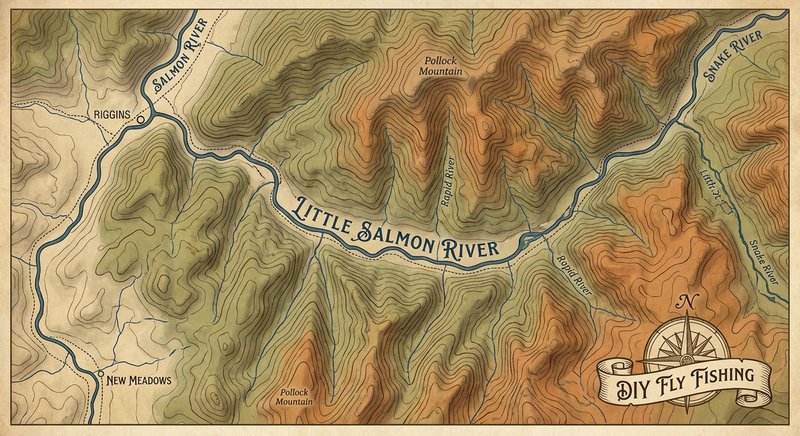
Little Salmon River
Fly fishing in Idaho · Intermediate · Best seasons: Summer, Fall
Target Species
Steelhead, Rainbow Trout
About This Water
Tributary of the main Salmon with steelhead and trout. Good public access near Riggins.
Fishing Recommendations
The Little Salmon River in Idaho is a unique and thrilling destination for fly anglers, offering an intimate river experience for some of the hardest-fighting fish in the Pacific Northwest. Unlike its massive neighbor, the main Salmon River, the "Little Salmon" provides a smaller-scale environment where you can often spot your target before making a cast.
Here is your comprehensive guide to fly fishing the Little Salmon River.
🎣 Location Overview
The Little Salmon River flows north through a dramatic, steep canyon along Highway 95, eventually meeting the main Salmon River at Riggins, Idaho. It is a high-gradient river characterized by "pocket water," plunging pools, and heavy boulder gardens.
What makes it special is the accessibility and the size of the fish relative to the water. In many stretches, the river is barely 30–50 feet wide, yet it holds massive ocean-run Steelhead and hard-fighting resident Rainbows. Anglers love it because it feels like small-stream fishing but with the potential to hook a 12-pound powerhouse that will test every inch of your backing.
🐟 Target Species & Behavior
Steelhead (A-Run)
- Behavior: These are primarily "A-Run" fish, meaning they are smaller (typically 4–8 lbs, though 10+ is possible) and return earlier than the larger B-run fish found in the Clearwater.
- Holding: They favor the "tail-outs" of deep pools and the soft water behind large mid-river boulders. In the Little Salmon, they often hold in surprisingly shallow water (2–4 feet) as they rest during their upstream migration.
- Feeding: While they aren't actively feeding to grow, they strike out of aggression or instinctual memory.
Rainbow Trout (Resident)
- Behavior: These are opportunistic feeders. Because the river is fast and turbulent, they don't have much time to inspect a fly.
- Holding: Look for them in the "seams" (where fast and slow water meet) and in the foam lines.
- Feeding: They focus on stoneflies, caddis, and during the fall, they gorge on eggs dropped by spawning Salmon and Steelhead.
📅 Best Times to Fish
Summer (July – August)
- Focus: Resident Rainbow Trout.
- Conditions: The water is clear and lower. Morning and late evening are best to avoid the heat of the Riggins canyon, which can exceed 100°F.
- Window: This is prime time for dry fly action and "hopper-dropper" rigs.
Fall (October – November)
- Focus: Steelhead (and "Fat" Rainbows).
- Conditions: As the water cools, the first push of Steelhead arrives from the Columbia/Snake system.
- Window: Mid-morning once the sun hits the water is often the "magic hour." Steelhead activity often spikes as the water temperature rises a few degrees.
🪰 Recommended Flies & Techniques
Steelhead Techniques
- Nymphing (The Go-To): Because the river is narrow and rocky, swinging flies is difficult. Indicator nymphing is the most effective method here.
- Flies: Glo-Bugs (Egg patterns) in peach or Oregon cheese, Beadhead Stoneflies (size 4–8), and the "Nightmare" jig fly.
- The "Dink" Link: Use a heavy stonefly nymph as an anchor to get your egg pattern down to the fish's eye level quickly.
Rainbow Trout Techniques
- Dry Fly: Stimulators (Orange or Yellow), Royal Wulffs, and Elk Hair Caddis.
- Streamers: Small Woolly Buggers (Black or Olive) swung through deep pockets can produce the larger resident "Redbands."
Presentation Tip
In the Little Salmon, mending is everything. The complex currents will pull your line instantly. High-sticking (keeping as much line off the water as possible) is often more effective than traditional long-distance casting.
💡 Pro Tips & Local Knowledge
- The "Riggins Hole" vs. The Canyon: The lower few miles near Riggins get crowded. If you want solitude, head south (upstream) into the canyon. The water is tighter, but the fish are there, and the pressure is lower.
- Watch the Boulders: Steelhead in this river love to hide directly in front of large boulders (the "cushion"). Don't just fish the tail-outs; cast into the soft water just upstream of a submerged rock.
- The "Egg Drop": In late fall, resident trout line up behind spawning Chinook or Steelhead. Fishing a single bead or egg pattern 10 feet behind a visible redd (if legal—check regulations) is a surefire way to hook a trophy Rainbow.
- Stealth Matters: Because the river is small, your shadow can spook fish. Wear earthy tones and move slowly when approaching the bank.
⚠️ Important Information
- Access: Highway 95 parallels almost the entire river. There are numerous pull-outs. However, be mindful of private property—some stretches are flanked by private ranches. If it's not posted or fenced, it's generally accessible via the high-water mark, but always respect local landowners.
- Regulations: Idaho Fish and Game (IDFG) rules are strict here.
- You must have a valid Idaho Fishing License and a Steelhead Permit if you are targeting Steelhead.
- Check for "Barbless Hook" requirements, which are standard for Steelhead seasons.
- Note that certain sections may be closed to protect spawning Salmon at specific times of the year. Always check the current IDFG Season & Rules.
- Safety: The canyon walls are steep and the rocks are notoriously slick. Studded wading boots and a wading staff are highly recommended.
Guide’s Final Word: The Little Salmon is a "blue-collar" river—it's rugged, loud, and right next to the highway. But when you hook a chrome Steelhead in a pool no wider than a living room, it’s one of the most electric experiences in fly fishing. Tight lines!
Bug Hatches & Matching Flies
| Hatch | Type | Peak months | Time of day | Hook sizes | Matching flies |
|---|---|---|---|---|---|
| Salmonfly Pteronarcys californica | stonefly | May, June | All day | #4-8 | Rogue River Stone #4-6, Pat's Rubber Leg #6-8, Clark's Stone #6-8 |
| Golden Stonefly Hesperoperla pacifica | stonefly | June, July | Morning/Evening | #8-12 | Chubby Chernobyl (Gold) #8-12, Golden 20-Incher #10-12, Norm Wood Special #8-10 |
| Blue Winged Olive Baetis tricaudatus | mayfly | March, April, September, October | Mid-day | #18-22 | Parachute Adams #18-22, RS2 #20-22, BWO CDC Emerger #18-20 |
| Pale Morning Dun Ephemerella excrucians | mayfly | June, July, August | Morning/Afternoon | #14-18 | PMD Sparkle Dun #16-18, Pheasant Tail #14-18, Split Case PMD #16-18 |
| Spotted Sedge Hydropsyche | caddis | June, July, August, September | Evening | #14-18 | Elk Hair Caddis (Tan) #14-16, LaFontaine's Deep Sparkle Pupa #14-18, Godzilla Caddis #14-16 |
| Western Green Drake Drunella doddsii | mayfly | June, July | Afternoon | #10-12 | Green Drake Hairwing #10-12, Hare's Ear Nymph #10-12, Green Drake Cripple #12 |
| Yellow Sally Isoperla spp. | stonefly | June, July, August | Afternoon/Evening | #14-16 | Yellow Sally Stimulator #14-16, Iron Lotus #16, Little Yellow Sloan #14-16 |
| Grasshopper Orthoptera | terrestrial | July, August, September | Mid-day/Afternoon | #8-12 | Morrish Hopper #8-12, Dave's Hopper #10-12, Amy's Ant #10-14 |
| Mother's Day Caddis Brachycentrus occidentalis | caddis | May | Afternoon | #14-16 | Peacock Caddis #14-16, Holy Grail #14-16, Z-Wing Caddis #14-16 |