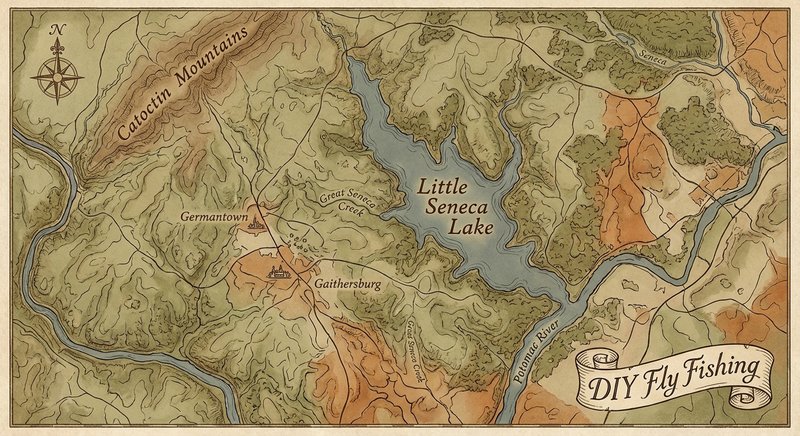
Little Seneca Lake
Fly fishing in Maryland · Beginner · Best seasons: Spring, Summer, Fall
Target Species
Largemouth Bass, Crappie, Bluegill
About This Water
Montgomery County reservoir with bass and panfish. Good family fishing.
Fishing Recommendations
Greetings, angler. It’s a pleasure to guide you through one of Central Maryland’s most productive warm-water fisheries. Little Seneca Lake, located within Black Hill Regional Park in Boyds, is a 505-acre gem. While many fly anglers in Maryland head west for trout, those in the know stay right here for some of the best bass and panfish action in the Mid-Atlantic.
Here is your comprehensive guide to fly fishing Little Seneca Lake.
🎣 Location Overview
Little Seneca Lake is a man-made reservoir characterized by its diverse structure. What makes it special—and challenging—is the sheer amount of submerged timber. When the lake was flooded, many trees were left standing, creating an underwater forest that provides elite habitat for predatory fish.
The water is generally "stained" to "clear," depending on recent rainfall. It features deep creek channels, expansive mud flats, and thick beds of aquatic vegetation (primarily milfoil and lily pads). Because it is an electric-motors-only lake, it remains remarkably quiet and peaceful, making it a perfect destination for kayak anglers and float tubers who want to stealthily approach spooky fish.
🐟 Target Species & Behavior
Largemouth Bass
The "kings" of the lake. Little Seneca is known for producing "chunks"—fat, healthy bass.
- Behavior: They are highly structure-oriented here. In the spring, they move to the shallow bays to spawn. In the summer, they retreat to the edges of the submerged timber or under thick mats of vegetation.
- Feeding: They focus on bluegill, shad, and crawfish.
Crappie (Black and White)
Little Seneca has a massive population of crappie that grow to impressive "slab" sizes.
- Behavior: They school heavily. In early spring, they are in the shallows (2–5 feet). As the water warms, they move to the "vertical" structure—specifically the standing timber in 10–15 feet of water.
- Feeding: Small minnows are their primary target.
Bluegill & Pumpkinseed
These are the backbone of the lake and provide non-stop action.
- Behavior: They inhabit the shoreline fringes and lily pads. During the summer "spawn," you’ll see their circular beds in the sandy shallows of the coves.
- Feeding: Aquatic insects, terrestrials (bees/ants), and small fry.
📅 Best Times to Fish
Spring (April – Early June)
- The Window: This is the prime time for all species. As the water hits 55°F, the crappie move shallow. When it hits 62°F, the bass follow.
- Prime Conditions: Overcast days with a light breeze. The fish are aggressive and guarding nests.
Summer (Late June – August)
- The Window: Early morning (dawn to 9:00 AM) and late evening (7:00 PM to dusk).
- Prime Conditions: Mid-day is tough as fish go deep or under heavy cover. Focus on the "low light" periods for topwater action.
Fall (September – November)
- The Window: As water temperatures drop, bass go on a feeding binge to prepare for winter.
- Prime Conditions: Sunny afternoons. The shallow water warms up faster, attracting baitfish and the bass that hunt them.
🪰 Recommended Flies & Techniques
For Largemouth Bass
- Flies:
- Topwater: Hard-body Poppers (Size 2-4) in Frog or White; BoogleBugs are a local favorite.
- Subsurface: Game Changers (White/Chartreuse) and Weedless Woolly Buggers (Size 4, Olive or Black).
- Technique: Use a weedless setup. Cast into the pockets of lily pads or right against the "stick-ups" (standing timber). Let the ripples settle, then give it two sharp pops. If using streamers, a "strip-strip-pause" retrieve near drop-offs is deadly.
For Crappie
- Flies:
- Micro-Zonkers (White/Silver), Clouser Minnows (Size 8-10, Pink/White), and Crappie Jigs (fly version) with marabou tails.
- Technique: Use a slow, steady retrieve. Crappie often strike on the drop. If you find one, there are fifty more in that exact spot.
For Bluegill
- Flies:
- Bead-head Prince Nymphs (Size 12-14), Foam Spiders, and Rubber-legged Ants.
- Technique: Drop a foam spider near the shore. If they aren't looking up, hang a small nymph 12 inches below the spider (dry-dropper rig).
💡 Pro Tips & Local Knowledge
- Work the "Bridges": The area around the Rt. 121 bridge and the old submerged roadbeds are magnets for fish. The bridge pilings hold fish year-round.
- The "Timber" Strategy: If you are in a boat, look for the "snags" sticking out of the water in the middle of the lake. These are the tops of massive trees. Position yourself upwind and cast your fly as close to the trunk as possible. Bass often sit on the "shady side" of the timber.
- Go Weedless or Go Home: The milfoil in Little Seneca is thick. If your flies don't have a mono weed guard, you will spend more time cleaning your hook than fishing.
- The Stealth Factor: Because it's an electric-only lake, the water is quiet. Long casts and a quiet approach are necessary, especially in the clear water near the dam.
⚠️ Important Information
- Access: The best access is via Black Hill Regional Park. There is a large boat ramp and a separate kayak/canoe launch. Shore access is available near the boat rentals and along the "Black Hill Trail," but a boat/kayak is highly recommended to reach the best timber.
- Regulations:
- A Maryland Non-Tidal Fishing License is required for everyone 16 and older.
- Check the DNR website for current creel limits, though "Catch and Release" is strongly encouraged for Bass to maintain the trophy quality.
- Boating: Gas motors are allowed on the boat but cannot be used. They must be tilted up, and only electric trolling motors may be operated.
- Supplies: There is no fly shop on-site. Be sure to stock up on leaders (0x to 3x for bass, 4x to 5x for panfish) before you arrive.
Little Seneca Lake is a technical but rewarding fishery. Respect the timber, watch the weather, and you'll find some of the finest warm-water fly fishing Maryland has to offer. Tight lines!
Bug Hatches & Matching Flies
| Hatch | Type | Peak months | Time of day | Hook sizes | Matching flies |
|---|---|---|---|---|---|
| Midges Chironomidae | midge | March, April, October, November | All Day | #18-24 | Zebra Midge #18-22, Griffith's Gnat #20-24, Chan's Chironomid Pupa #16-20 |
| Blue Damselfly Enallagma cyathigerum | terrestrial | June, July, August | Late Morning/Afternoon | #10-14 | Marabou Damselfly Nymph #10-12, Braided Butt Damsel #12-14 |
| Speckled Spinner (Callibaetis) Callibaetis ferrugineus | mayfly | May, June, September | Morning | #14-16 | Parachute Adams #14-16, Callibaetis Nymph #14-16, RS2 #16-18 |
| Giant Michigan Mayfly (Hex) Hexagenia limbata | mayfly | June, July | Dusk/Night | #6-10 | Hexagenia Paradun #6-8, Gold Ribbed Hare's Ear #8-10 |
| Green Darner Dragonfly Anax junius | terrestrial | July, August, September | Afternoon | #4-8 | Dragonfly Nymph #4-8, Woolly Bugger (Olive/Brown) #6-10 |
| Black Carpenter Ant Camponotus pennsylvanicus | terrestrial | August, September | All Day | #12-16 | Chernobyl Ant #10-14, Black Foam Ant #14-16 |
| White Winged Black Midge (Caenis) Caenis latipennis | mayfly | July, August | Early Morning | #22-26 | Caenis Spinner #24-26, Micro-midge Pupa #22-24 |
| Spotted Sedge Hydropsyche | caddis | May, June | Evening | #14-18 | Elk Hair Caddis #14-16, LaFontaine's Deep Sparkle Pupa #14-18 |