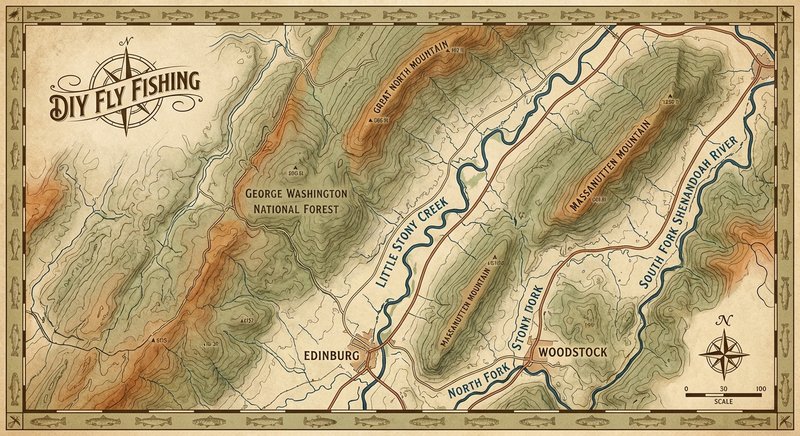
Little Stony Creek
Fly fishing in Virginia · Advanced · Best seasons: Spring, Summer, Fall
Target Species
Brook Trout, Brown Trout
About This Water
Giles County mountain stream with wild trout. Remote backcountry fishing.
Fishing Recommendations
As an expert guide who has spent years roaming the Appalachian freestone streams, I can tell you that Little Stony Creek in Giles County, Virginia, is a crown jewel of the Blue Ridge. Known primarily for the iconic 69-foot waterfall known as "The Cascades," this stream offers some of the most scenic and technically rewarding small-stream fly fishing in the Mid-Atlantic.
Here is your comprehensive guide to fishing Little Stony Creek.
🎣 Location Overview
Little Stony Creek is a classic high-gradient freestone stream located within the Jefferson National Forest. What makes this water special is its dramatic descent; it’s a staircase of plunge pools, boulders the size of Volkswagens, and tight rhododendron-choked runs.
The water is remarkably clear and remains colder than many other Virginia streams due to the heavy canopy cover and high elevation. Anglers love it because it offers a "choose your own adventure" experience: the lower sections are easily accessible and stocked, while the rugged terrain above the main falls holds some of the most beautiful wild trout in the state.
🐟 Target Species & Behavior
- Brook Trout (Native): These are the stars of the upper reaches. They are opportunistic but incredibly "spooky." They hold in the cold, highly oxygenated water at the heads of pools and in tiny "pockets" behind rocks.
- Brown Trout: You will find wild and holdover browns in the middle and lower stretches. They are the "kings" of the deeper plunge pools. Unlike the brookies, browns often tuck deep under ledges or into the shadows of large boulders during the day, coming out to feed during low-light transitions.
- Behavior: Because the current is swift, these fish don't have long to decide. If you don't spook them with your approach, they will often strike aggressively at anything that looks like food.
📅 Best Times to Fish
- Spring (April – June): This is the gold standard. Water levels are usually optimal, and the major hatches (Quill Gordons, March Browns, and Sulphurs) bring fish to the surface.
- Summer (July – August): While other streams get too warm, Little Stony stays fishable. However, you must focus on the early morning or the hour before dark. This is peak Terrestrial Season.
- Fall (September – November): My personal favorite. The Brown Trout become aggressive as they prepare to spawn, and the Brook Trout take on brilliant orange hues. The water is usually low, requiring a very stealthy approach.
- Prime Window: A rising barometer after a light rain is magic here. It stains the water just enough to give you cover from the fish's keen eyesight.
🪰 Recommended Flies & Techniques
Top Fly Patterns
- Dry Flies:
- Elk Hair Caddis (Size 14-18): The bread and butter of this creek.
- Parachute Adams (Size 16-20): For technical sips in slower glides.
- Royal Wulff or Stimulator (Size 12-14): High-visibility attractors for the fast "white water" sections.
- Nymphs:
- Pheasant Tail (Size 16-18): Mimics almost every small mayfly nymph in the creek.
- Bead-head Prince Nymph: Great for getting deep in the heavy plunge pools.
- Terrestrials (Summer):
- Black Foam Ants (Size 18) and Cricket/Beetle patterns.
Techniques
- The "Dry-Dropper" Rig: This is the most effective way to fish Little Stony. Use a buoyant Stimulator or Elk Hair Caddis as your "indicator" and hang a small Pheasant Tail nymph 12–18 inches below it.
- Tight-Line Nymphing: In the deep plunge pools, a standard indicator often gets caught in conflicting currents. High-sticking (keeping your fly line off the water) allows your nymph to sink naturally into the "bucket" where the big browns sit.
- Short Casts: You will rarely cast more than 15–20 feet. Accuracy and mending are far more important than distance.
💡 Pro Tips & Local Knowledge
- The "Hike-In" Rule: The Cascades trail is popular with hikers. Most casual anglers fish within a half-mile of the parking lot. If you hike 2+ miles in (past the main falls), the fishing pressure drops significantly, and the ratio of wild fish increases.
- Stealth is Everything: The water is "gin clear." Wear drab colors (greens and browns) to blend into the rhododendrons. If you can see the fish, they have likely already seen you and won't eat. Always fish upstream so you are approaching the fish from behind their field of vision.
- Check the "Bubbles": Many anglers skip the fast water. On Little Stony, look for the "bubble line" (where foam collects). Trout sit right under that foam because it provides cover and a concentrated food lane.
⚠️ Important Information
- Access: The primary access is via the Cascades Day Use Area near Pembroke, VA. There is a nominal daily parking fee ($3.00 - $5.00 typically).
- Regulations: Little Stony has sections with different regulations. The area above the falls is generally managed as Wild Trout Water (check the current VA Department of Wildlife Resources (DWR) digest for specific creel limits and lure restrictions—usually single-hook artificial lures only).
- Safety: The rocks here are notoriously slippery (covered in "didymo" or slick moss). Felt-soled boots or studs are highly recommended. Cell service is non-existent once you enter the gorge, so let someone know your plan.
- Permits: You need a valid Virginia Freshwater Fishing License and a National Forest Permit.
If you respect the water and move quietly, Little Stony Creek will provide one of the best "mountain trout" experiences in the Eastern United States. Tight lines!
Bug Hatches & Matching Flies
| Hatch | Type | Peak months | Time of day | Hook sizes | Matching flies |
|---|---|---|---|---|---|
| Quill Gordon Epeorus pleuralis | mayfly | March, April | Mid-day | #12-14 | Quill Gordon Dry #12-14, Quill Gordon Wet #12-14 |
| Blue Quill Paraleptophlebia adoptiva | mayfly | April | Late Morning | #16-18 | Blue Quill Dry #16-18, Pheasant Tail #16-20 |
| Hendrickson Ephemerella subvaria | mayfly | April, May | Afternoon | #12-14 | Red Quill #12-14, Hendrickson Emerger #14 |
| March Brown Maccaffertium vicarium | mayfly | May | Afternoon | #10-14 | March Brown Dry #10-12, Gold Ribbed Hare's Ear #10-14 |
| Sulfur Ephemerella dorothea | mayfly | May, June | Evening | #14-18 | Sulfur Parachute #14-18, Sulfur CDC Emerger #16 |
| Yellow Sally Isoperla spp. | stonefly | June, July | Afternoon/Evening | #14-16 | Yellow Stimulator #14-16, Little Yellow Stone Nymph #14-16 |
| Cinnamon Caddis Hydropsyche spp. | caddis | May, June, September | Evening | #14-16 | Elk Hair Caddis (Tan/Ginger) #14-16, LaFontaine's Deep Sparkle Pupa #14-16 |
| Blue-Winged Olive Baetis spp. | mayfly | March, October, November | Mid-day/Overcast | #18-22 | BWO Sparkle Dun #18-22, RS2 #20-22 |
| Light Cahill Stenacron interpunctatum | mayfly | June, July, August | Evening | #12-14 | Light Cahill #12-14, Cream Usual #14 |
| Terrestrials Formicidae / Coleoptera | terrestrial | July, August, September | All Day | #12-18 | Black Foam Ant #14-18, Cricket/Beetle Pattern #12-16 |