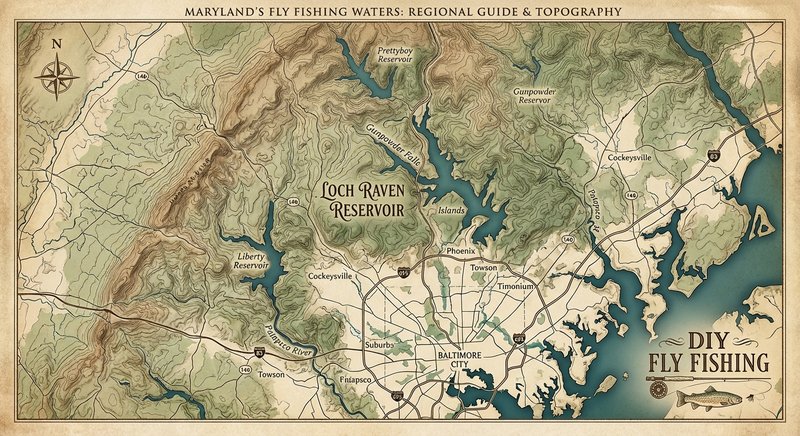
Loch Raven Reservoir
Fly fishing in Maryland · Beginner · Best seasons: Spring, Summer, Fall
Target Species
Largemouth Bass, Rainbow Trout, Crappie
About This Water
Baltimore area reservoir with largemouth bass and stocked trout. Scenic fishing close to city.
Fishing Recommendations
As your guide for the day, let’s talk about one of Central Maryland’s true gems. Located just north of Baltimore, Loch Raven Reservoir offers over 2,400 acres of water surrounded by 1,600 acres of protected forest. For the fly angler, it is a unique challenge: it’s deep, clear, and requires a different tactical approach than your typical farm pond or mountain stream.
🎣 Location Overview
Loch Raven is a primary drinking water source for Baltimore, which means the water quality is exceptional and the environment is strictly preserved. Unlike many Maryland lakes, gasoline motors are prohibited—only electric trolling motors or oars are allowed. This creates a peaceful, quiet atmosphere.
The reservoir is characterized by steep drop-offs, underwater rock ledges, and vast submerged "forests" of hydrilla and milfoil. The water is remarkably clear for the region, meaning the fish can be "spooky," but they also grow large and healthy due to a massive forage base of alewives (blueback herring) and perch.
🐟 Target Species & Behavior
Largemouth Bass
These are the kings of the reservoir. Because of the clear water, Loch Raven bass often behave more like "suspending" fish than southern bass.
- Behavior: They relate heavily to the weed lines and the points of the many "fingers" (coves) of the lake.
- Feeding: They primary gorge on alewives and bluegill. In late summer, they will move deep (20+ feet) during the day and push into the shallows at dawn and dusk.
Rainbow Trout
Wait, trout in a reservoir? Yes. While not a "wild" fishery, the Maryland DNR stocks the tributaries (like the Big Gunpowder Falls) and the main stem. During the cooler months, these trout migrate into the main reservoir.
- Behavior: They cruise the cooler, oxygenated inlets and the main dam area. They are often found deeper than you'd expect once the sun hits the water.
Crappie
Loch Raven holds "slabs"—massive black and white crappie.
- Behavior: They are highly structure-oriented. Look for "beaver lodges," submerged timber, or the pilings of the bridges (Dulaney Valley Road).
- Feeding: They are strictly minnow feeders here.
📅 Best Times to Fish
- Spring (Late March – May): Prime Time. As the water hits 55°F, bass move to the shallows to spawn. Crappie congregate around submerged wood in 5-10 feet of water.
- Summer (June – August): Best for low-light conditions. Focus on the first 90 minutes of daylight and the "golden hour" before sunset. During the day, fish deep or in the thickest grass.
- Fall (September – November): The "Second Spring." As water temperatures drop, bass become aggressive, chasing baitfish into the backs of coves. This is when you'll see "surface boils."
🪰 Recommended Flies & Techniques
For Largemouth Bass
- Topwater: Dahlberg Divers or Deer Hair Poppers in white/silver to mimic alewives. Use a "pop-and-pause" retrieve over the submerged weed beds.
- Streamers: Game Changers or clouser minnows (Chartreuse/White).
- The "Loch Raven Special": Use an intermediate sinking line to get a Murdoch Minnow down 5–8 feet along the edges of the drop-offs.
For Rainbow Trout
- Patterns: Woolly Buggers (Olive or Black) and Zebra Nymphs under an indicator near the mouth of the Gunpowder.
- Technique: If fishing from the shore near the bridges, use a slow strip-and-stop retrieve with a size 10 Bead-head Prince Nymph.
For Crappie
- Patterns: Micro-jig flies or small Marabou Streamers (White/Pink or Chartreuse) in sizes 8-12.
- Technique: Use a floating line with a long leader. Cast near timber, let the fly sink for a count of 10, and use tiny, rhythmic pulses.
💡 Pro Tips & Local Knowledge
- The "Drop-Off" Rule: In Loch Raven, the fish love "verticality." If you find a spot where the bank drops from 3 feet to 15 feet rapidly, you’ve found a honey hole. Bass use these as elevators to move between feeding and resting zones.
- Focus on the Points: The reservoir is full of long points of land. The windward side of these points usually pushes baitfish into a concentrated area—always fish the side where the wind is blowing into the shore.
- Stealth Matters: Because the water is clear, long casts are your friend. If you can see the fish, they have likely already seen your boat or your silhouette.
- The Bridges: The areas around the Dulaney Valley Bridge and Jarrettsville Pike Bridge create "pinch points" for current and baitfish. These are high-traffic areas for fish and anglers alike.
⚠️ Important Information
- Permits: You need a Maryland Non-Tidal Fishing License. Additionally, if you bring your own boat (kayak/canoe), you must have a specific Loch Raven Fishing Center permit.
- Boat Rentals: The Loch Raven Fishing Center (off Dulaney Valley Rd) is the only place to rent boats. They provide boats with electric motors. Note: You cannot bring your own electric motor; you must use theirs or row.
- Strict Regulations: No wading and no swimming. This is a reservoir; you must fish from a boat or from designated shoreline spots (usually near the bridges).
- Seasonality: The Fishing Center usually opens in April and closes in October. Shore fishing is available year-round, but check local signage for park hours (usually sunrise to sunset).
Guide’s Final Word: Bring a 6-weight rod for the bass to handle the wind and the weeds, and a 4-weight for the crappie. If the sun is high and the bite dies, tie on a heavy Clouser and fish the deep rocky points—there's always a big bass waiting in the shadows!
Bug Hatches & Matching Flies
| Hatch | Type | Peak months | Time of day | Hook sizes | Matching flies |
|---|---|---|---|---|---|
| Chironomids (Midges) Chironomidae | midge | March, April, October, November | All day | #18-24 | Zebra Midge #18-22, Griffith's Gnat #20-22, Palomino Midge #20-24 |
| Blue Winged Olive Baetis | mayfly | April, May, September, October | Afternoon | #18-22 | RS2 #20-22, Parachute BWO #18-20, Pheasant Tail Nymph #18-20 |
| Damselfly Enallagma | terrestrial | June, July, August | Morning/Afternoon | #10-14 | Marabou Damsel Nymph #12-14, Adult Damsel Dry #10-12 |
| Hexagenia (Great Olive Winged Drake) Hexagenia limbata | mayfly | June, July | Late Evening/Dusk | #6-10 | Hexagenia Nymph #6-8, Hexagenia Spinner #6-10 |
| Black Ants Formicidae | terrestrial | July, August, September | Afternoon | #12-18 | Black Foam Ant #14-16, Cinnamon Ant #16-18 |
| Japanese Beetle Popillia japonica | terrestrial | July, August | Afternoon | #10-14 | Foam Beetle #12-14, Coffee's Sparkle Beetle #12-14 |
| White Miller Nectopsyche | caddis | July, August | Evening | #12-16 | White EHC (Elk Hair Caddis) #14-16, White Miller Soft Hackle #14-16 |
| Dragonfly Anisoptera | terrestrial | June, July, August | Afternoon | #4-10 | Dragonfly Nymph (Dredger) #6-10, Chernobyl Ant #8-10 |