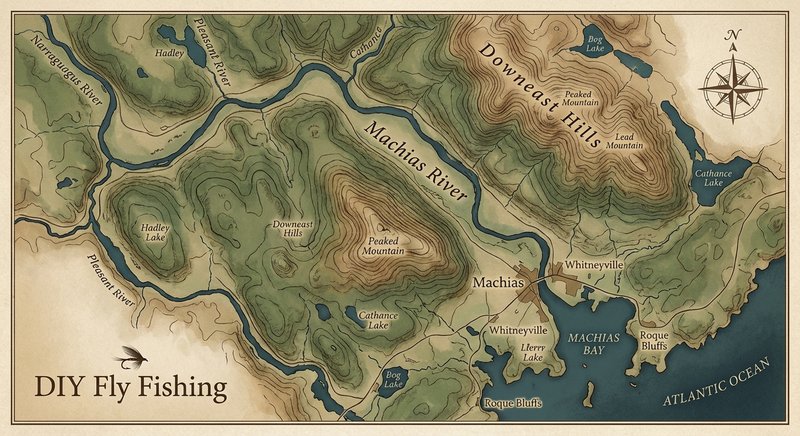
Machias River
Fly fishing in Maine · Intermediate · Best seasons: Summer, Fall
Target Species
Atlantic Salmon, Brook Trout
About This Water
Washington County river with Atlantic salmon restoration. Wild brook trout in tributaries.
Fishing Recommendations
The Machias River is a jewel of the "Downeast" Maine wilderness. It is one of the few remaining free-flowing rivers in the Eastern United States, running from the glacial lakes of the interior through rugged pine forests to the Atlantic.
As your guide, I must lead with a critical piece of information: The Machias River is one of the last strongholds for the endangered Atlantic Salmon. While they are a "target" in terms of interest and ecology, federal and state laws strictly prohibit directed fishing for Atlantic Salmon. However, the river offers world-class pursuit of wild Brook Trout and a chance to stand in some of the most historic salmon pools in North America.
🎣 Location Overview
The Machias is the epitome of "wild Maine." Characterized by its tannin-stained "root beer" water, the river flows through a landscape of granite boulders, steep drops, and expansive "deadwaters" (slow-moving stretches).
What makes it special is its lack of dams. It is a primal waterway where the pulse of the Atlantic still dictates the movement of fish. Anglers love the Machias for its solitude; it is common to spend a whole day on the water without seeing another soul. The river transitions from technical Class II-III rapids to serene, deep pools, requiring an angler to be versatile and mobile.
🐟 Target Species & Behavior
Brook Trout (Native)
The Machias is home to vibrant, wild Brook Trout. These are not your average hatchery fish; they are deep-colored with fiery orange bellies and blue-haloed spots.
- Behavior: They are opportunistic but wary. In the summer, they seek "cold water refugia"—deep holes where springs seep in or the mouths of cold tributaries.
- Sea-Run "Salters": In the lower reaches, you may find "salters"—Brookies that migrate to the estuary. They are silver-sided and exceptionally strong.
Atlantic Salmon (Endangered - Protected)
- Status: You cannot legally target Atlantic Salmon in the Machias River.
- Behavior: If you see a large, silver fish leaping in a pool, it is likely a salmon. They hold in the "tailouts" of pools or in the "cushion" in front of large boulders.
- Note: If you hook one accidentally while trout fishing, you are required by law to keep the fish in the water and release it immediately.
📅 Best Times to Fish
Summer (Late June – August)
- Conditions: Water levels drop and temperatures rise.
- Strategy: Focus on the early morning (5:00 AM – 9:00 AM) and the "golden hour" before dusk. This is prime time for dry fly action. Look for "bubble lines" where the current carries insects.
Fall (September)
- Conditions: The "Grand Finale." As water temperatures drop, Brook Trout become aggressive and move toward spawning gravel.
- Strategy: This is the best time for streamers. The fish are dressed in their spawning colors and are highly territorial.
- Windows: Overcast, drizzly days are arguably the best fishing days in Maine. The low light brings the big trout out from under the logs.
🪰 Recommended Flies & Techniques
Because of the dark, tannin-stained water, visibility is key.
Top Fly Patterns
- Streamers:
- Black Ghost: A Maine classic. The white wing stands out beautifully in dark water.
- Muddler Minnow: Excellent for imitating sculpins or even large grasshoppers.
- Woolly Bugger (Olive or Black): With a copper or gold bead for flash.
- Dry Flies:
- Stimulators (Orange or Yellow): Great high-floaters for rough water.
- Elk Hair Caddis: A staple for summer evenings.
- Royal Wulff: High visibility in the foam.
- Nymphs:
- Pheasant Tail (Bead Head): Sizes 14-18.
- Prince Nymph: The flash helps in the tea-colored water.
Techniques
- The "Downeast" Swing: Cast a streamer 45 degrees downstream, let it sink, and swing it through the current. Give it small "strips" to mimic a fleeing baitfish.
- Piping the Pockets: Use a short line to drop dry flies into the soft water behind large boulders. Brookies love to sit in the "dead spot" behind a rock and wait for food to pass.
💡 Pro Tips & Local Knowledge
- Target the "Deadwaters": Many anglers focus only on the rapids. However, the deep "deadwaters" hold the largest Brook Trout. Use a canoe to access these reaches and fish the submerged timber.
- Watch the Temperature: If the water temperature hits 70°F, stop fishing for trout. They are under high stress in warm water and the mortality rate for catch-and-release skyrockets.
- Color Choice: In the Machias, Black and Gold is the winning color combination. Gold beads, gold tinsel, or black wings provide the best contrast against the tannin water.
- Key Spots: Focus on the areas around Wigwam Rapids and Holmes Falls. These sections provide the oxygen and structure that trout crave.
⚠️ Important Information
- Access: Much of the river is accessed via logging roads (Stud Mill Road). These are active haul roads; logging trucks always have the right of way. Keep your headlights on and give them room.
- Regulations: Always check the Maine IF&W Open Water Regulations. The Machias has specific "S-Codes" (Special Regulations) regarding tackle (often Fly Fishing Only or Artificial Lures Only).
- Salmon Awareness: It is illegal to even cast at a surfacing Atlantic Salmon. If you are caught doing so by a Game Warden, fines are heavy and gear seizure is possible.
- Safety: This is remote country. There is zero cell service. Carry a physical map, a spare tire, and a first aid kit. The black flies and mosquitoes in early summer are legendary—bring heavy-duty repellent or a head net.
Guide’s Final Word: The Machias is a place for the soul. Don't just count the fish; take in the scent of the balsam fir and the sound of the water. It is one of the last truly wild places in the East. Tight lines!
Bug Hatches & Matching Flies
| Hatch | Type | Peak months | Time of day | Hook sizes | Matching flies |
|---|---|---|---|---|---|
| Blue-Winged Olive Baetis | mayfly | April, May, September, October | Midday | #18-22 | BWO Sparkle Dun #18-20, Pheasant Tail #18-22, RS2 #20 |
| Hendrickson Ephemerella subvaria | mayfly | May | Afternoon | #12-14 | Hendrickson Dark Dun #12-14, Red Quill Spinner #14, Hendrickson Nymph #12-14 |
| Grannom Caddis Brachycentrus | caddis | May | Morning/Evening | #14-16 | Green Weenie #14-16, Elk Hair Caddis (Olive) #14-16, LaFontaine's Deep Pupa #14 |
| March Brown Maccaffertium vicarium | mayfly | June | Afternoon | #10-12 | March Brown American #10-12, Gold Ribbed Hare's Ear #10-12, March Brown Wet Fly #10-12 |
| Black Fly Simulium | midge | May, June | All Day | #18-24 | Zebra Midge (Black) #18-22, Griffith's Gnat #18-24, Black Gnat #18-20 |
| Light Cahill Stenonema/Stenacron | mayfly | June, July | Evening | #12-14 | Light Cahill #12-14, Cahill Nymph #12-14 |
| Golden Stonefly Acroneuria | stonefly | June, July | Morning/Night | #6-10 | Kaufmann's Stone #6-10, Golden Stimulator #8-12 |
| White Miller Ephoron leukon | mayfly | August | Late Evening/Dusk | #12-14 | White Wulff #12-14, Ephoron Spinner #12-14 |
| Eastern Trico Tricorythodes | mayfly | July, August, September | Early Morning | #22-26 | Trico Spinner #22-26, Trico Dun #22-24 |
| Terrestrials (Ants & Beetles) Formicidae/Coleoptera | terrestrial | July, August, September | All Day | #12-18 | Chernobyl Ant #10-14, Black Foam Beetle #14-16, Cinnamon Ant #16-18 |