Mad River
Fly fishing in Vermont · Intermediate · Best seasons: Spring, Summer, Fall
Target Species
Brown Trout, Brook Trout
About This Water
Central Vermont freestone stream near Sugarbush. Wild brown and brook trout in challenging pocket water.
Fishing Recommendations
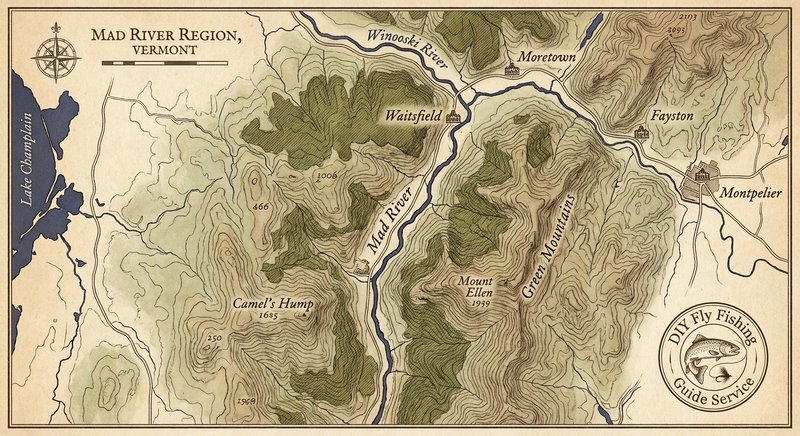
The Mad River in Central Vermont is one of the most quintessential "Green Mountain" fly fishing experiences. Winding through the scenic Mad River Valley—past covered bridges, steep mountain gaps, and the towns of Warren and Waitsfield—it is a classic freestone river.
As your guide, here is the deep dive into fishing this beautiful, sometimes moody, but highly rewarding fishery.
🎣 Location Overview
The Mad River is a medium-sized freestone stream that originates in the mountains of Granville and flows north to join the Winooski River. It is characterized by its high gradient, crystal-clear water, and dramatic "pocket water" structure.
What makes it special is its diversity of water. In the upper reaches near Warren, you’ll find tight, technical pockets and plunging pools. As you move toward Moretown, the river widens into larger runs and deep, slow pools. It is a "flashy" river, meaning it rises and falls quickly with rain, which keeps the bottom clean and the fish active.
🐟 Target Species & Behavior
Brown Trout
The Mad is famous for its Brown Trout. While there is a healthy stocking program, there are significant populations of wild, holdover Browns, especially in the deeper holes and undercut banks.
- Behavior: They are wary and light-sensitive. They love structure—look for them under the "Mad River boulders," beneath overhanging trees, and at the very tail-outs of pools during low light.
Brook Trout
Native Brookies dominate the upper headwaters and the many cold-water tributaries (like Mill Brook).
- Behavior: Aggressive and opportunistic. They hold in the faster, highly oxygenated "white water" pockets. If there is a basketball-sized rock with a soft eddy behind it, a Brookie is likely there.
📅 Best Times to Fish
Spring (May – Mid-June)
This is "hatch season." Once the snowmelt (runoff) subsides, usually by mid-May, the river comes alive.
- Conditions: High but clear water is prime.
- Window: Mid-day (11:00 AM – 3:00 PM) when the water warms slightly.
Summer (Late June – August)
The water drops and clears. This is technical fishing time.
- Conditions: Water temperature is critical. If the water hits 70°F, stop fishing to protect the trout.
- Window: First light and last light. The "evening rise" in July is legendary.
Fall (September – October)
My favorite time. The Browns become aggressive as they prepare to spawn, and the Brookies take on brilliant orange hues.
- Conditions: Crisp mornings and low, clear water.
- Window: All day, but focus on the afternoons as the sun warms the rocks.
🪰 Recommended Flies & Techniques
Top Fly Patterns
- Dry Flies:
- Hendrickson (Size 12-14): The first major hatch in May.
- Elk Hair Caddis (Size 14-18): The "bread and butter" of the Mad River. Tan and Olive are best.
- Royal Wulff / Stimulator: Excellent for the fast pocket water in the upper sections.
- Terrestrials: Black foam ants and beetles are lethal in August.
- Nymphs:
- Pheasant Tail (Size 14-18): Classic for a reason.
- Prince Nymph: Works well in the faster runs.
- Pats Rubber Legs: Great for high water or "big fish" hunting in Moretown.
- Streamers:
- Woolly Bugger (Black or Olive): Swing these through deep holes in the fall.
Techniques
- Dry-Dropper: This is the most effective way to fish the Mad. Use a buoyant Stimulator as your indicator and hang a small beaded Pheasant Tail 18 inches below it.
- Tight-Line Nymphing: Because the river is so rocky, traditional indicator fishing often results in "micro-drag." A Euro-style or tight-line approach allows you to get deep into the pockets.
💡 Pro Tips & Local Knowledge
- The "Moretown Gap": If you are looking for a trophy Brown, focus on the lower river near Moretown. The water is deeper and the fish have more room to grow.
- Avoid the Swimming Holes: The Mad River is popular with locals for swimming (e.g., Warren Falls). During summer afternoons, these spots will be crowded. Walk 200 yards up or downstream from any bridge, and you’ll usually find solitude.
- Watch the Gauge: Use the USGS gauge at Moretown. If the flow is above 400 cfs, it's difficult to wade. Between 150-250 cfs is the "sweet spot" for most anglers.
- Stealth is Key: Because the water is so clear, trout can see you from a distance. Wear earthy colors (olive/tan) and approach pools from downstream.
⚠️ Important Information
- Access: Vermont has generous access laws, but always look for "Posted" signs. Most of the river along Route 100 has pull-offs. The Lareau Park in Waitsfield and the Moretown recreation fields offer excellent public access.
- Regulations: The Mad River generally follows Vermont General Trout Waters regulations (Open 2nd Saturday in April to Oct 31). However, check the VT Fish & Wildlife digest for specific "Catch and Release Only" sections that may be implemented seasonally.
- Permits: You need a valid Vermont Fishing License, which can be purchased online.
- Wading Safety: The rocks in the Mad are notoriously slippery (covered in "didymo" or rock snot at times). Studded wading boots and a staff are highly recommended.
Guide’s Final Word: The Mad River doesn't always give up its secrets easily, but if you fish the pockets with a Caddis and stay stealthy, it's one of the most rewarding days you can have in New England. Tight lines!
Bug Hatches & Matching Flies
| Hatch | Type | Peak months | Time of day | Hook sizes | Matching flies |
|---|---|---|---|---|---|
| Blue-Winged Olive Baetis | mayfly | April, May, September, October | Mid-day/Afternoon | #18-22 | RS2 #20-22, Parachute BWO #18-20, BWO CDC Emerger #18-22 |
| Hendrickson Ephemerella subvaria | mayfly | May | Afternoon | #12-14 | Red Quill #12-14, Pheasant Tail Nymph #12-14, Hendrickson Sparkle Dun #12-14 |
| March Brown Maccaffertium vicarium | mayfly | May, June | Afternoon | #10-12 | March Brown Wet #10-12, March Brown Parachute #10-12, Hare's Ear Nymph #10-12 |
| Sulphur Ephemerella invaria/dorothea | mayfly | June, July | Evening | #14-18 | Sulphur Parachute #14-18, Sulphur Emerger #16-18, Sulphur Cripple #16 |
| Tan Caddis Hydropsyche | caddis | May, June, July | Morning/Evening | #14-16 | Elk Hair Caddis (Tan) #14-16, Pupa-Le-Do #14-16, Holy Grail #14-16 |
| Light Cahill Stenacron interpunctatum | mayfly | June, July | Late Afternoon/Evening | #12-14 | Light Cahill #12-14, Gold Ribbed Hare's Ear #12-14 |
| Isonychia Isonychia bicolor | mayfly | July, August, September | Evening | #10-12 | Iso Nymph #10-12, Purple Haze #12, Wulff Royal #10-12 |
| Yellow Sally Isoperla | stonefly | June, July | Afternoon/Evening | #14-16 | Yellow Sally Dry #14-16, Kaufmann's Mini Stone #14-16 |
| Ants and Beetles Formicidae/Coleoptera | terrestrial | July, August, September | All Day | #12-18 | Cinnamon Ant #16-18, Black Foam Beetle #14-16, Chernobyl Ant #10-12 |