Magalloway River
Fly fishing in Maine · Intermediate · Best seasons: Summer, Fall
Target Species
Brook Trout, Landlocked Salmon
About This Water
Northwestern Maine river with excellent brook trout. Remote wilderness fishing near NH border.
Fishing Recommendations
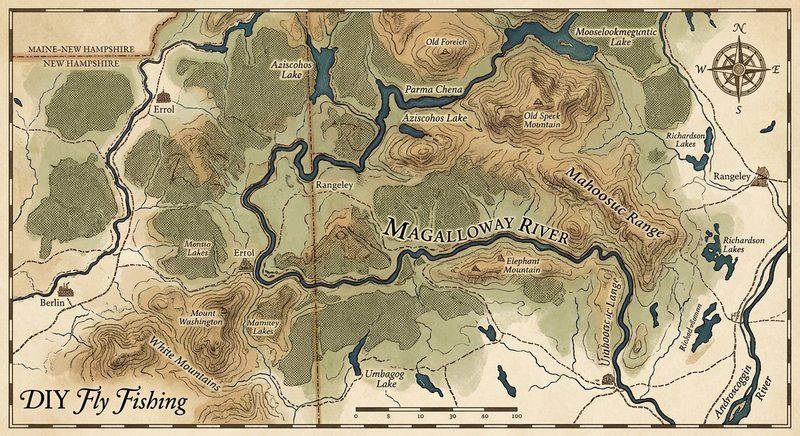
The Magalloway River is the crown jewel of the Rangeley Lakes region in Western Maine. Flowing from Aziscohos Lake down to Umbagog Lake, it is a quintessential "Northwoods" river, characterized by cold, gin-clear water, rugged boulder gardens, and some of the largest wild Brook Trout and Landlocked Salmon in the lower 48 states.
As your guide, here is everything you need to know to find success on these historic waters.
🎣 Location Overview
The Magalloway is a classic tailwater, but don’t let that label fool you—it feels entirely wild. The most famous stretch is the Upper Magalloway, specifically the section below Aziscohos Dam. This is "big fish" territory.
The river is defined by its diversity: you’ll find turbulent pocket water, long glassy pools, and deep runs. What makes it special is its cold-water refuge. Because the water is drawn from the bottom of Aziscohos Lake, the river stays chilly even in the heat of August, making it a reliable summer sanctuary when other Maine rivers become too warm to fish safely.
🐟 Target Species & Behavior
Wild Brook Trout
These are not your average "brookies." The Magalloway holds "trophy" specimens, often reaching 18–22 inches.
- Behavior: They are opportunistic but cautious. In the summer, they hug the cold bubbles of oxygenated pocket water. In the fall, they become aggressive as they prepare to spawn, moving into shallower gravel runs.
- Feeding: They keyed into the prolific caddis and stonefly hatches but will rarely pass up a well-presented terrestrial or a bulky streamer.
Landlocked Atlantic Salmon
The "Silver Leaper" of the north. These fish are known for their explosive runs and aerial acrobatics.
- Behavior: Salmon are current-oriented. They love the "seams" where fast water meets slow water. They are notorious for holding in the very top of a pool (the "riffle") or the very tail-out.
- Feeding: They are highly focused on smelt (their primary forage in the lakes) and specific insect hatches like the Isonychia.
📅 Best Times to Fish
Summer (July – August)
While many rivers shut down, the Magalloway shines.
- Window: Early morning and late evening are best for dry fly action.
- Conditions: Look for consistent dam releases. Steady flows mean happy fish. This is the prime time for "match the hatch" technical fishing.
Fall (September – October)
This is the "magic hour" for the Magalloway.
- Window: All day. As the water cools and the days shorten, the fish move up from Umbagog Lake into the river to spawn.
- Conditions: The fish are at their most colorful and aggressive. Late September is arguably the best time of year to land a 4-pound Brook Trout. Note: The season typically ends September 30th on the river, but some lower sections/lakes remain open—always check current Maine IF&W laws.
🪰 Recommended Flies & Techniques
Dry Flies
- Caddis: Elk Hair Caddis (Tan/Olive, #14-18).
- Stoneflies: Golden Stones (#8-12) for summer.
- Terrestrials: Chernobyl Ants, Foam Beetles, and Hopper patterns in August.
- The "Iso": Isonychia patterns (#10-12) are deadly in late summer/early fall.
Nymphs
- The "Magalloway Special": A Bead-head Pheasant Tail (#14-18) is the gold standard here.
- Pat's Rubber Legs: Black or Brown (#8-12) to imitate the large stoneflies.
- Prince Nymphs: High visibility in the bubbly pocket water.
Streamers (The Local Choice)
- Black Ghost: A classic Maine pattern for Salmon.
- Grey Ghost: Mimics the smelt that Salmon crave.
- Muddler Minnow: Fished on a swing or stripped fast.
- Wooly Buggers: Olive or Black with some flash.
Techniques
- The "Swing": For Salmon, cast across and slightly downstream, letting the streamer swing through the current.
- High-Stick Nymphing: Essential for the boulder-heavy pocket water where complex currents cause drag.
- Dry-Dropper: A large foam dry with a small nymph 2 feet below is the most effective way to cover water in the summer.
💡 Pro Tips & Local Knowledge
- The "Long Pool": Located just below the dam, it’s the most famous spot. It holds the most fish, but also the most anglers. If it's crowded, hike downstream. The "Lower Magalloway" below the covered bridge offers more solitude and excellent fall fishing.
- Stealth Matters: The water is clear. Use long leaders (9-12 feet) and fluorocarbon tippet (4X or 5X) for nymphs. For dry flies, 5X is usually necessary.
- Watch the Flows: The Magalloway is a regulated river. Check the Brookfield Renewable US flow gauges for "Magalloway River at Aziscohos Dam." Ideal wading flows are generally between 200 and 400 cfs. Anything over 600 cfs becomes difficult and dangerous to wade.
- The "Maine Twitch": When fishing a dry caddis, give it a tiny skate or twitch. These fish react to the movement of a natural insect trying to take flight.
⚠️ Important Information
- Access: The most popular access is via the Wilsons Mills Road (Route 16). There is a parking area near the bridge below the dam.
- Regulations: The Magalloway has specific "Fly Fishing Only" (FFO) sections and strict catch-and-release rules for certain species. You must carry a valid Maine Fishing License.
- Safety: The rocks in the Magalloway are incredibly slick. Felt-soled boots with studs are highly recommended. A wading staff is not just a suggestion—it's a necessity.
- Wildlife: This is moose and bear country. Keep a clean camp/vehicle and be alert when hiking through the thick brush along the river banks.
Tight lines, and enjoy the beauty of the Maine woods!
Bug Hatches & Matching Flies
| Hatch | Type | Peak months | Time of day | Hook sizes | Matching flies |
|---|---|---|---|---|---|
| Hendrickson Ephemerella subvaria | mayfly | May, June | Afternoon | #12-14 | Red Quill #12-14, Hendrickson Emerger #14, Pheasant Tail #12-16 |
| Blue-Winged Olive Baetis spp. | mayfly | May, September, October | Late Morning/Afternoon | #18-22 | BWO Sparkle Dun #18-22, RS2 #20-22, WD-40 #18-22 |
| Green Drake Ephemera guttulata | mayfly | June, July | Evening | #8-10 | Green Drake Paradox #8-10, Coffin Fly #8-10, Hare's Ear #8-12 |
| Grannom Caddis Brachycentrus | caddis | May | All Day | #14-16 | Elk Hair Caddis (Olive/Black) #14-16, Deep Sparkle Pupa #14-16, Peacock Caddis #16 |
| Golden Stonefly Acroneuria spp. | stonefly | June, July | Morning/Evening | #6-10 | Kaufmanns Stone #6-10, Golden Stimulator #8-12, Pat's Rubber Legs #6-10 |
| Slate Drake Isonychia bicolor | mayfly | July, August, September | Afternoon | #10-12 | Iso Parachute #10-12, Isonychia Nymph #10-12, Zug Bug #12 |
| Pale Evening Dun Ephemerella dorothea | mayfly | June, July | Evening | #16-18 | Pale Evening Dun #16-18, Sulfur Parachute #16-18, Dorothea Emerger #16-18 |
| Light Cahill Stenacron/Stenonema | mayfly | July, August | Evening | #12-14 | Light Cahill #12-14, Cream Usual #14, Gold Ribbed Hare's Ear #14 |
| Cinnamon Caddis Hydropsyche | caddis | July, August | Evening | #14-18 | Elk Hair Caddis (Tan) #14-18, LaFontaine's Emergent Pupa #16, Soft Hackle Hare's Ear #14-16 |
| Terrestrials (Ants & Beetles) Formicidae / Coleoptera | terrestrial | July, August, September | All Day | #12-18 | Chernobyl Ant #10-14, Black Foam Ant #16-18, Japanese Beetle #12-14 |