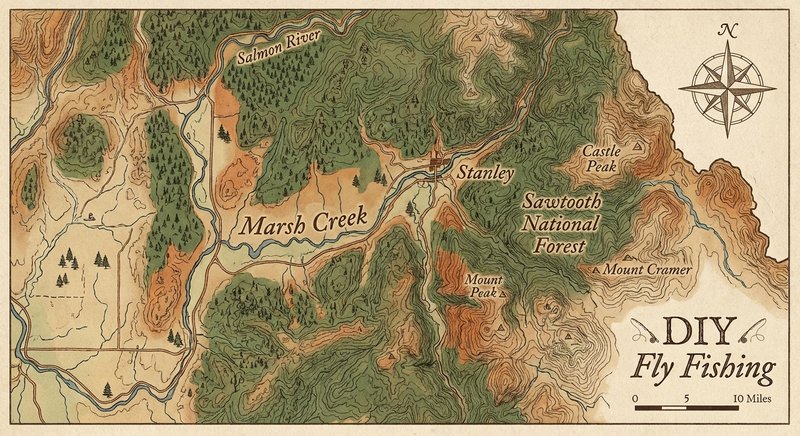
Marsh Creek
Fly fishing in Idaho · Intermediate · Best seasons: Summer, Fall
Target Species
Cutthroat Trout
About This Water
Headwaters of Middle Fork Salmon. Wild cutthroat in scenic mountain meadows.
Fishing Recommendations
Marsh Creek is one of the most iconic high-country meadow streams in Idaho. Flowing through a sprawling, lodgepole-rimmed valley near Stanley, it serves as the primary headwater for the Middle Fork of the Salmon River. For the fly angler, Marsh Creek offers a "pure" experience: native fish, crystal-clear water, and the quiet solitude of the Frank Church-River of No Return Wilderness.
🎣 Location Overview
Marsh Creek is the quintessential "meadow stream." It meanders through the Cape Horn area, characterized by deep undercut banks, slow-moving bends, and occasional riffles. What makes it special is its role in the ecosystem; it is a critical spawning ground for Chinook Salmon and Steelhead, though the resident stars for anglers are the native Westslope Cutthroat Trout.
The water is cold, clear, and nutrient-poor, meaning the fish are opportunistic and eager to rise to a dry fly. The scenery is breathtaking, with the Sawtooth Mountains looming in the distance and the creek winding through lush willows and grassy flats. It is a walk-and-wade paradise that rewards stealth and precise presentation.
🐟 Target Species & Behavior
- Westslope Cutthroat Trout: These are the primary targets. They are beautiful, with vivid orange slashes under the jaw and spotting concentrated near the tail.
- Behavior: In the slow meadow sections, Cutthroats hold in the "shadows"—under overhanging willows and deep in the undercut banks. In the swifter sections, they sit at the heads of pools or behind submerged logs.
- Feeding: They are highly insectivorous. Because the growing season is short at 6,500 feet, they aren't overly picky, but they are very "splashy" eaters. They will often track a fly for several feet before committing.
- Other Species: You may occasionally encounter Bull Trout (which must be released immediately without being removed from the water) and juvenile Chinook Salmon/Steelhead, which should be handled with extreme care.
📅 Best Times to Fish
- Summer (July – August): This is the prime window. The snowpack usually melts off by late June. Once the water clears and the meadows dry out enough to walk, the dry fly fishing is world-class.
- Fall (September – early October): The crowds disappear, and the temperatures drop. The fish sense the coming winter and feed aggressively. The Kokanee salmon may be moving in nearby waters, but the Cutthroats in Marsh Creek remain focused on terrestrial insects.
- Time of Day: During the heat of summer, the "morning doldrums" are real. Fishing is best from 10:00 AM to 4:00 PM when the sun hits the water and triggers insect activity (especially grasshoppers).
- Conditions: Overcast days are rare but can lead to spectacular Blue Winged Olive hatches. Generally, bright sun is the norm; use the light to spot fish, but stay low to avoid casting a shadow.
🪰 Recommended Flies & Techniques
Top Fly Patterns
- Terrestrials (The MVP):
- Hoopers: Dave’s Hopper, Pink Pookie, or Tan Chubby Chernobyl (#8–12).
- Ants/Beetles: Black Foam Ants or Cinnamon Ants (#14–16).
- Dry Flies:
- Parachute Adams: The gold standard for any Idaho water (#14–18).
- Purple Haze: High visibility and highly effective for Westslopes.
- Stimulators: Orange or Yellow (#10–14) to imitate small stoneflies or large caddis.
- Nymphs (if the rise stalls):
- Beadhead Pheasant Tail: (#14–18).
- Zebra Midge: Red or Black (#18–20).
Techniques
- The "Dinosaur" Approach: Move slowly. The banks are made of peat and soil; heavy footsteps send vibrations through the water that will spook every fish in the pool before you even cast.
- Dry-Dropper: This is the most effective rig. Hang a small Pheasant Tail about 18–24 inches below a buoyant foam hopper.
- Bank Sniping: Instead of casting into the middle of the creek, drop your fly within 2 inches of the grassy undercut bank. Many fish live under the grass you are standing on.
💡 Pro Tips & Local Knowledge
- The "Lola" Factor: The lower stretches of Marsh Creek (near the confluence with Bear Valley Creek to form the Middle Fork) require a bit of a hike but offer larger fish.
- Avoid the "Drag": Meadow water has complex micro-currents. Even if it looks slow, your line will likely pull the fly unnaturally. Use a "Reach Cast" to keep your line upstream of your fly.
- Carry Bear Spray: This is prime habitat for both Black Bears and the occasional Grizzly, not to mention Moose. Be "bear aware" and make noise while moving through thick willows.
- Look for "The Bubble Line": In the meandering bends, find the line where foam and bubbles collect. The fish are almost certainly sitting directly under that line.
⚠️ Important Information
- Access: The most popular access point is the Lola Creek Campground area or the Marsh Creek Trailhead (Hwy 21 near Cape Horn). The trail follows the creek for miles, providing endless access.
- Regulations:
- Marsh Creek is generally under General Fishing Season rules, but it is Barbless Hook Only and Catch and Release for trout in many stretches to protect the wilderness character and spawning runs.
- Always check the current Idaho Fish & Game Seasons and Rules before heading out.
- Wading: The bottom can be very silty and "mucky." Be careful not to get stuck in the soft mud in the slower sections.
- Gear: A 3-weight or 4-weight rod (8'6" to 9') is perfect. A 9-foot 4X or 5X leader is standard.
Guide’s Final Note: Marsh Creek isn't about trophy sizes; it's about the soul of Idaho fly fishing. Respect the native Cutthroat, leave no trace in the wilderness, and take a moment to look up from the water—you're in one of the wildest places left in the Lower 48.
Bug Hatches & Matching Flies
| Hatch | Type | Peak months | Time of day | Hook sizes | Matching flies |
|---|---|---|---|---|---|
| Salmonfly Pteronarcys californica | stonefly | June, July | All Day | #4-8 | Rogue River Stone #4-6, Pat's Rubber Leg #6-8, Cat Puke #6 |
| Western Green Drake Drunella doddsii | mayfly | July | Afternoon | #10-12 | Hair Wing Green Drake #10-12, Drake Cripple #12, 20 Incher Stone #10-12 |
| Pale Morning Dun (PMD) Ephemerella excrucians | mayfly | July, August | Morning/Afternoon | #16-18 | Sparkle Dun #16-18, Pheasant Tail #16-18, Quigley's PMD Cripple #16 |
| Golden Stonefly Hesperoperla pacifica | stonefly | July | Morning/Evening | #8-12 | Chubby Chernobyl (Gold) #8-12, Golden Stone Nymph #10-12, Norm Wood Special #10 |
| Blue Winged Olive (BWO) Baetis tricaudatus | mayfly | May, September, October | Late Morning/Afternoon | #18-22 | Parachute Adams #18-22, RS2 #20-22, JujuBaetis #18-20 |
| Spotted Sedge Hydropsyche | caddis | July, August, September | Evening | #14-16 | Elk Hair Caddis (Tan) #14-16, LaFontaine's Deep Sparkle Pupa #14-16, Godzilla Caddis #14 |
| Grasshoppers Acrididae | terrestrial | August, September | Midday/Afternoon | #8-12 | Morrish Hopper #8-12, Parachute Hopper #10-12, Dave's Hopper #10 |
| Little Yellow Stonefly (Yellow Sally) Isoperla | stonefly | July, August | Afternoon/Evening | #14-16 | Yellow Sally Foam #14-16, Iron Lotus #16, Little Yellow Sloat #14 |