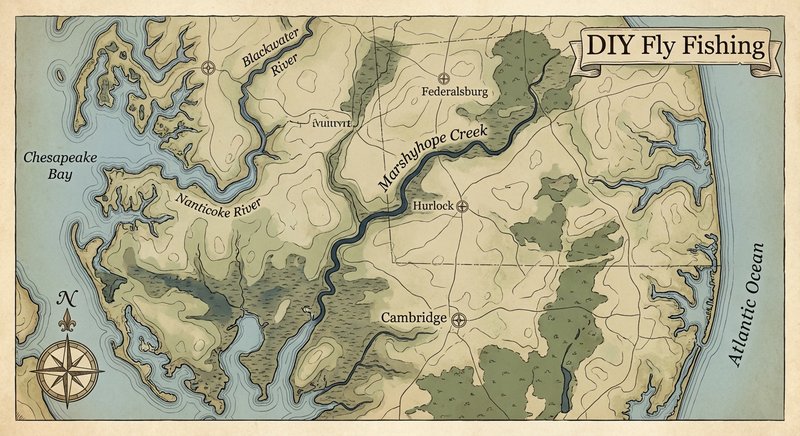
Marshyhope Creek
Fly fishing in Maryland · Beginner · Best seasons: Spring, Summer, Fall
Target Species
Largemouth Bass, Chain Pickerel, Crappie
About This Water
Eastern Shore stream with bass and pickerel. Remote tidal creek fishing.
Fishing Recommendations
Welcome to the Marshyhope Creek, one of the Eastern Shore’s most underrated tidal treasures. As a guide, I consider the Marshyhope a "sleeper" fishery. While many anglers head straight to the main stem of the Nanticoke, the Marshyhope offers a more intimate, secluded experience with exceptional numbers of resident fish.
Here is your comprehensive guide to fly fishing the Marshyhope.
🎣 Location Overview
Marshyhope Creek is a major tributary of the Nanticoke River, flowing through Delaware and into Maryland via Dorchester and Caroline counties. It is a tidal freshwater creek, meaning while the water is fresh enough for Bass and Crappie, it rises and falls with the tides.
The water is characterized by its tannic (tea-colored) clarity and a "wild" feel. The banks are lined with dense forests, fallen timber (laydowns), and vast fields of spatterdock (lily pads). What makes it special is the lack of heavy boat traffic compared to other Maryland rivers, allowing for a quiet, stealthy approach that fly anglers crave.
🐟 Target Species & Behavior
Largemouth Bass
The "resident" bass here are dark-backed and hard-fighting. They are highly structure-oriented. Because it is a tidal system, they don't wander much; they pick a piece of wood or a specific pocket in the lily pads and wait for the tide to bring food to them.
- Feed on: Killifish (mummichogs), juvenile herring, crawfish, and frogs.
Chain Pickerel
Known locally as "Federalsburg Pike," these fish thrive in the Marshyhope’s acidic, tannic water. They are aggressive ambush predators.
- Behavior: They hold in the "coves" of the spatterdock and near submerged grass. They are particularly active in the cooler months of Spring and Fall.
Crappie
The Marshyhope holds a "slab" population. They school heavily around vertical structure—think bridge pilings, dock posts, and standing timber in deeper bends.
- Behavior: They move into the shallow wood to spawn in the Spring and retreat to deeper submerged brush piles in the Summer.
📅 Best Times to Fish
Optimal Seasons
- Spring (March – May): This is the peak. The Hickory Shad run through here in early spring (a bonus for fly anglers!), followed closely by the Bass and Crappie spawn.
- Summer (June – August): Focus on the early morning and late evening. The midday heat can push fish deep or under the thickest lily pads.
- Fall (September – November): This is the "Second Season." As water temperatures drop, Pickerel become hyper-aggressive, and Bass feed heavily on baitfish moving out of the marshes.
The "Tide Window"
In the Marshyhope, the tide is more important than the time of day.
- The Best Window: The last two hours of the falling tide and the first hour of the rising tide.
- Why: A falling tide pulls baitfish and shrimp out of the protective marsh grass and into the main channel where predators are waiting.
🪰 Recommended Flies & Techniques
Top Fly Patterns
- For Bass:
- BoogleBug Poppers (Yellow or Black): Exceptional for morning topwater.
- Clouser Minnow (Chartreuse/White or Black/Silver): The gold standard for tidal baitfish imitation.
- Gamechanger (Small): To mimic the juvenile river herring.
- For Pickerel:
- Flashy Streamers: Anything with plenty of Krystal Flash. Pickerel react to glint.
- Bunny Leech (White): The pulsating movement is irresistible to them.
- For Crappie:
- Micro-Wooly Buggers (Size 8-10): In white, pink, or chartreuse.
- Bead-head Nymphs: To get down to the school in deeper wood.
Effective Techniques
- The "Pop and Pause": When using topwater poppers near the pads, give it a sharp pop, then let it sit until the rings disappear. Most strikes happen on the pause.
- The Strip-Set: Because Bass and Pickerel have bony mouths, avoid the "trout lift." Point the rod at the fish and pull the line hard to set the hook.
- Weedless Rigging: Use flies with wire weed guards. You must be able to throw your fly into the heart of the wood and pads to catch fish here.
💡 Pro Tips & Local Knowledge
- Target the "Drains": Look for small trickles of water or "guts" emptying from the marsh into the creek during a falling tide. These are "conveyor belts" of food. Park your boat/kayak upstream and cast into the flow.
- The "Shadow Line": In the summer, fish the side of the creek that provides the most shade. Bass will tuck right against the bank under overhanging trees to stay cool.
- Don't Forget the Wire: If you are targeting Pickerel, use a 6-inch bite tippet of 15lb wire or 30lb fluorocarbon. Their teeth will slice through standard 10lb tippet instantly.
- Stealth Matters: The Marshyhope is narrow. Use a push pole or a quiet electric motor. If you slam a hatch or bang a paddle, the fish in these shallow waters will spook.
⚠️ Important Information
Access Information
- Federalsburg Boat Ramp: Located in the heart of town. This is the best jumping-off point for motorized boats and kayaks.
- Idylwild Wildlife Management Area: Offers some bank access and smaller launch spots for canoes/kayaks. It’s more rugged but very productive.
Regulations & Permits
- License: You will need a Maryland Tidal Sport Fishing License. Even though the water feels fresh, it is legally tidal.
- Reciprocity: Maryland and Delaware have some reciprocal agreements, but ensure you are within the MD border if using an MD license.
- Catch and Release: While Crappie are often kept for the pan, I highly recommend catch and release for the resident Largemouth to maintain the quality of this smaller fishery.
Special Considerations
- Safety: Be wary of submerged logs just below the surface ("deadheads"). They can damage a boat motor or flip a kayak if the tide is moving fast.
- Insects: During Summer, the mosquitoes and "deer flies" can be brutal in the marsh. Bring high-quality repellent.
Guide’s Final Word: The Marshyhope is a "rhythm" creek. Once you find the rhythm of the tide and the wood, you’ll have 20-fish days that you'll remember for a lifetime. Tight lines!
Bug Hatches & Matching Flies
| Hatch | Type | Peak months | Time of day | Hook sizes | Matching flies |
|---|---|---|---|---|---|
| Blue-Winged Olive Baetis spp. | mayfly | March, April, October, November | Mid-day | #18-22 | RS2 #20-22, Parachute Adams #18-22, Pheasant Tail Nymph #18-20 |
| Chironomids Chironomidae | midge | March, April, May, September | All day | #18-26 | Zebra Midge #18-22, Griffith's Gnat #20-24, Mercury Midge #20-22 |
| Spotted Sedge Hydropsyche | caddis | May, June, July | Evening | #14-18 | Elk Hair Caddis #14-16, LaFontaine's Deep Sparkle Pupa #14-18, Holy Grail Caddis #16 |
| Blue Damselfly Enallagma spp. | terrestrial | June, July, August | Afternoon | #10-14 | Adult Damsel #10-12, Marabou Damsel Nymph #12-14 |
| Common Green Darner Anax junius | terrestrial | July, August, September | All day | #4-10 | Dragonfly Nymph #6-10, Deer Hair Dragonfly #4-8 |
| Trico Tricorythodes spp. | mayfly | July, August, September | Morning | #22-26 | Trico Spinner #22-24, Trico Drown Spinner #22-26 |
| Black Carpenter Ant Camponotus pennsylvanicus | terrestrial | June, July, August | Afternoon | #12-18 | Black Foam Ant #14-18, Cinnamon Ant #16-18 |
| Japanese Beetle Popillia japonica | terrestrial | July, August | Afternoon | #10-14 | Foam Beetle #12-14, Coffee's Sparkle Beetle #12 |
| White Mayfly Ephoron leukon | mayfly | August | Evening/Night | #12-14 | White Wulff #12-14, Ephoron Spinner #12-14 |