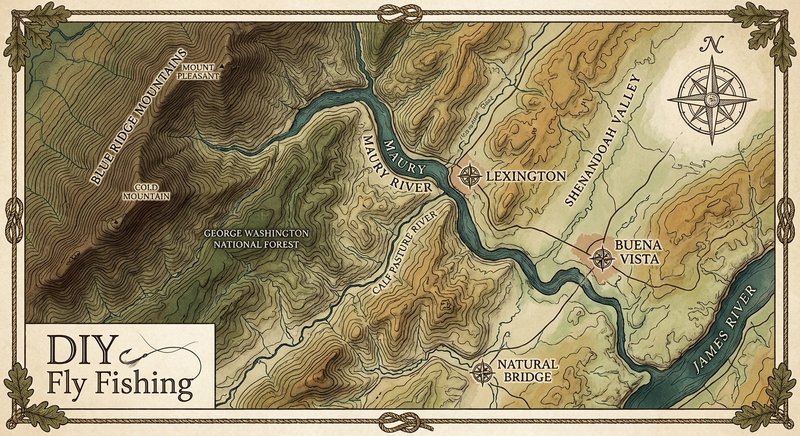
Maury River
Fly fishing in Virginia · Intermediate · Best seasons: Spring, Summer, Fall
Target Species
Smallmouth Bass, Rainbow Trout, Brown Trout
About This Water
Central Virginia river with smallmouth bass and stocked trout. Goshen Pass section.
Fishing Recommendations
The Maury River, flowing through the heart of Rockbridge County, Virginia, is one of the most underrated fly fishing gems in the Mid-Atlantic. Named after Matthew Fontaine Maury, it is a river of two faces: a rugged, high-gradient mountain stream in its upper reaches and a classic, ledge-filled smallmouth factory in its lower sections.
As your guide, here is the comprehensive breakdown of how to fish this magnificent waterway.
🎣 Location Overview
The Maury is a "freestone" river, meaning its flow is entirely dependent on rainfall and mountain runoff. It is famous for Goshen Pass, a breathtaking three-mile gorge where the river carves through the Allegheny Mountains.
What makes the Maury special is its diversity. You can fish for wild-behaving stocked trout in the morning amidst massive boulders and Class II-III rapids, then float or wade lower sections in the afternoon for some of the hardest-fighting Smallmouth Bass in the state. The water is generally clear, with a bottom composed of limestone ledges, cobblestone, and large "bus-sized" boulders.
🐟 Target Species & Behavior
Smallmouth Bass
The "Bronze Backs" are the kings of the Maury.
- Behavior: They are highly opportunistic. In the spring, they move from deep wintering holes to shallower gravel bars for spawning. In summer, they occupy fast "oxygenated" water at the heads of riffles or deep under limestone ledges.
- Feeding: Their diet consists heavily of Crayfish and Hellgrammites (dobsonfly larvae), as well as Madtoms and Shiners.
Rainbow and Brown Trout
The Maury is a "Put-and-Take" and "Delayed Harvest" fishery depending on the section.
- Behavior: Trout are primarily found in the upper reaches (Goshen Pass and above). They hold in "pocket water"—small soft spots behind large rocks—and in the deep, cold pools of the gorge.
- Feeding: They focus on aquatic insects (Caddis, Mayflies) in the spring and shift to terrestrial patterns (Ants, Beetles) and streamers as the water warms.
📅 Best Times to Fish
- Spring (March – May): Prime Trout Season. This is when the water is cool and oxygenated. The trout are most active, and the Smallmouth start their pre-spawn feed.
- Conditions: Watch for heavy spring rains; the Maury can "blow out" (become muddy and dangerous) quickly.
- Summer (June – August): Prime Smallmouth Season. This is the time for wet-wading. The Smallmouth are aggressive and will look to the surface.
- Best Time of Day: Early morning (6:00 AM – 10:00 AM) and "the magic hour" before sunset for topwater action.
- Fall (September – November): The Trophy Window. As the water cools, the larger Smallmouth feed heavily to prepare for winter. The river is often low and crystal clear, requiring stealth.
🪰 Recommended Flies & Techniques
Smallmouth Bass
- Topwater: BoogleBugs (size 4-6) in yellow or green, and Rainy’s CF Poppers.
- Subsurface: The Murray’s Hellgrammite (a local legend fly) is mandatory. Also, Clouser Minnows (Chartreuse/White) and Sneaky Petes.
- Technique: "Chug" poppers near the banks and overhanging trees. For streamers, cast 45 degrees downstream and use a "strip-strip-pause" retrieve to mimic a wounded minnow.
Trout
- Dry Flies: Elk Hair Caddis (14-16), Adams (14-18), and Chernobyl Ants in late summer.
- Nymphs: Bead-head Pheasant Tails (14-16) and Prince Nymphs.
- Technique: High-stick nymphing is essential in Goshen Pass. Because the water is turbulent, you need to keep your fly line off the various conflicting currents to avoid drag.
💡 Pro Tips & Local Knowledge
- The "Hellgrammite" Secret: The Maury has a massive population of Hellgrammites. If the fishing is slow, put on a heavy black or olive wooly bugger or a dedicated Hellgrammite pattern and "dead-drift" it right along the bottom of deep runs.
- Stealth in Goshen Pass: The water in the Pass is exceptionally clear. Wear natural colors (greens/browns) to blend into the rocks. If you can see the fish, they have likely already seen you.
- Read the Ledges: The lower Maury is full of limestone ledges that run perpendicular to the flow. Bass sit in the "cracks" of these ledges. You must get your fly deep into those crevices to find the bigger fish.
- The Murray Influence: Harry Murray, a Virginia fly fishing icon, developed many of his techniques here. His "Strymph" and "Hellgrammite" patterns are the gold standard for this river.
⚠️ Important Information
Access Points
- Goshen Pass (Rte 39): Numerous pull-offs along the road. It involves some steep hiking down to the water.
- Bean’s Bottom: Located near the town of Lexington; great for wading.
- Jordan’s Point (Lexington): A popular spot for launching canoes or kayaks for the lower sections.
- Locher Gardens: Excellent access for the lower river near the confluence with the James.
Regulations & Safety
- Permit: You need a valid Virginia Freshwater Fishing License. If fishing for trout in designated waters, you also need a Trout License.
- Wading Safety: The Maury is notoriously slippery. Felt-soled boots or studs are highly recommended. The "Maury Shuffle" is a real thing—move slowly and carefully.
- Flow Rates: Check the USGS gauge at Rockbridge Baths.
- Ideal for wading: 2.0ft to 3.5ft.
- Dangerous: Anything over 5ft is generally unsafe for wading.
The Maury River is a place of solitude and immense natural beauty. Treat the river with respect, practice catch and release, and you’ll find it to be one of the most rewarding fly fishing experiences in the South.
Bug Hatches & Matching Flies
| Hatch | Type | Peak months | Time of day | Hook sizes | Matching flies |
|---|---|---|---|---|---|
| Blue Winged Olive Baetis | mayfly | March, April, September, October | Afternoon | #18-22 | BWO Sparkle Dun #18-20, RS2 #20-22, Pheasant Tail #18-22 |
| Quill Gordon Epeorus pleuralis | mayfly | March, April | Mid-day | #12-14 | Quill Gordon #12-14, Hare's Ear #12-14 |
| Hendrickson Ephemerella subvaria | mayfly | April, May | Afternoon | #12-14 | Hendrickson Pink Lady #12-14, Red Quill #14, Hendrickson Emerger #14 |
| Tan Caddis Hydropsyche | caddis | April, May, June | Evening | #14-16 | Elk Hair Caddis #14-16, Pupa-X #16, Hydropsyche Larva #14-16 |
| March Brown Maccaffertium vicarium | mayfly | May, June | Afternoon/Evening | #10-12 | March Brown American #10-12, Gold Ribbed Hare's Ear #10-12 |
| Sulfur Ephemerella dorothea | mayfly | May, June | Evening | #16-18 | Pale Morning Dun #16-18, Sulfur Parachute #16-18, Sulfur Emerger #16-18 |
| Golden Stonefly Acroneuria | stonefly | June, July | Morning/Evening | #6-10 | Golden Stone #8-10, Pat's Rubber Leg #6-10 |
| Terrestrials Formicidae / Coleoptera | terrestrial | July, August, September | All Day | #12-16 | Chernobyl Ant #10-14, Black Foam Beetle #14-16, Cinnamon Ant #16 |