Mettawee River
Fly fishing in New York · Beginner · Best seasons: Spring, Summer, Fall
Target Species
Brown Trout, Brook Trout
About This Water
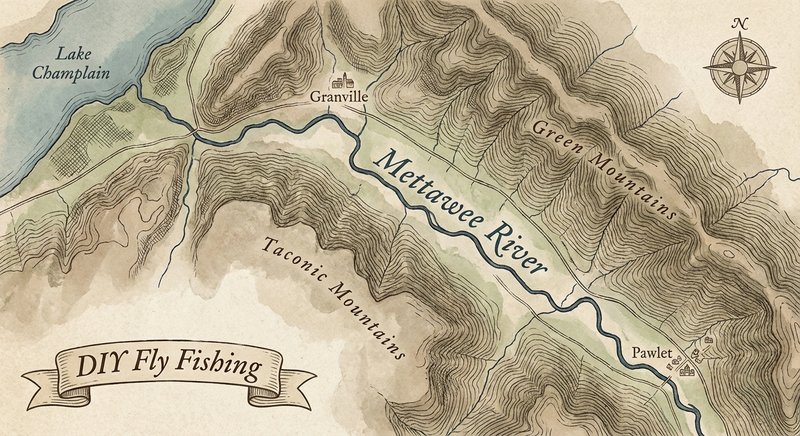
Eastern NY stream flowing to Lake Champlain. Wild brown trout in rural setting.
Fishing Recommendations
The Mettawee River (often spelled Mettowee) is one of the most charming and productive "under-the-radar" trout streams in the Northeast. Flowing from the Green Mountains of Vermont into Washington County, New York, it offers a classic pastoral fly fishing experience. Unlike its more famous neighbor, the Battenkill, the Mettawee is generally more user-friendly, with higher fish counts and more consistent hatch activity.
🎣 Location Overview
The Mettawee is a classic freestone river characterized by a mix of high-gradient pocket water, long glassy runs, and deep, mysterious pools. What makes it unique is its geology: the riverbed is often composed of slate and shale, which provides a distinct "stair-step" structure to the pools.
Anglers love the Mettawee for its scenic beauty—winding through rolling farmland and slate quarries—and its diversity of water. You can fish a heavy nymph through a turbulent chute and, fifty yards later, stalk rising fish in a calm tailout. It feels intimate, rarely exceeding 40–50 feet in width, making it an ideal river for the 4-weight or 5-weight rod enthusiast.
🐟 Target Species & Behavior
The Mettawee is primarily a Brown Trout fishery, with Brook Trout found predominantly in the upper reaches near the Vermont border and in the colder tributaries.
- Brown Trout: You will find both wild and stocked browns here. The wild fish are incredibly wary and favor the "skinny" water at the heads of pools or tucked tightly under the overhanging willows. During the day, larger browns hold in the deep "slate slots"—crevices in the bedrock.
- Brook Trout: These are the jewels of the upper river. They are opportunistic but require cold, highly oxygenated water. In the heat of summer, they will migrate toward the mouths of feeder streams.
- Feeding Behavior: These fish are highly insect-oriented. While they will certainly smash a streamer in high water, this is a "match the hatch" river where subtle changes in fly size can make or break your day.
📅 Best Times to Fish
Spring (Mid-April – June)
- The Window: This is the prime time. Once the spring runoff subsides (usually by early May), the river comes alive.
- Conditions: Look for the Hendrickson hatch in early May, followed by the March Browns.
- Time of Day: Late morning through late afternoon.
Summer (July – August)
- The Window: Early mornings and "Magic Hour" (dusk).
- Conditions: The Mettawee can get low and warm. Check water temperatures! If the water exceeds 68°F, stop fishing to protect the trout.
- Highlights: Incredible Trico hatches in the morning and terrestrial (crickets/hoppers) action in the afternoon.
Fall (September – October)
- The Window: The entire month of September through the close of the season.
- Conditions: As water temps drop, the browns become aggressive and territorial ahead of the spawn.
- Highlights: Isonychia hatches and streamer fishing. The fall colors in Washington County are world-class.
🪰 Recommended Flies & Techniques
Dry Flies
- Hendrickson (Dark & Light): Sizes 12-14 (May)
- Sulfurs: Sizes 16-18 (June)
- Elk Hair Caddis: Sizes 14-16 (All season - Tan or Olive)
- Tricos: Sizes 22-24 (Summer mornings)
- Ausable Wulff: Great for the faster pocket water sections.
- Terrestrials: Black ants, beetles, and Dave’s Hoppers (Sizes 10-14).
Nymphs
- Pheasant Tail: Sizes 14-18 (The gold standard here).
- Hare’s Ear: Sizes 12-16.
- Perdigons: Size 16 in silver or copper (Essential for getting deep in the slate slots).
- Pat’s Rubber Legs: Size 8-10 (During higher spring flows).
Streamers
- Wooly Buggers: Black or Olive (Size 6-10).
- Muddler Minnow: Excellent during the evening when sculpins are active.
Presentation Tips
- The "Greased Line": In the long runs, a down-and-across swing with a wet fly or soft hackle is deadly on the Mettawee.
- Stealth: Because the water is often clear and the river is small, a low profile and long leaders (9-12 feet) are mandatory for the flat water sections.
💡 Pro Tips & Local Knowledge
- The Slate Factor: The slate bottom is incredibly slippery. Studded wading boots or felt are highly recommended. Aluminum bars or cleats are even better.
- Focus on Granville: The stretches around Granville, NY, offer excellent Public Fishing Rights (PFR). Look for the yellow "Public Fishing" signs.
- The "Hidden" Pockets: Don't just fish the big pools. Some of the biggest browns live in "bucket-sized" depressions in the middle of shallow riffles.
- The Thermal Refuge: In mid-summer, look for where small, cold mountain creeks enter the main stem. The fish will stack up here, but be ethical—if they are stressed by heat, give them a break.
- Night Fishing: For the truly brave, fishing a large black Gurgler or mouse pattern in the deep pools after dark can produce the river's largest "trophy" browns.
⚠️ Important Information
- Access: New York DEC provides excellent Public Fishing Rights (PFR) maps for the Mettawee. Respect private property where signs are not present.
- Regulations: As of recent updates, much of the Mettawee falls under the statewide trout regulation (April 1 – Oct 15 harvest allowed, Oct 16 – March 31 Catch & Release only, artificial lures only). Always check the current NYSDEC Region 5 regulations before heading out.
- License: You must have a valid New York State Fishing License. If you cross the border into Vermont, you will need a separate Vermont license.
- Didymo: This invasive algae (rock snot) has been found in nearby waters. Clean, Drain, and Dry your gear to prevent its spread into the Mettawee.
The Mettawee is a river that rewards the patient angler who appreciates technical dry fly fishing and the quiet beauty of the New York countryside. Tight lines!
Bug Hatches & Matching Flies
| Hatch | Type | Peak months | Time of day | Hook sizes | Matching flies |
|---|---|---|---|---|---|
| Blue-Winged Olive Baetis / Pseudocloeon | mayfly | April, May, September, October | Mid-day | #18-22 | RS2 #18-22, Parachute BWO #18-20, Pheasant Tail Nymph #18-22 |
| Hendrickson Ephemerella subvaria | mayfly | April, May | Afternoon | #12-14 | Hendrickson Sparkle Dun #12-14, Red Quill #12-14, Hare's Ear Nymph #12-14 |
| Grannom Caddis Brachycentrus | caddis | April, May | Morning/Afternoon | #14-16 | Elk Hair Caddis (Olive) #14-16, LaFontaine's Deep Sparkle Pupa #14-16, Peacock Caddis #14-16 |
| Sulfur Ephemerella invaria / dorothea | mayfly | May, June | Evening | #14-18 | Sulfur Parachute #14-18, Sulfur Emerger #16-18, Pheasant Tail #14-18 |
| Light Cahill Stenonema / Stenacron | mayfly | June, July | Evening | #12-14 | Light Cahill #12-14, Gold Ribbed Hare's Ear #12-14 |
| Isonychia Isonychia bicolor | mayfly | June, September | Late Afternoon/Evening | #10-12 | Iso Parachute #10-12, Prince Nymph #10-12, Zug Bug #10-12 |
| Tan Caddis Hydropsyche | caddis | June, July, August | Evening/Night | #14-16 | Elk Hair Caddis (Tan) #14-16, Pupa Sedge #14-16, Soft Hackle Hare's Ear #14-16 |
| Terrestrials Formicidae / Coleoptera | terrestrial | July, August, September | All Day | #12-18 | Black Foam Ant #14-18, Chernobyl Ant #10-12, Crowe Beetle #14-16 |