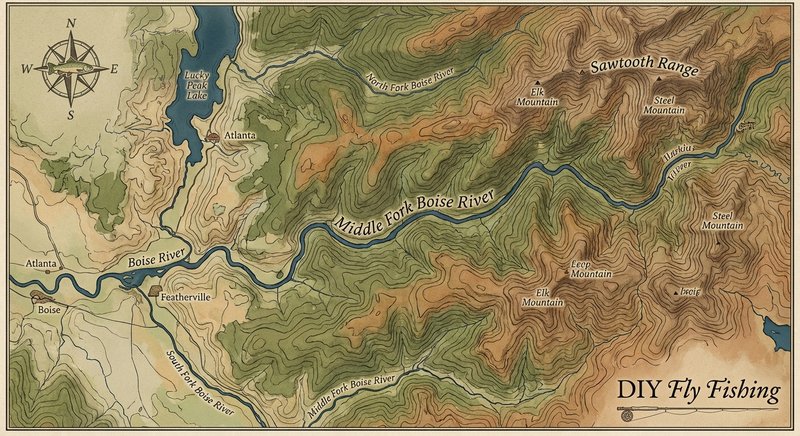
Middle Fork Boise River
Fly fishing in Idaho · Advanced · Best seasons: Summer, Fall
Target Species
Bull Trout, Rainbow Trout
About This Water
Remote wilderness stream with native bull trout and rainbow. Backcountry fishing adventure.
Fishing Recommendations
The Middle Fork of the Boise River is one of Idaho’s premier "blue-ribbon" freestone experiences, offering a rugged, backcountry feel despite being relatively accessible from the state's capital. As your guide, I’ll tell you that this river isn't just about catching fish; it’s about the raw beauty of the Sawtooth National Forest and the challenge of navigating its granite-strewn pocket water.
🎣 Location Overview
The Middle Fork of the Boise River is a classic high-desert-to-mountain freestone stream. It flows through a dramatic landscape of steep canyon walls, towering ponderosa pines, and massive granite boulders.
What makes it special is its wild character. Unlike the nearby South Fork, which is a tailwater governed by dam releases, the Middle Fork is a true freestone. Its flows are dictated by snowmelt, meaning the river changes character throughout the season. Anglers love it for the Redband Trout—a hardy, native subspecies of Rainbow Trout known for their brilliant colors and incredible fighting strength—and the chance to encounter the elusive, predatory Bull Trout.
🐟 Target Species & Behavior
Wild Rainbow (Redband) Trout
- Behavior: These are aggressive, opportunistic feeders. Because the growing season is short, they aren't usually "picky" eaters, but they are wary of poor presentations.
- Holding Water: Look for them in "pocket water"—small soft spots behind boulders, in the "seams" where fast and slow water meet, and at the heads of deep pools.
- Diet: A mix of stoneflies, caddis, and terrestrial insects (grasshoppers/ants) in the summer.
Bull Trout
- Behavior: The "wolves" of the river. Bull Trout are apex predators. They don't care about your #18 dry fly; they want a high-calorie meal. They are often found in the deepest, darkest holes or lurking at the tail-outs of pools waiting for a smaller trout to pass by.
- Diet: Almost exclusively piscivorous (fish-eaters). They shadow schools of Whitefish or smaller Rainbows.
📅 Best Times to Fish
Summer (July – August)
- Conditions: This is the prime window. The spring runoff usually recedes by early July, clearing the water and making the river wadeable.
- Time of Day: Early morning for nymphs; late afternoon and evening for spectacular dry fly action as the sun drops behind the canyon walls.
Fall (September – October)
- Conditions: My personal favorite. The water is low and crystal clear. The cottonwoods turn gold, and the fish are aggressively feeding before winter.
- Time of Day: Mid-day becomes more productive as the water warms.
- Prime Window: Late September brings out the big Bull Trout as they prepare for their spawning run, and the terrestrial fishing (hoppers) remains excellent until the first hard frost.
🪰 Recommended Flies & Techniques
Dry Fly Fishing (The Main Event)
The Middle Fork is a dry-fly paradise. Because the water is fast, use high-visibility flies.
- Patterns: Chubby Chernobyl (Size 8-12) in gold, purple, or tan; Stimulators; Pink Alberts; Elk Hair Caddis.
- Technique: "Hopper-Dropper" is the gold standard here. Hang a weighted nymph 18-24 inches below a large foam dry fly.
Nymphing
When the fish aren't rising, go deep.
- Patterns: Pat’s Rubber Legs (the "workhorse" of Idaho); Prince Nymphs; Pheasant Tails (Size 14-16).
- Technique: Short-line nymphing in the pockets. You don't need a 50-foot cast; you need a 10-foot drift with no drag.
Streamers (For Bull Trout)
- Patterns: Sex Dungeon, Sparkle Minnow, or large articulated streamers in olive, white, or black.
- Technique: Use a sink-tip line and "swing" the streamer through deep pools or strip it aggressively near submerged logs. Be prepared for a violent strike.
💡 Pro Tips & Local Knowledge
- Cover Ground: Don't spend an hour in one hole. The Middle Fork rewards the "mobile" angler. Hit the high-probability pockets and move on.
- The "Stealth" Factor: The water is exceptionally clear. Wear earthy tones (no bright white hats) and avoid splashing when wading. If you see a fish, it has likely already seen you.
- The Bull Trout "Twitch": If you're fighting a small Rainbow and it suddenly feels like you hooked a log that started moving, a Bull Trout has likely grabbed your fish. If this happens, keep the pressure steady; sometimes you can bring both to the net (but remember, the Bull Trout must be released immediately).
- Focus on the Confluences: Where small tributaries enter the Middle Fork, the water is oxygenated and brings extra food. These are "honey holes."
⚠️ Important Information
Access
- Access is via Middle Fork Road (Forest Road 268). It is a long, bumpy dirt road that follows the river for miles.
- A high-clearance vehicle is highly recommended, especially as you go further upstream toward the town of Atlanta.
- Cell service is non-existent. Tell someone where you are going.
Regulations & Permits
- Bull Trout: These are a federally protected species. You cannot specifically harvest them. If you catch one, keep it in the water, take a quick photo, and release it immediately.
- Barbless Hooks: While not always mandatory depending on the specific stretch, it is highly encouraged to protect the wild Redband population.
- License: A valid Idaho Fishing License is required.
- Check the IDFG Seasons: Specific sections (like the stretch near the mouth) may have different seasonal closures to protect spawning fish.
Safety
- Wildlife: This is Black Bear and Mountain Lion country. Carry bear spray and keep a clean camp.
- Wading: The granite rocks are incredibly slick. Felt-soled boots or studs are a life-saver here.
Bug Hatches & Matching Flies
| Hatch | Type | Peak months | Time of day | Hook sizes | Matching flies |
|---|---|---|---|---|---|
| Blue Winged Olive Baetis | mayfly | March, April, September, October | Afternoon | #16-22 | RS2 #18-22, Parachute Adams #16-20, BWO Limp Critic #18-20 |
| Salmonfly Pteronarcys californica | stonefly | May, June | All Day | #4-8 | Pats Rubber Legs #4-8, Chubby Chernobyl (Orange) #6-10, Cat Puke #6-8 |
| Golden Stonefly Hesperoperla pacifica | stonefly | June, July | Morning/Afternoon | #8-12 | Golden Chubby #8-12, Halfback Nymph #8-10, Norm Wood Special #10-12 |
| Pale Morning Dun Ephemerella excrucians | mayfly | June, July, August | Late Morning/Afternoon | #14-18 | PMD Sparkle Dun #16-18, Pheasant Tail #14-18, Split Case PMD #16-18 |
| Spotted Sedge Hydropsyche | caddis | June, July, August | Evening | #14-18 | Elk Hair Caddis #14-18, Z-Wing Caddis #14-16, LaFontaine Sparkle Pupa #14-18 |
| Yellow Sally Isoperla | stonefly | July, August | Afternoon/Evening | #14-16 | Yellow Stimulator #14-16, Little Yellow Sloan #14-16, Sally Nut #14-16 |
| Grasshopper Acrididae | terrestrial | August, September | Afternoon | #8-12 | Morrish Hopper #8-12, Rainy's Hopper #10-12, Dave's Hopper #10-14 |
| Midge Chironomidae | midge | January, February, March, December | Late Morning/Afternoon | #18-24 | Zebra Midge #18-22, Griffith's Gnat #18-22, Mercury Midge #20-24 |