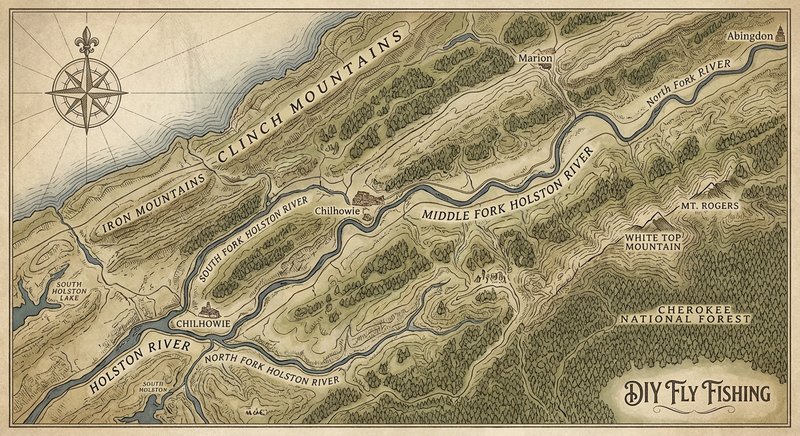
Middle Fork Holston River
Fly fishing in Virginia · Beginner · Best seasons: Spring, Summer, Fall
Target Species
Smallmouth Bass, Rock Bass
About This Water
Southwest Virginia stream with smallmouth bass. Good wade fishing.
Fishing Recommendations
The Middle Fork of the Holston River is a hidden gem in Southwest Virginia. While its sister, the South Fork, gets the glory for its tailwater trout, and the North Fork is famous for its wild Smallmouth scenery, the Middle Fork offers a unique "limestone" influence that makes it one of the most productive warm-water fisheries in the region.
Here is your comprehensive guide to fly fishing the Middle Fork Holston.
🎣 Location Overview
The Middle Fork flows through the Great Valley of Virginia, cutting through Smyth and Washington Counties. What makes this river special is its limestone geology. Because the water passes through limestone rock, it is more alkaline and nutrient-rich than typical mountain freestone streams.
The river is characterized by long, deep pools, dramatic limestone ledge formations, and moderate riffles. It feels more intimate than the James or the New River, making it perfect for the wading angler or those in small kayaks/canoes. Anglers love it because the fish grow fast here, and the "Redeye" (Rock Bass) population is arguably some of the best in the state.
🐟 Target Species & Behavior
Smallmouth Bass (The "Bronzeback")
Smallmouths are the primary draw. In the Middle Fork, they are opportunistic but can be wary in the clear limestone water.
- Behavior: They hold in the "seams" between fast and slow water. Unlike trout, they love structure—look for submerged logs, the shady side of boulders, and the undercut limestone ledges.
- Feeding: Their diet is heavy on crawfish and hellgrammites. They also forage on stonerollers, shiners, and occasional hatches of large aquatic insects.
Rock Bass (The "Redeye")
Often overlooked but incredibly fun on a 4-weight or 5-weight rod.
- Behavior: These are "structure junkies." If there is a fallen tree or a dark crevice in a rock, there is a Rock Bass inside it.
- Feeding: They are highly aggressive and will often strike flies nearly as large as they are. They feed primarily on small crustaceans and minnows.
📅 Best Times to Fish
- Spring (Late April – June): This is the "big fish" window. As water temps hit 55°F, fish become active. Post-spawn (usually June) is prime time for aggressive streamer strikes.
- Summer (July – August): The best time for topwater action. Low water levels make the fish easy to locate in the deeper oxygenated riffles and the heads of pools.
- Fall (September – October): As temperatures drop, Smallmouths go on a feeding binge to prepare for winter. This is the best time to use large, meaty streamer patterns.
Prime Conditions: Overcast days are best for Smallmouth. In the heat of summer, focus on the "Golden Hours"—the first two hours of light and the last two hours before dark.
🪰 Recommended Flies & Techniques
Topwater (The Most Exciting)
- Patterns: BoogleBugs (size 4-6), Stealth Bombers, and Murdich Minnows.
- Technique: Cast tight to the bank or overhanging brush. Use a "Pop-and-Pause" retrieve. Most strikes happen when the fly is sitting perfectly still.
Subsurface / Streamers
- Patterns: Game Changers (small sizes), Olive or Black Woolly Buggers (bead-head), and Clouser Minnows (chartreuse/white).
- Technique: "Swing" the fly through the riffles or strip it erratically through deep pools.
Nymphing / Bottom Bouncing (The "Meat and Potatoes")
- Patterns: Pat’s Rubber Legs (size 4-8) in coffee or black to mimic hellgrammites. Near Nuff Crawfish or Half-back nymphs.
- Technique: Use a heavy leader and fish these under an indicator or high-stick them through deep runs. If you aren't bumping the bottom, you aren't fishing.
💡 Pro Tips & Local Knowledge
- The "Ledge" Secret: The Middle Fork is full of limestone shelves. Smallmouths love to tuck under these shelves where the current has carved out a pocket. You must cast your fly upstream of the ledge and let it sink so it drifts right past the "lip" of the rock.
- Stealth Matters: Because the water is often clear, long casts are an advantage. If you can see the fish, they can likely see you. Wear earthy tones (camos/greens) to blend into the bank.
- Wading Safety: The limestone ledges can be extremely slippery and drop off suddenly. I highly recommend studded wading boots and a wading staff for this specific river.
- Go Small for Rock Bass: If the Smallmouth are being finicky, tie on a size 8 rubber-legged nymph. You can catch Rock Bass all day in the wood debris, keeping the action high.
⚠️ Important Information
- Access Points:
- Seven Mile Ford: Good wading access near the bridge.
- Chilhowie/Old Stage Road: Several spots where the road parallels the river, but be mindful of private property.
- South Holston Lake Headwaters: The lower section of the Middle Fork as it nears the lake holds the largest fish, but requires a kayak or small boat.
- Regulations: A valid Virginia Freshwater Fishing License is required. Check the DWR Website for any seasonal creel limits.
- Private Property: Much of the Middle Fork flows through private farmland. Always stay in the riverbed and only access via public bridges or VDGIF (DWR) designated ramps. Respect fences and "Posted" signs.
- Conservation: The Middle Fork is a fragile ecosystem. Practice Catch and Release for Smallmouth Bass to ensure the trophy quality of the river remains for years to come.
Bug Hatches & Matching Flies
| Hatch | Type | Peak months | Time of day | Hook sizes | Matching flies |
|---|---|---|---|---|---|
| Blue-Winged Olives Baetis | mayfly | March, April, October, November | Midday | #18-22 | RS2 #18-22, Parachute BWO #18-20, Pheasant Tail #18-20 |
| Sulphurs Ephemerella invaria/dorothea | mayfly | May, June | Evening | #14-18 | Sulphur Parachute #14-18, Split Case Sulphur #16-18, Sulphur CDC Emerger #16 |
| Grannom Caddis Brachycentrus | caddis | April | Afternoon | #14-16 | Elk Hair Caddis (Dark) #14-16, Peacock Caddis #14-16, Deep Sparkle Pupa #14-16 |
| Quill Gordon Epeorus pleuralis | mayfly | March, April | Midday | #12-14 | Quill Gordon #12-14, Hare's Ear #12-14 |
| March Brown Maccaffertium vicarium | mayfly | May | Afternoon | #10-14 | March Brown Western #12-14, Gold Ribbed Hare's Ear #10-12 |
| Cinnamon and Tan Caddis Hydropsyche | caddis | May, June, July, August | Evening | #14-18 | Tan Elk Hair Caddis #14-18, Hydropsyche Larva #14-16, Soft Hackle Tan #16 |
| Terrestrials (Ants and Beetles) Formicidae/Coleoptera | terrestrial | July, August, September | All Day | #12-18 | Black Foam Beetle #14-16, Cinnamon Ant #16-18, Chernobyl Ant #10-12 |
| Little Black Stonefly Taeniopteryx | stonefly | February, March | Midday | #14-18 | Early Brown Stone #16, Zebra Midge #18-20, Prince Nymph #14-16 |